Seas and oceans
The residents of the Shark Tunnel, the rays and the colourful fish of the coral reefs.
Visitor favourites
Click any of them and its description opens in the list below.
Residents of the seas and oceans
69 species. Click a name for details.
Raccoon butterflyfishChaetodon lunulaLeast Concern
The eyes of the raccoon butterflyfish are covered by a dark marking that can confuse predators. It often swims in pairs and stays with the same partner for a long time. With its slender mouth it easily picks food out from among the corals. At night it usually retreats into crevices in the reef.
Golden trevallyGnathanodon speciosusLeast Concern
When young it has a bright yellow base colour with contrasting black stripes, which fade by adulthood. It often moves in shoals. It prefers shallow coastal waters. It also feeds actively near sandy bottoms, searching the seabed for prey. It sometimes appears around larger reefs too.
When young they live as pilot fish: they accompany larger predators, such as sharks.
Spotted scatScatophagus argusLeast Concern
The scat (in Hungarian “Argus fish”) got its name from the dark spots on its body, which reminded its namer of the eyes of Argus, the mythological giant with a thousand eyes. It is a highly adaptable fish that thrives even in water of varying salinity. Its young often live in larger shoals. The spines of its dorsal fin can be mildly venomous, so even predators approach these fish more cautiously.
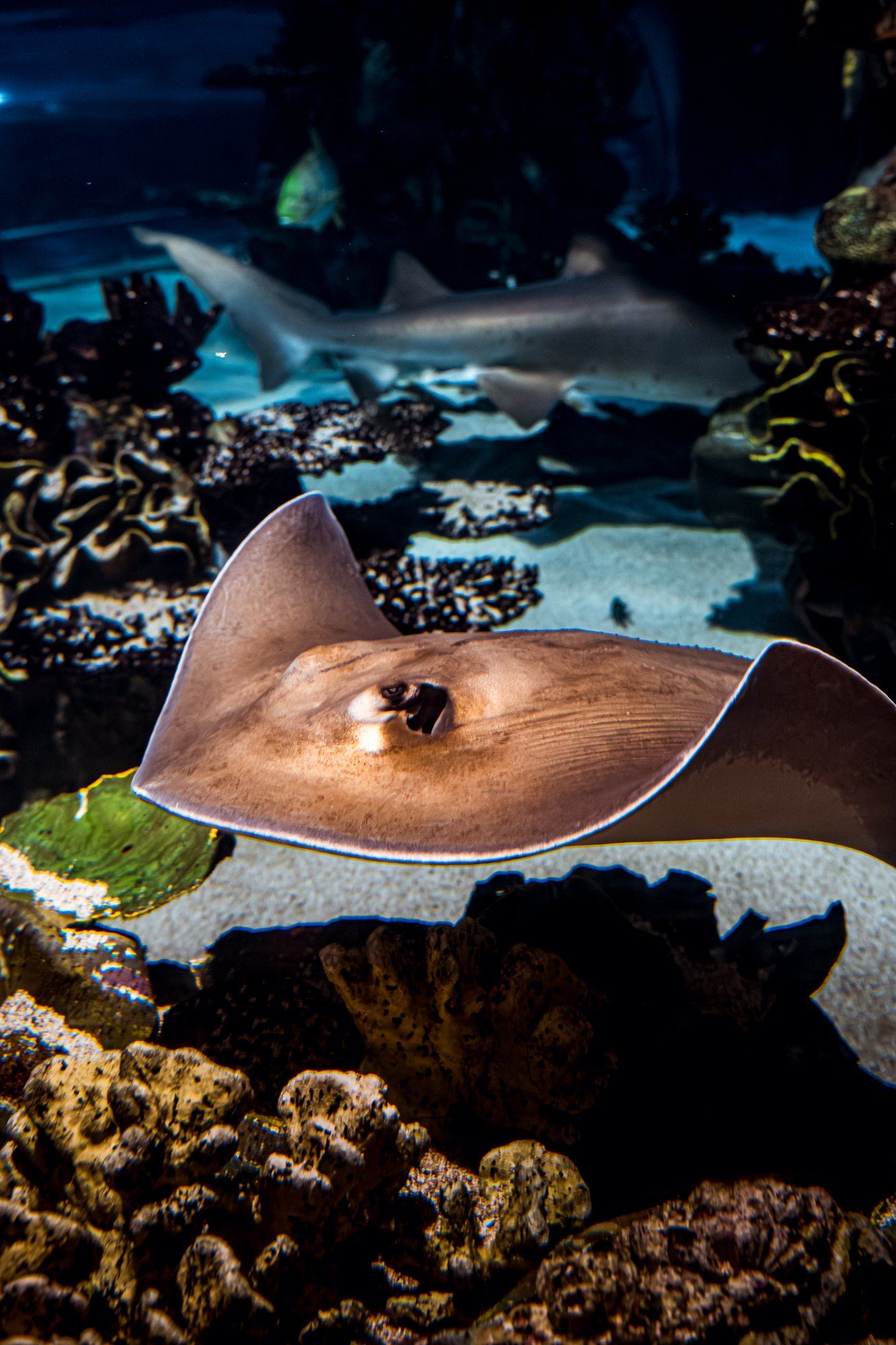
Southern stingrayHypanus americanusNear Threatened
A peculiar relative of sharks
With its flattened body, the southern stingray is perfectly adapted to a bottom-dwelling life. It often buries itself fully or partly in the sand, so that only its eyes and spiracles show. This behaviour is seen mainly when the animal is startled. It helps it avoid most predators, and it can also strike at prey from ambush.
On its long tail there are one or more sharp, venomous spines, which it uses for defence. This spine can cause serious injury if the animal is disturbed or accidentally stepped on. The animal uses this spine only in self-defence.
Its food consists mainly of creatures hiding in the sand. It crushes hard-shelled prey with its grinding-like teeth. Little data is available on its population, but coastal habitat degradation and fishing have a negative effect on its numbers. It does not stay only on the bottom; like other rays, it can also swim in the upper layers of the water.
Banggai cardinalfishPterapogon kauderniEndangered
The Banggai cardinalfish is an especially vulnerable species because of its small range. Its long fins, two dorsal fins and black-and-silver pattern make it easy to recognise. The male carries the fertilised eggs in his mouth until they hatch. Its young often seek shelter from predators among the spines of sea urchins.
Green chromisChromis viridisLeast Concern
The green chromis is one of the best-known shoaling coral reef fish. Its bluish-green, metallic shimmering colour is especially striking in the shoals swimming above the reefs. It mostly hovers in large groups above the corals, to which it darts back in a flash when danger threatens. It feeds mainly on tiny floating planktonic organisms, which it filters from open water. It is a peaceful species and therefore a popular shoaling fish in marine aquariums. During the spawning season males defend a territory and also guard the eggs until they hatch.
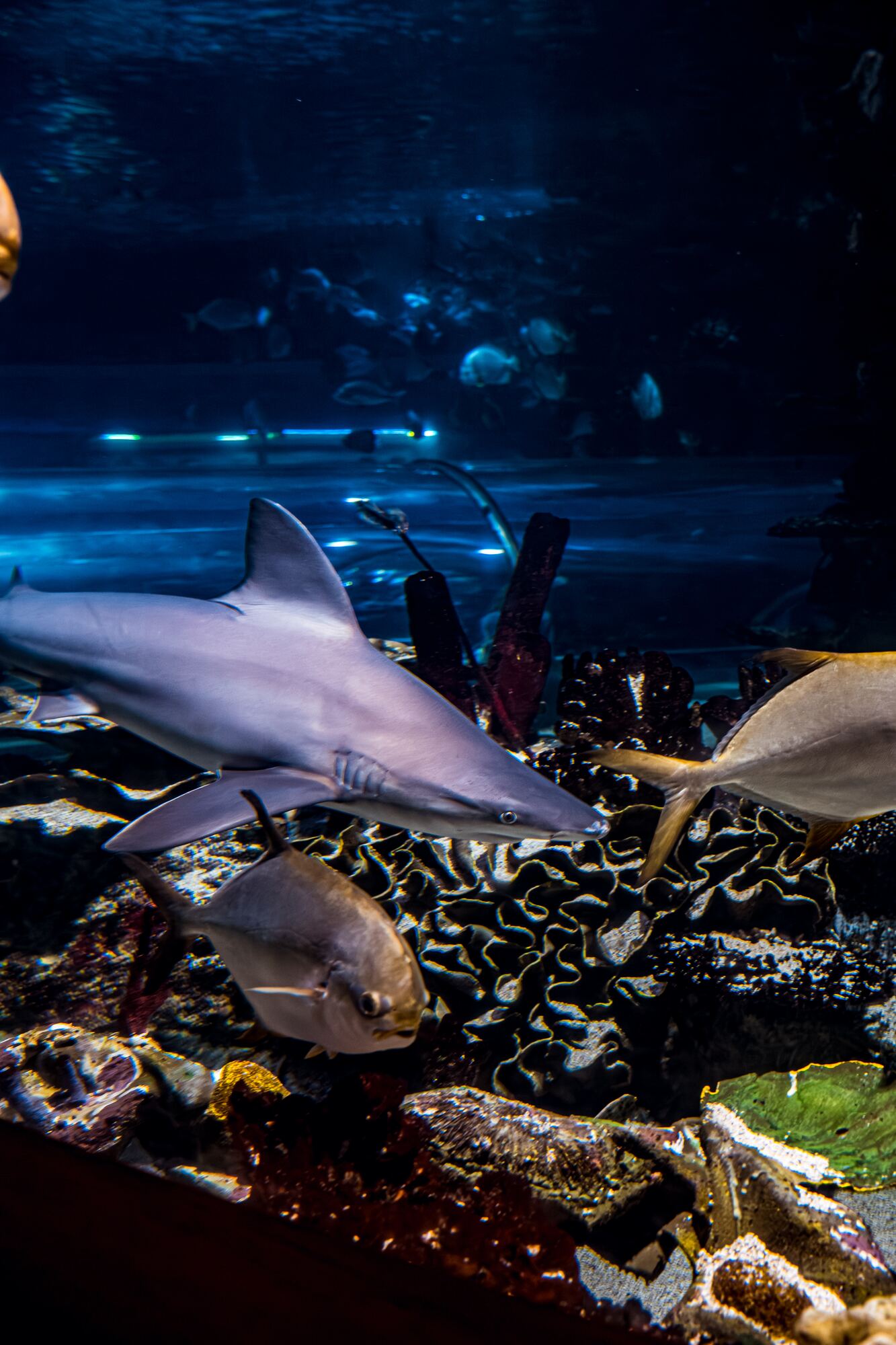
Sandbar sharkCarcharhinus plumbeusEndangered
Living torpedoes
The sandbar shark is a massively built, torpedo-shaped, powerful predator that often occurs in shallow coastal waters. Its hallmark is the large, triangular dorsal fin, which makes it recognisable from a distance. Although it can retreat into deeper waters, it most often swims over sandy bottoms in shallow coastal areas with sandbars, sandbanks and gradually deepening seabeds. This is where the species gets its other name in Hungarian, “sandbank shark”.
Females are larger and more robust than males. It is a viviparous shark species; the embryos develop inside the female’s body, with a placenta-like connection. One interesting behavioural trait of the species is that it uses shallow, sheltered bays as a “nursery”, where fewer predators lie in wait for the young. Because of its slow growth, late sexual maturity, loss of habitat and fishing for its fins, however, populations struggle to recover, and the species is now threatened with extinction.
As an apex predator, the species plays an important role in the ecosystem by regulating the numbers of smaller predatory fish. It is generally not dangerous to humans, but because of its size it commands respect. Its jaws are smaller than those of the sand tiger shark. Its teeth are also smaller and triangular.
The sandbar shark’s senses are superbly developed: besides detecting vibrations in the water, it has excellent eyesight and sense of smell. Although it does not mind a solitary life, it may occasionally gather in larger groups, especially during migration or when food is plentiful.
Maroon clownfishPremnas biaculeatusNot Evaluated
The maroon clownfish is one of the largest clownfish species. Females are considerably larger and more aggressive than males. It fiercely defends its anemone and territory against other fish. A thick layer of mucus protects its body from the stinging cells of the sea anemones.
Lawnmower blennySalarias fasciatusLeast Concern
The lawnmower blenny grazes almost constantly on the surface of rocks and corals. With its strong lips and tiny teeth it scrapes the thin layer of algae off the substrate. It can often be seen “sitting” on rocks, propped up on its pectoral fins. Its camouflage colouring lets it blend in well with the algae-covered parts of the reef.
Long-spined sea urchinDiadema setosumNot Evaluated
The long-spined sea urchin defends itself effectively against predators with its extremely long, thin spines. It is more active at night, when it feeds on algae and organic debris. It plays an important role in keeping algal growth on reefs in check. Its spines are brittle and can be mildly venomous. Young Banggai cardinalfish often seek shelter among the spines of the long-spined sea urchin.
Silver moonyMonodactylus argenteusLeast Concern
Its strongly laterally flattened body gives it a distinctive “disc-shaped” look. It swims in larger shoals and adapts well to waters of varying salinity. It mainly inhabits brackish areas, but can sometimes also be seen in open water.
Red-toothed triggerfishOdonus nigerLeast Concern
Despite the “black” in its Hungarian name, the red-toothed triggerfish is actually dark blue-purple in colour, and its teeth are strikingly red. Unlike many other triggerfish, it often swims in larger shoals in open water. Its powerful jaws easily crack even hard food. When in danger, it can lock itself between rocks by raising the spine of its first dorsal fin, which gives it a bow-like appearance.
Moon jellyfishAurelia auritaLeast Concern
Most of its body is water
Jellyfish are ancient animals, with 95–97% of their body made up of water. The moon jellyfish got its name from its distinctive “ear-like” or horseshoe-shaped gonads, visible inside the bell. Their number varies, usually between 3 and 5, most often 4. Jellyfish bodies consist largely of water, and they move slowly through the water with umbrella-like pulsations; moon jellyfish drift more than they actively swim. Their stinging cells are mildly venomous and are used to catch tiny prey – various planktonic organisms such as small crustaceans.
The species has an extremely complex life cycle: during its life it alternates between a motionless polyp form attached to the substrate and the familiar free-swimming medusa form. These polyps have nothing to do with eight-armed octopuses. They can form tiny colonies which, under favourable conditions – for example when the temperature changes – can develop en masse, that is, transform into free-swimming jellyfish. The moon jellyfish is one of the most common jellyfish species in the world. It often appears in huge swarms, and although it looks fragile, it is remarkably adaptable and can survive in a wide variety of marine environments.
The moon jellyfish has no brain, heart or true skeleton, yet it senses its surroundings efficiently. With its simple nerve net it responds to light, touch and the movement of the water. Its movement comes from rhythmic contractions of the bell, but over longer distances it is mainly carried by currents. The mass proliferation of moon jellyfish – known as a jellyfish bloom – is a natural phenomenon on some coasts and can be influenced by water temperature, currents and the amount of food. Although the stinging cells of the moon jellyfish are mostly harmless to humans, they can cause mild irritation in people with more sensitive skin.
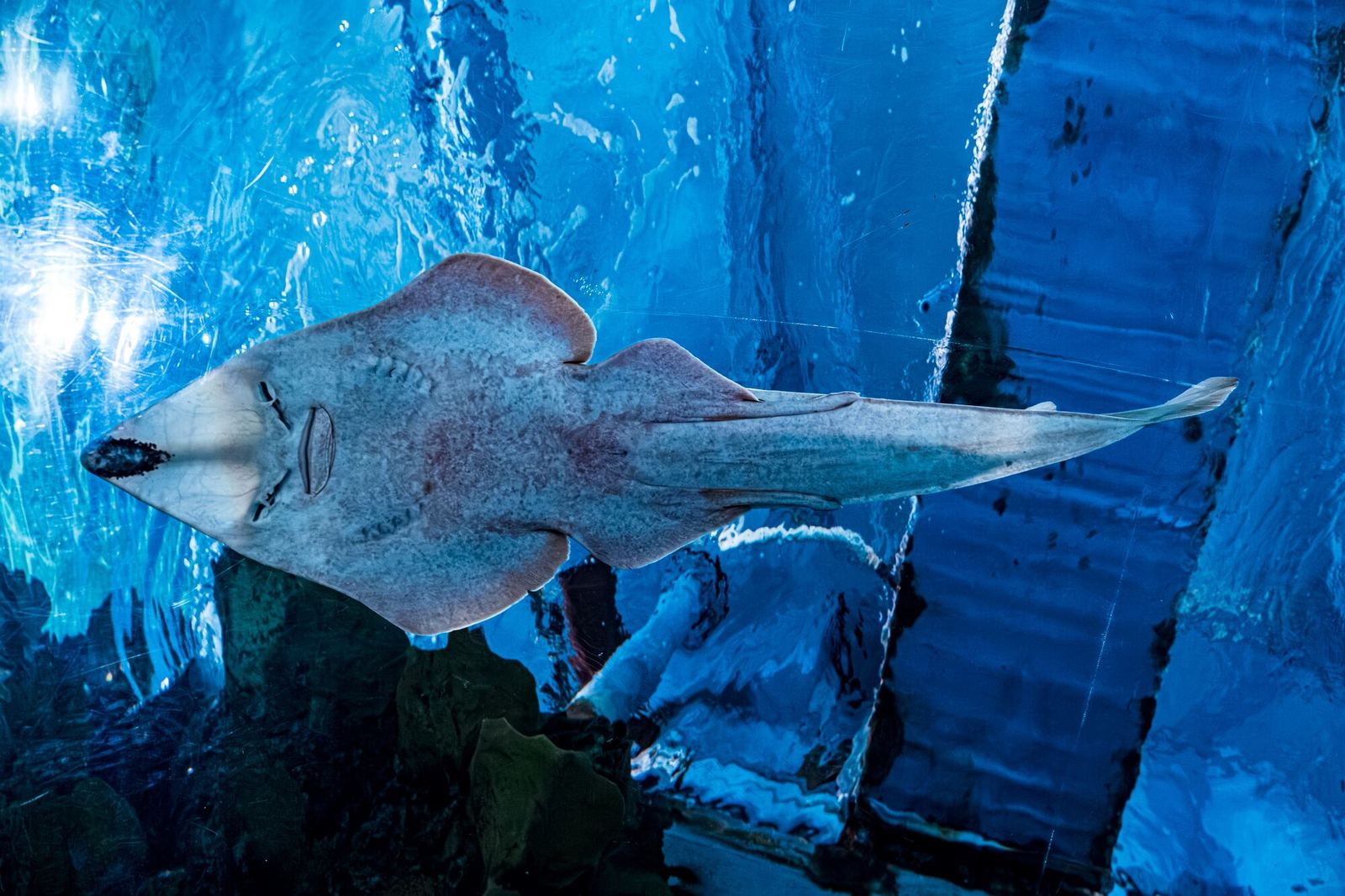
Giant shovelnose rayGlaucostegus typusCritically Endangered
The odd one out among rays
The giant shovelnose ray is a fish of unusual appearance: although it belongs to the rays, it resembles a transitional form between sharks and rays. Several guitarfish species are known, and outside their ranges they also differ somewhat in appearance. The head and pectoral fins of guitarfish are flattened, like those of a ray, while the rear part of the body is more shark-like. This body shape allows it to move efficiently near the seabed. The snout of guitarfish is relatively hard. Their skin does not feel soft, as is typical of rays, but rough and sandpaper-like, as in sharks, because of the tiny tooth-like projections on the skin.
It camouflages itself superbly on sandy substrate, so it often goes unnoticed by predators. It gets its food mainly from bottom-dwelling invertebrates, which it crushes with its powerful jaws. It finds its prey with the help of highly refined senses. It does not only swim near the seabed – it can also be met in the upper layers of water. It is a live-bearing species: females give birth to relatively few, but well-developed young. Unfortunately it reproduces slowly, which has also contributed to the species being critically endangered today, mainly because of intensive fishing. Its fins and meat are eaten, just like those of sharks.
Sixline wrassePseudocheilinus hexataeniaLeast Concern
The sixline wrasse is easily recognised by the vivid bluish stripes running along its body. It is an extremely active fish that constantly searches among the corals for food. Quick reflexes and secretive behaviour help it avoid predators. Kept in an aquarium, it can be useful for eating smaller pests.
Seven-spot archerfishToxotes chatareusNot Evaluated
The seven-spot archerfish is one of the largest members of its genus. It is named after the large dark spots on its sides. Thanks to its powerful build, it hunts not only with jets of water but often leaps right out of the water to catch prey. In the wild it is often seen among the roots of mangrove trees, lurking near the surface for insects and smaller animals.
Sand tiger sharkCarcharias taurusCritically Endangered
The apex predator with a revolving set of teeth
The sand tiger shark is a relatively well-known shark species. Among the shark species kept in the world’s zoos and aquariums, it is one of the largest and most spectacular. Its build is stocky, and females are larger and more robust than males. Its mouth is always slightly open, so its pointed teeth are clearly visible, which gives it a fearsome look. Nevertheless, it is generally calm and rarely aggressive towards humans. Its long, pointed teeth make it perfectly suited to grasping its main food, fish. Its teeth sit in several rows, and if one falls out, a new one grows in its place within weeks. This phenomenon is called a revolving set of teeth. Despite its name, its pattern is not striped but spotted, with darker spots irregularly arranged along its sides.
What makes the species special is that it can gulp air at the surface and, by storing it in its stomach, regulate its buoyancy, so that it almost motionlessly “hovers” in the water. This energy-efficient way of moving helps it when hunting. In an aquarium it can sometimes be seen sinking to the bottom and resting motionless, making use of the currents.
Its reproduction is highly unusual: the embryos already have well-developed teeth in the womb and eat their siblings, so only the strongest individuals survive. This phenomenon is known as intrauterine cannibalism. As a result, the species reproduces very slowly, with only 1–2 young born at a time, which makes it particularly vulnerable to overfishing. Sand tiger sharks are often seen at sites visited by divers, as they tolerate human presence relatively well. The destruction of coastal habitats and fishing are reducing their populations worldwide. So-called ampullae of Lorenzini play an important role in their orientation, allowing them to detect the weak electrical signals of other living creatures. This is especially useful for finding prey hidden under the sand. Their excellent sense of smell also helps them find food.
Longfin batfishPlatax teiraLeast Concern
The longfin batfish has extremely long fins when young, which may remind predators of a leaf or drifting debris. Young and adult specimens look markedly different from each other. Older individuals are more rounded. It is a slow-swimming, peaceful fish that moves in small groups. In the wild it can sometimes also be seen around man-made objects or piles.
Indian vagabond butterflyfishChaetodon decussatusLeast Concern
The body of the Indian vagabond butterflyfish is covered in a dense, net-like pattern that clearly sets it apart from other butterflyfish species. It mostly moves in pairs or small groups among the reefs. With its long, tube-like mouth it can pick food out of even narrow crevices. It is a constantly swimming, active fish that covers large areas while feeding.
Indian sea starProtoreaster linckiiNot Evaluated
The Indian sea star is easily recognised by the red knobs and spines on its thick arms. Despite its slow movement, it is an effective scavenger and substrate cleaner. With its tube feet it can cling firmly to rocks and, when kept in an aquarium, to the glass as well. Damaged arms can partly regenerate.
Banded archerfishToxotes jaculatrixNot Evaluated
Despite its Hungarian name (“Javan”), it is not native only to Java. The banded archerfish is one of nature’s best-known “sharpshooters”. Thanks to the special structure of its mouth cavity, it can shoot a precise jet of water, knocking insects sitting above the surface into the water. A larger fish can hit its target with surprising accuracy even from several metres away. It often lives in small groups, and younger fish frequently hunt together in shallow coastal zones.
Giant moray eelGymnothorax javanicusLeast Concern
The snake-bodied fish
Despite their snake-like appearance, moray eels are not reptiles but fish, belonging to the eel order. The giant moray is one of the largest-growing moray species in the world. Its base colour is brownish-yellow, covered with darker spots and marble-like patterns, so it blends in superbly among coral reefs and rocks. Its head is robust and its mouth wide, with sharp, backward-curving teeth that are perfect for gripping prey. It is also helped in catching prey by a second set of jaws that it can thrust forward.
It is an active hunter at night, ambushing its victims. It leads an essentially solitary life and defends its territory against others of its kind. In aquarium conditions, however, several individuals can be kept together, and sometimes several moray species get along well in the same tank. We know relatively little about its reproduction, but like most moray species it releases its eggs into open water, from which transparent, leaf-like “larvae” develop. Although it is not among the endangered species, the destruction of coral reefs and overfishing may lead to a decline in its populations in the long term.
While breathing, morays often keep opening and closing their mouths, which can look threatening but is actually part of breathing – it moves water across their gills. By day the giant moray mostly hides in rock crevices or caves and usually only sticks its head out of its hiding place. Because of its powerful bite, even larger predatory fish are wary of bigger specimens.
Blue and yellow grouperEpinephelus flavocaeruleusLeast Concern
The blue giant
With its vivid colours, the blue and yellow grouper is one of the conspicuous inhabitants of the reefs. Its body is a deep blue shade, often speckled with yellowish spots or patterns, especially when young. The colouring of older individuals is duller and less vivid than that of the young. This colouring may help with hiding among the corals. Although it does not grow as large as its close relative, the giant grouper, it too can reach an impressive size, and its weight can exceed 12–15 kg.
It leads a solitary life and maintains its own territory, which it defends against other individuals. When hunting, it attacks from ambush, making use of the cover provided by its surroundings. During spawning, the otherwise solitary blue and yellow groupers gather together, and group spawning is often observed among them, which increases the chances of fertilisation. As in many other related species, it can change sex during its life. Although it is currently not endangered, the destruction of reefs may affect it in the long term.
Bluestripe snapperLutjanus kasmiraLeast Concern
A fish that lives in loosely structured schools. It uses hiding places near the reefs for daytime rest. It becomes truly active at night, when it sets off in search of prey. Although it is a great scourge of smaller animals, it is itself an important food source for larger predators.
Orbicular batfishPlatax orbiculareLeast Concern
Its young have a different body shape from adults. Young individuals have longer fins and a darker pattern. It is a slow-moving fish that lives among the reefs. It is mostly seen in small groups. Besides coral reefs, it also prefers man-made landmarks, such as shipwrecks.
Two-banded seabreamDiplodus vulgarisLeast Concern
A fish that is also found in colder waters. Its young often group together in different habitats, while older individuals tend to be more solitary. The two dark bands on its body make this species easy to recognise. With its hard jaws it can crack open even mussels and snails. It is an important fish of coastal ecosystems.
Rockmover wrasseNovaculichthys taeniourusLeast Concern
It got its name from the fact that, with its strong mouth, it can move even smaller stones and pieces of coral while searching for food. The colouring of young individuals differs markedly from that of adults. At night it often buries itself in the sand. It is an active, lively fish that covers a large area of the coral reef searching for food.
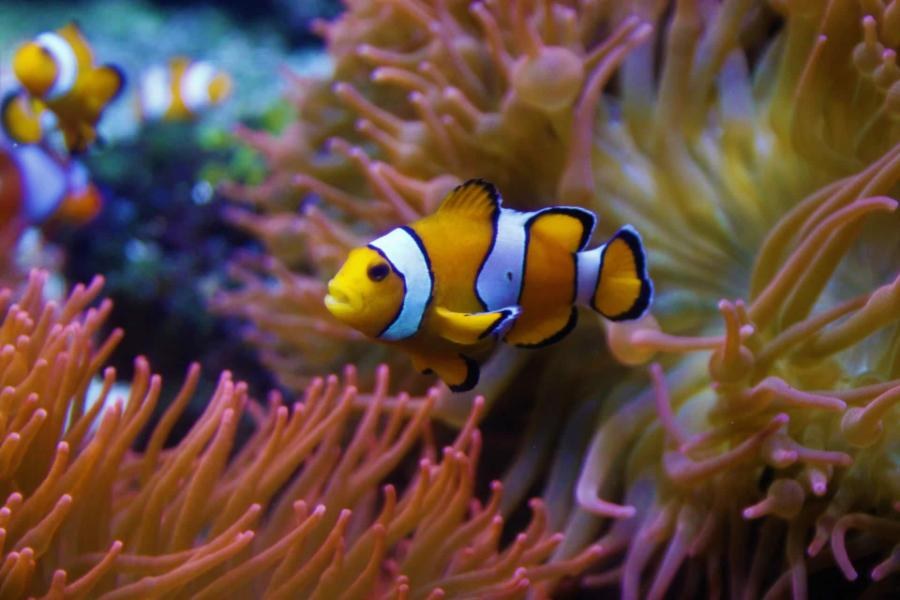
Ocellaris clownfishAmphiprion ocellarisLeast Concern
The ocellaris clownfish is a strongly territorial fish that lives in small groups. A strict hierarchy develops within the group, led by the female, the largest individual in the group. Young fish are initially male and can change sex when necessary. When breeding, the eggs are usually laid on a rock surface, which the male guards constantly and fans with fresh water.
Copperband butterflyfishChelmon rostratusLeast Concern
The reef’s solitary hermit
The copperband butterflyfish is one of the best-known marine fish kept in aquariums. With its distinctive long, tube-like snout it easily picks its prey out from among the corals. Its body is decorated with orange stripes on a white background, complemented by a black eyespot near the dorsal fin. This pattern may help to confuse predators.
It is peaceful towards other fish, but aggressively chases others of its own species out of its territory. It is rare for more than one individual to be kept successfully in an aquarium. When feeding, it searches for small invertebrates in the crevices of the reef with precise movements. Kept in aquariums, it can easily nibble on coral polyps and tube worms. Despite all this, it is one of the most effective hunters of glass anemones, a pest species of anemone. In the wild it releases its eggs into open water, where the larvae drift with the currents.
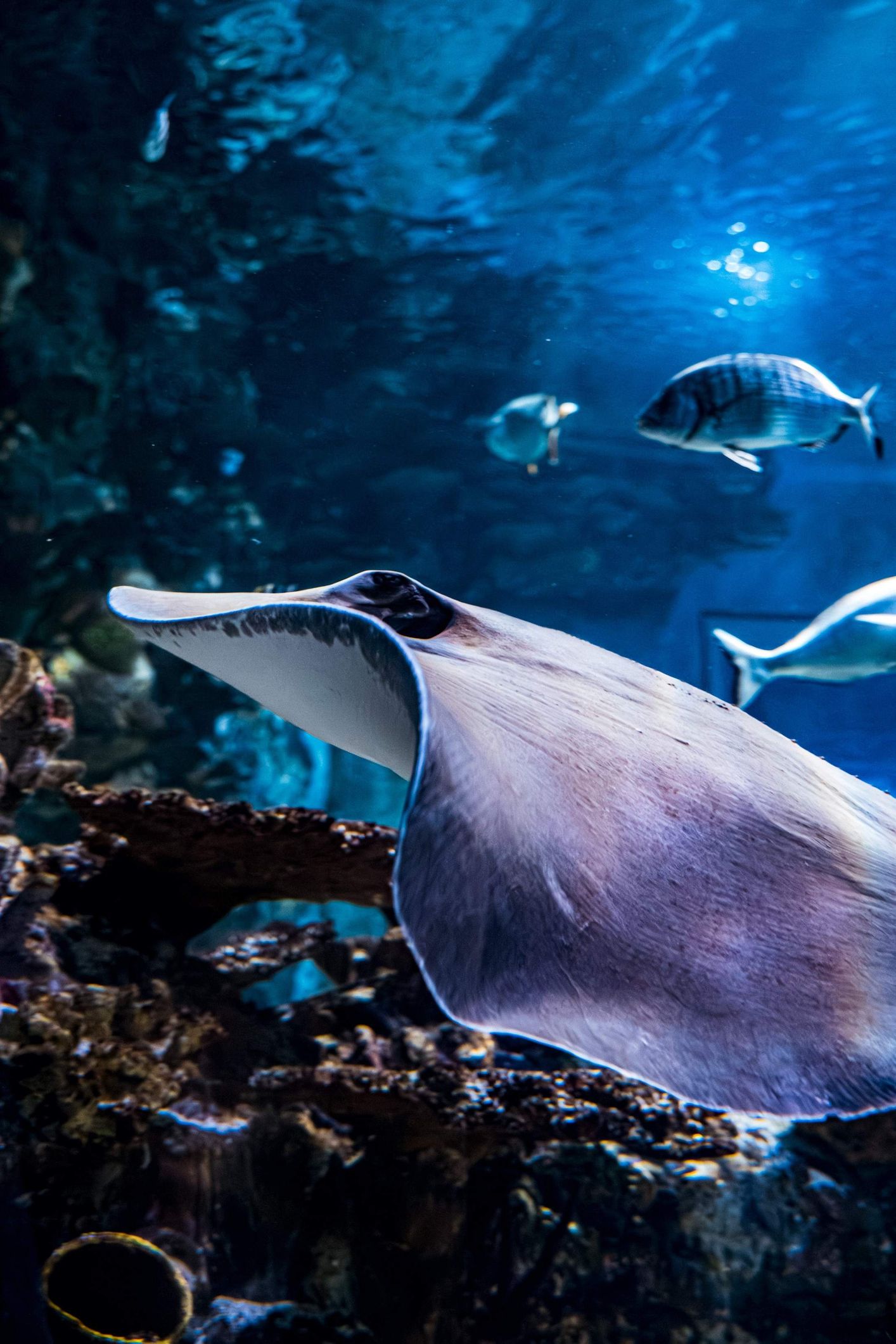
Common stingrayDasyatis pastinacaVulnerable
The rays of Europe
The common stingray is one of the best-known European ray species, often resting hidden in the sand in coastal waters. Its colour blends perfectly into the seabed, so it is hard to spot. Unlike the roughtail stingray, its tail is relatively short compared to its body. On its tail it has one or more venomous spines, which it uses solely for defence if disturbed or accidentally stepped on. Its food consists of smaller bottom-dwelling invertebrates, which it finds with the help of its well-developed senses. Disturbance of coastal habitats and fishing have a negative effect on its population in places.
Leopard wrasseMacropharyngodon meleagrisLeast Concern
The leopard wrasse got its name from its spotted, leopard-like pattern. During the day it constantly searches for food among rocks and corals. At night or when in danger it often buries itself in the sand, where it rests hidden. The colouring of young and adult individuals can differ markedly. In an aquarium it is considered a more delicate species, especially during transport and while getting used to a new environment.
FlounderBothus sp.Not Evaluated
The flounder’s flattened body is perfectly adapted to a bottom-dwelling life. As a fry it resembles ordinary fish, but in adulthood both of its eyes sit on the same side of the body. It can partly bury itself in the substrate, so it blends almost completely into its surroundings.
Blotched fantail rayTaeniura meyeniVulnerable
A changing pattern
The blotched fantail ray got its name from its distinctive dark and white blotched pattern, which provides excellent camouflage in the shadowy surroundings of reefs. The base colour of young rays is black, but as they grow older their pattern changes. Older animals are more grey, with black spots. Blotched fantail rays can be seen both alone and in small groups.
With its strong, flat teeth it can even break up hard-shelled prey. Although it looks slow, when disturbed it is capable of quick, powerful movements. It has a venomous spine on its tail, used for defence. Overfishing and habitat destruction threaten its survival in several regions.
Fourstripe damselfishDascyllus melanurusLeast Concern
The fourstripe damselfish is a reef-dwelling fish easily recognised by its black-and-white pattern. It mostly lives in small groups and is closely tied to coral reefs. When young, it often hides among branching corals, where predators have a harder time reaching it. It actively defends its territory against other smaller fish. In an aquarium it is hardy, but can sometimes be dominant and bossy in character.
Magnificent sea anemoneHeteractis magnificaNot Evaluated
The magnificent sea anemone anchors itself to the rock with its strongly adhesive pedal disc. Its tentacles constantly change shape depending on light conditions and water movement. Symbiotic algae live in its tissues and supply their host with nutrients through photosynthesis. Under favourable conditions it can stay in the same spot for many years. If something does not suit it, it is able to change location.
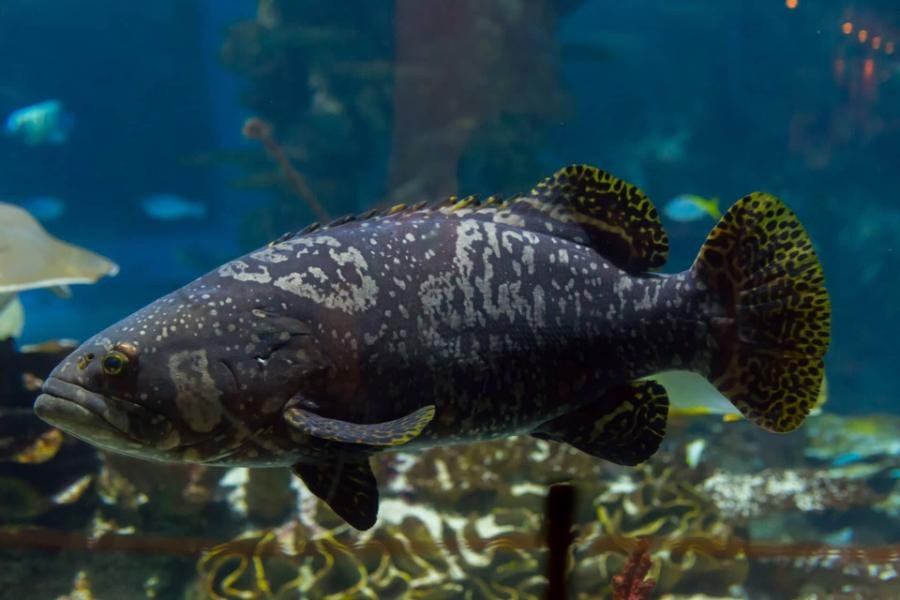
Giant grouperEpinephelus lanceolatusVulnerable
The shark-eating fish
The giant grouper is one of the largest-growing predatory fish of the coral reefs. Its huge body and powerful jaws allow it to catch large prey, even smaller sharks. It moves slowly, but can strike with lightning speed when hunting.
It often hides in caves or rock crevices, from which it attacks suddenly. It defends its territory aggressively against other fish. In aquarium conditions, however, several individuals can sometimes be kept together. When spawning it releases an enormous number of eggs into the water, of which only a few offspring survive to adulthood. The heads of young animals are elongated and their patterns more vivid. Older specimens are duller and the shape of their head is rounded. They are long-lived fish, reaching their full adult size only at around 10–15 years of age. Sadly, its population is declining because of intensive fishing and the destruction of its habitats.
Giant trevallyCaranx ignobilisLeast Concern
This species is one of the largest jacks. Its young often live in shallower, more sheltered lagoons, while older individuals also occur in more open waters. It has strong swimming muscles and is capable of fast, persistent pursuit. It mostly catches its prey by sudden ambush. It even preys on birds by leaping out of the water.
Cowtail stingrayHimantura uarnakEndangered
The leopard of the rays
The cowtail stingray is easily recognised by its distinctive leopard pattern. It got its name from its extremely long, whip-like tail, which is often several times longer than its body. This tail also serves for defence, with one or more venomous spines on it. The cowtail stingray is bottom-dwelling, often half-burying itself in the sand, from where it ambushes its prey.
When feeding, it crushes hard-shelled crustaceans and molluscs with its powerful jaws and pebble-like teeth. It is an extremely cautious, secretive species that often leaves only its eyes and breathing openings showing above the sediment. Its habitats are threatened mainly by the development of coastal areas and by fishing.
Longfin bannerfishHeniochus acuminatus
Sergeant majorAbudefduf saxatilisLeast Concern
A highly territorial species, especially during the spawning season, when males aggressively defend the area around the nest. Young individuals often live in open water in shoals, while adults are more tied to the reefs. Its striking stripes help individuals communicate visually. It is often seen in shallow, sunlit waters.
Blue bird wrasseGomphosus caeruleusLeast Concern
With its long, beak-like mouth, the blue bird wrasse can pick prey out of the crevices of corals. Males are usually vivid blue-green, while females are brownish-red. It is a fast-moving, active fish that constantly searches for food. It moves through the water with a flight-like motion, which is where its name comes from. At night it often retreats into the sand or between rock crevices.
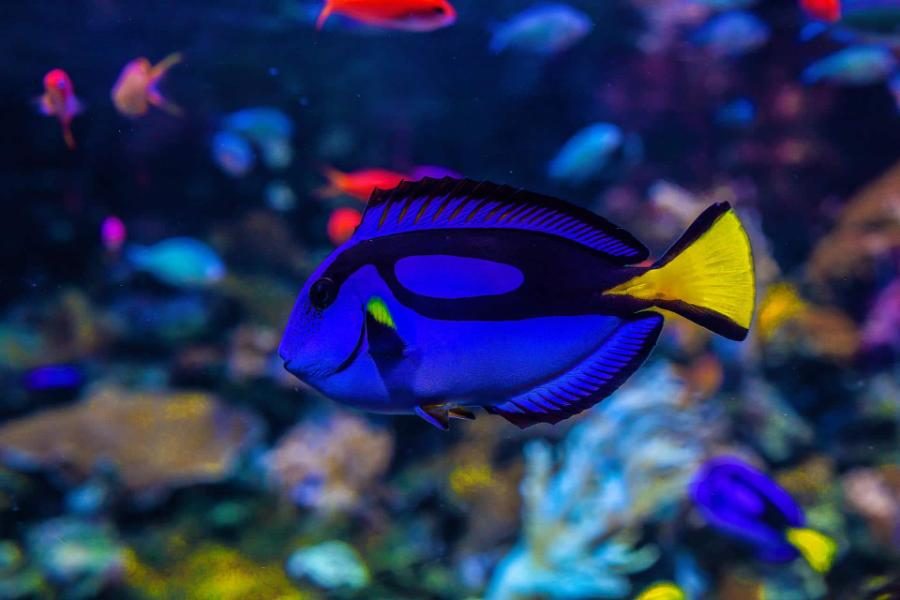
Palette surgeonfishParacanthurus hepatusVulnerable
With its vivid blue colouring and black pattern, the palette surgeonfish is one of the best-known fish of the coral reefs. It got its name from the sharp, scalpel-like spine on its tail base, which it uses for defence; it reminded those who named it of a surgeon’s scalpel. When young it often lives in small groups, but larger individuals can become solitary. By eating algae it plays an important role in maintaining the balance of coral reefs.
Spotted sharpnose pufferCanthigaster solandriLeast Concern
A pufferfish with an unusual look
Despite its small size, the spotted sharpnose puffer is a striking presence on coral reefs. Unlike most pufferfish, its body is slender and its snout pointed. Its body is covered in a light base colour and tiny dark dots, which provide excellent camouflage. Like all pufferfish, it can inflate its body when in danger, making it harder for predators to swallow, and also intimidating them by appearing larger than it really is. In aquarium conditions, inflating its body can be so stressful for it that it may even die from it.
Its skin and organs contain a potent toxin, tetrodotoxin, which provides effective protection. It is a slow but agile fish that constantly searches for food. It shows territorial behaviour towards others of its species. When breeding, it lays its eggs on the substrate and may guard them for a short time.
Green chromidePseudetroplus maculatusLeast Concern
The green chromide is easily recognised by its bright orange colouring and dark spots. Like most cichlids, it shows well-developed parental care: the parents guard the eggs and the hatching fry together. It often lives in small groups and is more peaceful than many other cichlids. In its natural habitats it has also adapted well to slightly salty brackish waters.
Spotted garden eelHeteroconger hassiLeast Concern
A worm-like fish
Although it looks like a worm or a snake, the spotted garden eel is actually a thin-bodied fish of unusual appearance. It got its name because it digs burrows in the seabed like a gardener digging up a flower bed. Most of its body always stays buried in the substrate, with only its head and upper body rising out, constantly turned towards the current. Its colour is a light white base speckled with tiny black dots, which helps it blend into its surroundings. If it senses danger, it instantly retreats into its burrow.
Garden eels form loose colonies in which each individual lives in its own burrow, yet they sit close to one another, so the “field” forms a swaying, living structure. This behaviour provides both protection and better feeding opportunities for the animals.
During reproduction the eggs are released into open water, where they develop into planktonic larvae, that is, they swim freely in the open water. Only later do they return to the seabed to found a new colony.
Spotted mandarinSynchiropus picturatusNot Evaluated
The spotted mandarin’s body is covered in a thick layer of mucus, which partly protects it from parasites and predators. Its eyes are unusually large in proportion to its body. With a slow, hovering motion it searches for food among the rocks. It feeds on tiny organisms. During courtship the males perform a spectacular mating dance.
Picasso triggerfishRhinecanthus aculeatusLeast Concern
A painting come to life
With its striking colours and pattern, the Picasso triggerfish is one of the best-known fish of the coral reefs. It also got its name from its colouring: the little fish gives the impression of having swum straight out of one of Pablo Picasso’s paintings. Its strong jaws and teeth allow it to crack hard-shelled prey such as sea urchins and shellfish.
Its territorial behaviour is especially remarkable: it defends its realm aggressively, even against creatures much larger than itself. It can often be seen guarding its “nest” dug into the sand, while also chasing off people swimming nearby. Even in aquarium conditions it should only be kept with larger fish. Although it is not endangered, the shrinking of its habitat and the pet trade may have a negative effect on the survival of its population.
Red bubble-tip anemoneEntacmaea quadricolorNot Evaluated
Not a flower, but an animal
Despite its plant-like appearance, the red bubble-tip anemone is an animal belonging to the cnidarians. Several colour variants of the species are known, of which red is the most common in aquarium keeping. The red bubble-tip anemone got its name from its distinctive tentacles with bubble-like tips. These tentacles contain stinging cells with which it paralyses its prey.
It lives in a special relationship with clownfish, which find protection among its tentacles and in return clean and feed their host. The anemone’s colour is partly due to the symbiotic algae living in it, which produce nutrients for it through photosynthesis.
It can reproduce both sexually and asexually, the latter by splitting in two to create new individuals. Thanks to this it multiplies quickly even in aquarium conditions if the conditions are favourable. Although it is not among the endangered species, it is sensitive to environmental changes, especially rising water temperatures and the destruction of coral reefs.
Pajama cardinalfishSphaeramia orbicularisLeast Concern
The pajama cardinalfish got its name from its distinctive spotted and striped pattern. During the day it hides in small groups among coral branches or sea urchins. The males are mouthbrooders: they carry the fertilised eggs in their mouths until they hatch. It feeds more actively in the dark, when it preys on tiny planktonic organisms.
Snubnose pompanoTrachinotus blochiiLeast Concern
The most common fish in our shark aquarium. Its body is strongly flattened from the sides, which allows it to make quick turns in open water. It moves in shoals. It also feeds actively near the bottom, where it can even filter food out of the sand. It plays an important role in the food web of coastal ecosystems, as it is a favourite prey of many predators.
Foxface rabbitfishSiganus vulpinusLeast Concern
The foxface rabbitfish got its Hungarian name from its elongated head shape. The spines of its dorsal fin are mildly venomous, providing effective protection. It often lives in pairs or small groups. Its colour can temporarily fade during stress or rest.
Orangespine unicornfishNaso lituratusLeast Concern
The orangespine unicornfish got its Hungarian name (“lipstick surgeonfish”) from the orange spines at the base of its tail, which reminded those who named it a little of surgeons’ scalpels. In adulthood, long, streamer-like extensions can develop on its tail. The orangespine unicornfish usually swims over long distances in the outer parts of coral reefs. By constantly eating algae it helps keep the corals clean.
Yellow boxfishOstracion cubicusLeast Concern
Young yellow boxfish are bright yellow, speckled with black dots. Its rigid, box-like body armour gives it an unusual appearance. Although it resembles pufferfish, the two are not related, and the boxfish cannot inflate itself when in danger. It is a slow-swimming fish that mainly searches for food among the coral reefs. When stressed it can release a toxic substance that can be dangerous to other fish too.
Yellowhead butterflyfishChaetodon xanthocephalusLeast Concern
A butterflyfish species that is easy to recognise by its yellow head and contrasting body pattern. It often moves in pairs or small groups. It is strongly attached to its own territory, which it defends even against other butterflyfish. It looks for its food on coral reefs.
Yellowbar angelfishPomacanthus maculosusLeast Concern
On adult yellowbar angelfish, the yellow band running across the middle of the body is clearly visible. The pattern of young individuals differs significantly from that of adults, being characterised by white stripes on a blue background. It is a strongly territorial species, especially towards other angelfish and its own kind. When feeding, it nibbles its food off the surface of coral reefs.
African moonyMonodactylus sebaeNot Evaluated
The African moony is easily recognised by its tall, disc-shaped body and silvery shimmering scales. It lives in shoals and in its natural habitats often occurs near tidal zones. When young it mostly lives in brackish water, and later can even be found in the open sea.
Emperor angelfishPomacanthus imperatorLeast Concern
The pattern of the emperor angelfish as a juvenile and as an adult is completely different. Young specimens have light blue circular markings on a dark background, while adults are striped yellow and blue. It is territorial by nature, especially towards other angelfish. It chases both its own kind and fish of other species out of its territory. With its strong jaws, the emperor angelfish easily eats even harder food.
Reef pipefishCorythoichthys haematopterusLeast Concern
The seahorse’s cousin
The reef pipefish is a slender fish with a segmented, armour-like body, a distant relative of seahorses. Its Hungarian name comes from its elongated, needle-like body. The body is long and tube-shaped, covered in tiny bony plates that give it a rigid yet flexible structure. Its colour varies: brownish, greenish and reddish patterns break up its outline, helping it blend in among corals and algae.
Its movement is slow and undulating – it “hovers” rather than swims, often following the currents head-down or at a slant. Its food consists of tiny crustaceans and other planktonic organisms, which it sucks up with its tube-shaped mouth. What makes pipefish special is that the males hatch the young: the female lays the eggs in a brood pouch on the male’s belly, where they continue to develop in a protected environment. This is rare among fish and plays a significant role in the species’ survival strategy. The reef pipefish often lives in pairs or small groups and is strongly attached to its familiar habitat. When threatened, it often goes motionless, trying to hide from predators that way.
Rainbow land crabCardisoma armatumLeast Concern
Africa's colourful land crabs
The rainbow land crab is native to the coastal areas of West Africa and occasionally also occurs in river estuaries and on islands. The carapace of young animals is bluish-purple, which together with the red legs makes for an attractive appearance. After moulting the animal's colours are always more vivid, and the intensity of the colouring fades with age. It spends most of its time on land. If frightened, it often escapes into the water and tries to hide from its attacker there. It likes to hide under stones or fallen trees. It is an omnivore, eating food of both animal and plant origin. It also eats carrion, and adults may even eat young of their own species.
In the wild it often stays in burrows it digs itself, which protect it from predators and from drying out. With its strong claws it not only gets food but can also move soil effectively. The moulting period is especially vulnerable for it, as its shell is still soft then, so it leads a more secretive life. In coastal ecosystems it plays an important part in breaking down dead plant and animal remains.
The name rainbow land crab is sometimes also used for other colourful land crab species. It defends its territory aggressively, so under terrarium conditions it can only be kept alone or in a small group.
Dancing shrimpRhynchocinetes durbanensisNot Evaluated
The dancing shrimp got its name from its distinctive swaying movement, which can be seen especially while feeding. Its body is decorated with a reddish base colour and light dots, and it is easily recognised by its long, beak-like, forward-pointing head section. It mostly lives in small groups, often hiding in rock crevices or among coral branches by day. It becomes more active at night, when it searches the seabed for tiny food. After moulting its colours usually become more vivid, but its shell is still soft then, so it is especially sensitive and secretive.
Cleaner shrimpLysmata grabhamiNot Evaluated
The cleaner shrimp is easily recognised by its striking red-and-white pattern and long antennae. In its natural habitat it sets up so-called “cleaning stations”, where larger fish stop so the shrimp can remove parasites and dead tissue from their bodies. The fish behave surprisingly calmly at such times, and even predatory species tolerate its presence. In an aquarium it is a peaceful and useful animal that is often actively on the move among rocks and corals even by day. Its reproduction is unusual: individuals of the species carry both male and female reproductive organs at the same time.
Bluestreak cleaner wrasseLabroides dimidiatusLeast Concern
One of the species’ best-known behaviours is “cleaning” larger fish, removing parasites and dead skin from their bodies. It also picks leftover food from between the teeth of larger predators. It sets up “cleaning stations” where other fish species often queue up and wait. Its distinctive black, blue and white stripe makes it recognisable on the reefs. With this remarkable behaviour it plays a key role in maintaining the health of coral reefs.
Fire gobyNemateleotris magnificaLeast Concern
The fire goby is a fish known for its slender body and vivid reddish-orange colouring. It is mostly seen hovering above coral reefs, from where it darts back into its burrow in a flash if danger arises. It lives alone or in pairs. It uses its long first dorsal fin ray for communication, for signalling between members of its species. Because of its peaceful nature it is a popular marine ornamental fish.
Bluespine unicornfishNaso unicornisLeast Concern
It got its name from the distinctive horn-like protrusion on its forehead. The horn of adult males is larger; in females it may be missing entirely, or only a small horn-like bump grows on the forehead. It also occurs in larger shoals, especially when young, while older individuals tend to be more solitary. It plays an important role in keeping algae in check. It is a good swimmer that can cover long distances searching for food. Males in breeding colours take on a particularly beautiful pattern.
Russian sturgeonAcipenser gueldenstaedtiiCritically Endangered
Protected in Hungary, with a conservation value of HUF 10,000
A sturgeon with a rounded snout
The Russian sturgeon is a medium-sized fish of the sturgeon family found in flowing waters. In Hungary it is a rare and protected species, found mainly in the Danube, the Tisza and larger stretches of their tributaries, but only scattered individuals are encountered in Hungary. The species has a conservation value of HUF 10,000. Its body is elongated and laterally flattened, with a dark olive-green back, silvery shimmering sides and a pale belly. Its mouth is on the underside, and with the help of three pairs of sensory barbels it filters food from the bottom, which consists mainly of molluscs, crustaceans and tiny invertebrates. Interestingly, young Russian sturgeon are often mistaken for the starlet or the Siberian sturgeon, but with a little practice they can be told apart fairly easily. From the starlet, the Russian sturgeon can be distinguished by its more slender body proportions and smaller, flatter head; its barbels are longer and thinner, whereas the starlet has a rounder, stockier head shape. Unlike the Siberian sturgeon, the Russian sturgeon has an evenly curved back line, while the Siberian sturgeon’s back line is often slightly raised; in addition, the Russian sturgeon’s barbels start from the edge of the mouth and are longer, whereas in young Siberian sturgeon the barbels are shorter and the head slightly blunter. The Russian sturgeon’s snout is shorter and more rounded than that of the other two sturgeon species.
For spawning, the species often chooses the gravelly and sandy stretches of the original river bed, where the young hide among the sand and mud. The Russian sturgeon can grow up to 1–1.2 metres long and 10–15 kilograms, although in Hungarian waters smaller specimens of 60–80 cm are more common. The species is sensitive to water quality and oxygen levels, so its presence is a good indicator of the ecological condition of rivers.
Valentini pufferfishCanthigaster valentiniLeast Concern
The Valentini pufferfish is easily recognised by its distinctive black bands and light base colour. When in danger, it inflates its body with water to scare off predators, trying to look bigger than it really is. Toxic substances can accumulate in its skin and internal organs.
Sailfin tangZebrasoma veliferumLeast Concern
The sailfin tang got its name from its extremely tall dorsal and anal fins, which it spreads fully when in danger. This gives the fish a sail shape. Its young often live in shallower lagoons, while larger individuals occur in deeper waters, on coral reefs. It constantly grazes algae off rocks and corals. At the base of its tail it has a sharp, blade-like spine, which it uses for defence.
Purple tangZebrasoma xanthurumLeast Concern
With its deep violet-blue colouring and bright yellow tail, the purple tang is one of the best-known surgeonfish species. It defends its territory aggressively against other algae-eating fish and sometimes against its own kind. In the wild it often lives alone or in small groups. By keeping algae in check it plays an important role in maintaining the health of coral reefs.
Lyretail anthiasPseudanthias squamipinnisLeast Concern
The lyretail anthias hovers in large groups above coral reefs, where it gathers drifting planktonic organisms. Males are more vividly coloured and larger than females. Females can change sex if the group’s male dies. Males aggressively defend their harem against other males.
See them
in person too
Buy tickets
Frequently asked questions
When is the shark feeding?
On Mondays at 14:30 the sharks are fed from above, and on Thursdays at 14:30 by divers, in the shark aquarium. You can find the times of the other feedings on the Feedings and keeper talks page.
Can we come in bad weather or rain?
Yes. Tropicarium is a fully covered indoor attraction inside the Campona building, so you can enjoy it comfortably whatever the weather, in rain or cold.
How long does a visit take?
At a relaxed pace, 1.5–2 hours on average. If you want to catch a feeding or spend more time at the ray-petting pool, allow a longer visit.
Can I take photos?
For personal use, yes, but flash is prohibited because it disturbs the animals.
You will find answers to further questions on the FAQ page.