All our animals
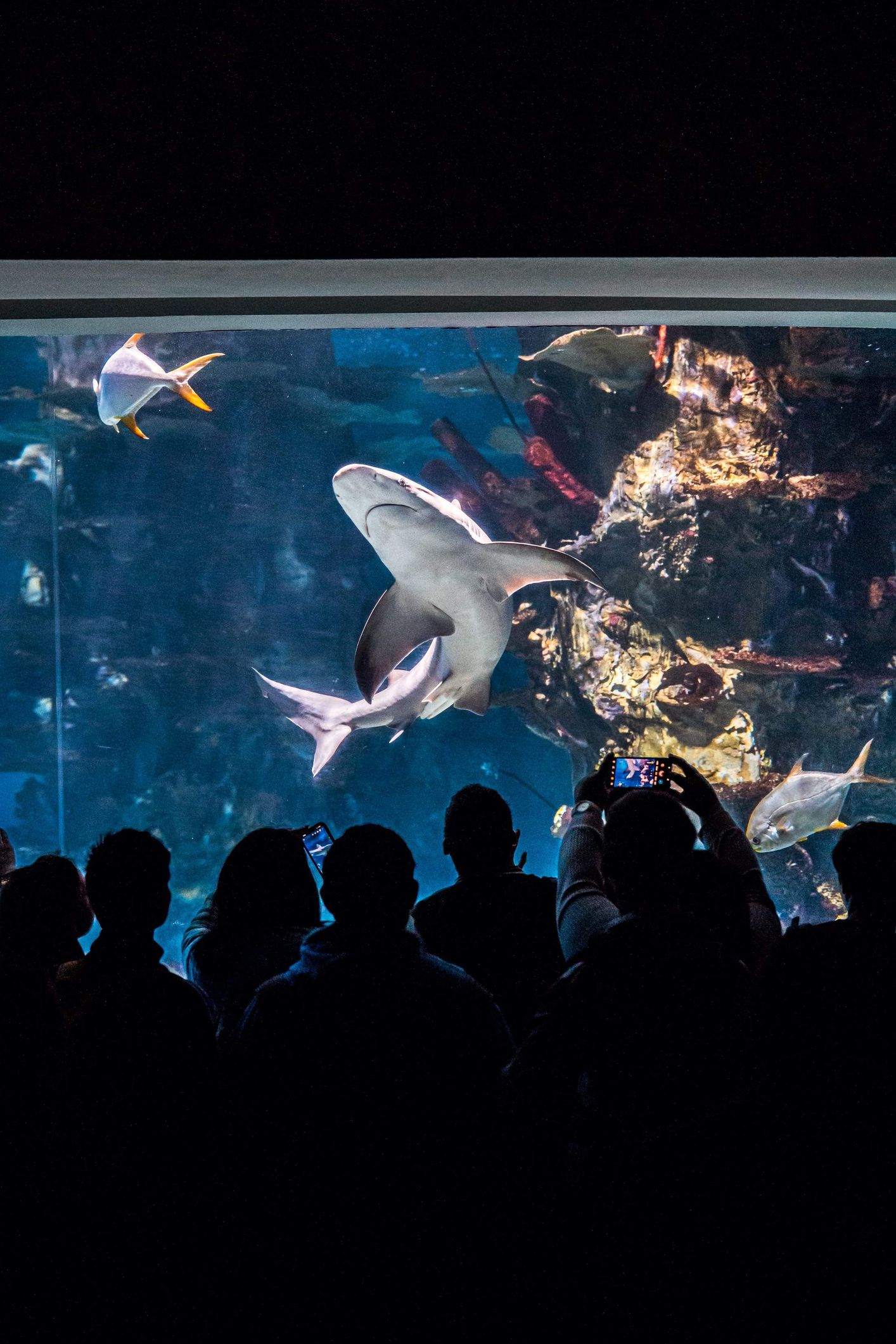
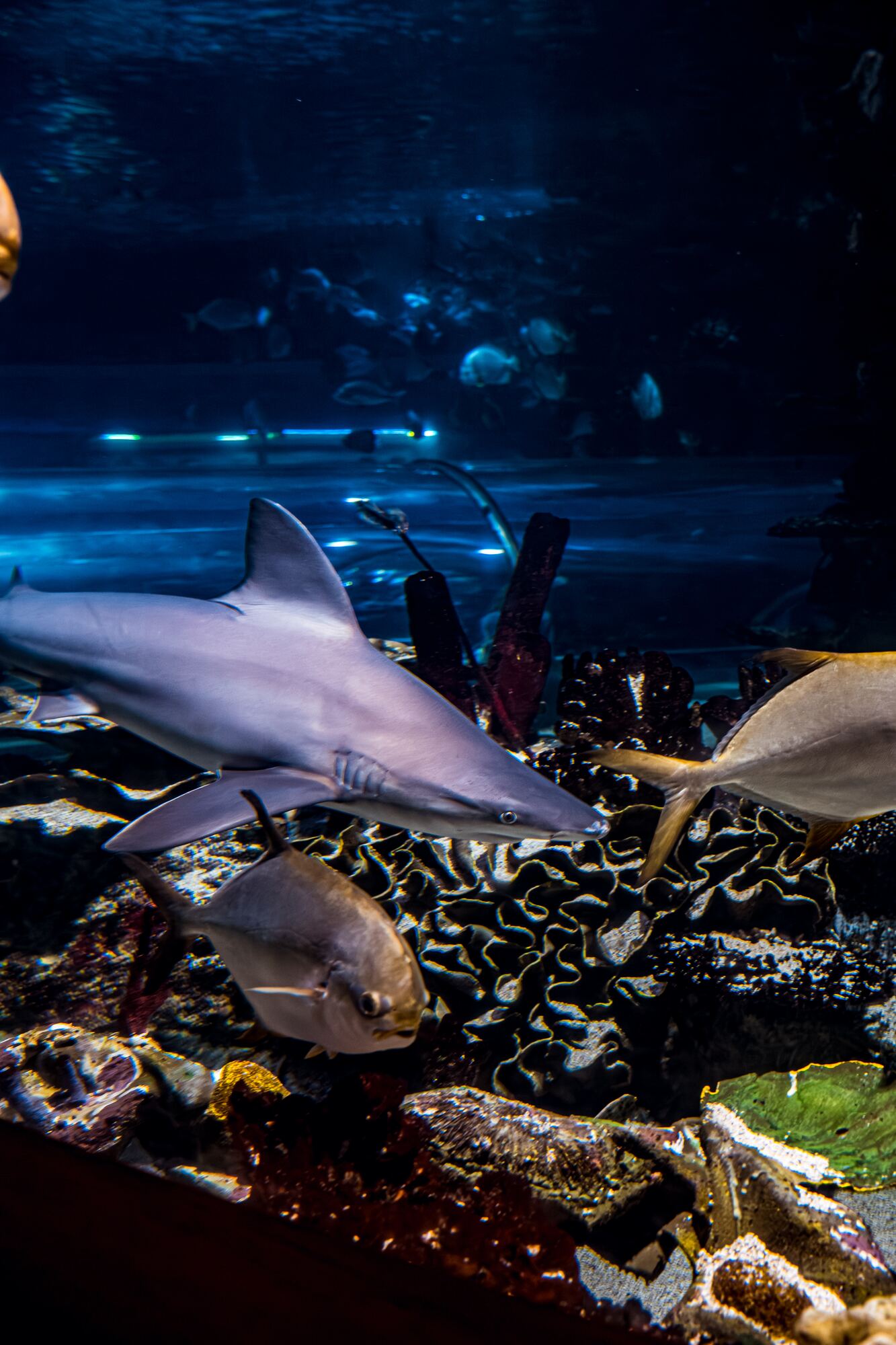
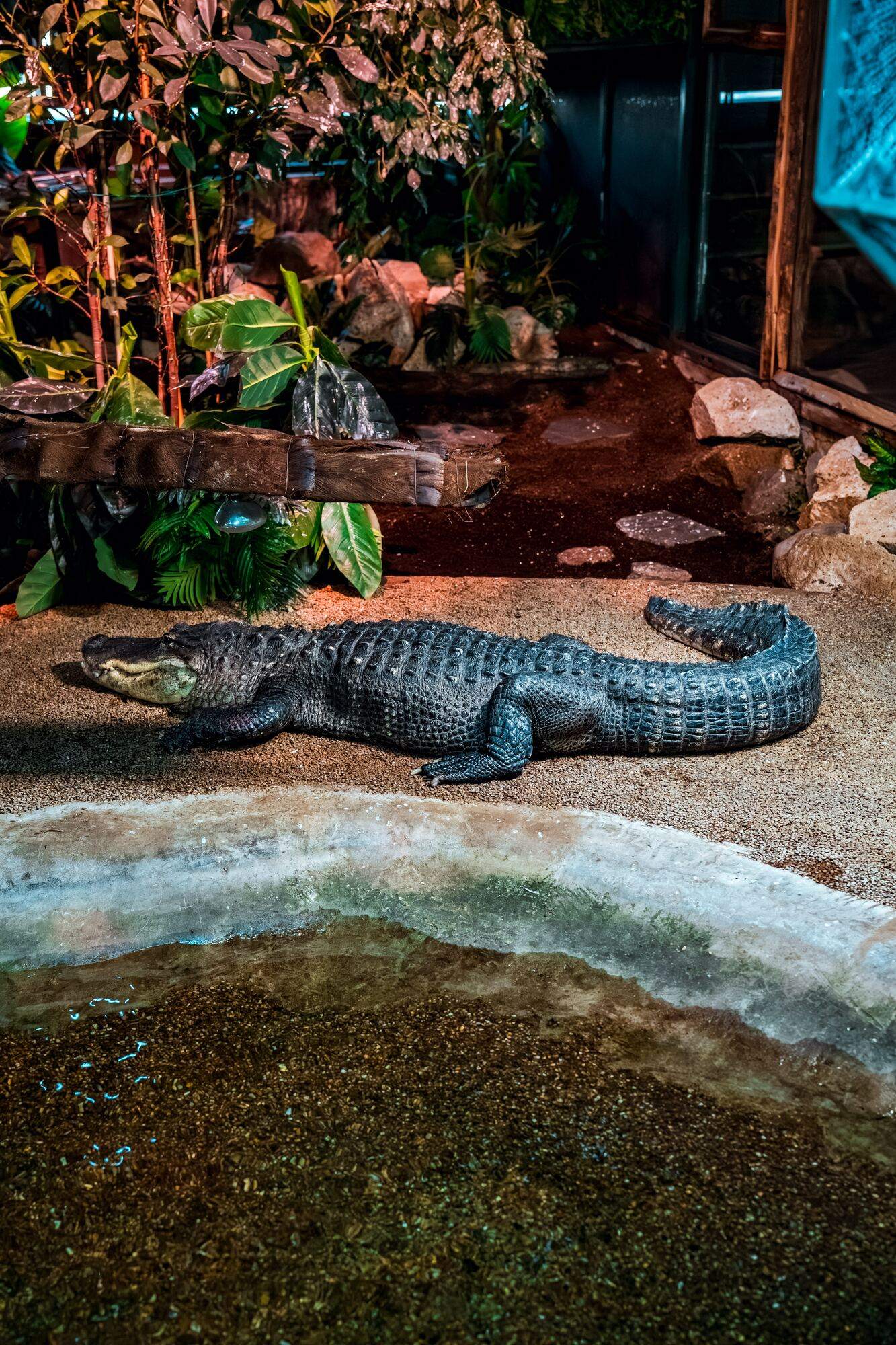
Sharks, rays, alligators, giant snakes and many more — here you'll find every species on show at the Tropicarium.
Our featured animals
All our species
233 species. Click a name for details, or filter by habitat, taxonomy, danger level and conservation status.
No results with these filters.
West African lungfishProtopterus annectensNot Evaluated
The African lungfish belongs to the lungfishes, one of the most ancient groups of fish still living today in evolutionary terms. Its special feature is that besides its gills, a modified swim bladder works like a lung, so it can also take oxygen from the air. This lets it survive in waters where other fish would suffocate.
In the dry season it burrows into the ground and wraps itself in a cocoon of mucus, reducing its metabolism to a minimum, so it can survive for months without water. It moves slowly, in a snake-like way, and lives mostly on the bottom. It is an active predator mainly at night, feeding on smaller fish and invertebrates. Because of its appearance and way of life it is often called a “living fossil”.
African red-eyed tetraArnoldichthys spilopterusLeast Concern
A fast-moving schooling fish that swims mainly in open water. Its diet consists of insect larvae, planktonic organisms and plant matter. Males are usually more brightly coloured, especially in the breeding season. In its natural habitats it plays an important role in regulating populations of small aquatic invertebrates.
Raccoon butterflyfishChaetodon lunulaLeast Concern
The eyes of the raccoon butterflyfish are covered by a dark marking that can confuse predators. It often swims in pairs and stays with the same partner for a long time. With its slender mouth it easily picks food out from among the corals. At night it usually retreats into crevices in the reef.
Masked flower chaferPachnoda marginataNot Evaluated
A colourful terrarium resident
The masked flower chafer is a well-known tropical species of the flower chafer subfamily. The pattern on the back of each masked flower chafer is unique to the individual: no two specimens have the same markings. It plays a major role in the decomposition processes of forest ecosystems. The adults are often seen on flowers and fermenting fruit, where they not only feed but may also play an indirect part in pollination.
The species has a rapid development cycle, which allows populations to recover quickly under favourable environmental conditions.
Its larvae develop in the humus-rich layers of the soil, where they break down organic matter intensively and so contribute to nutrient cycling. During their short lifespan the adults specialise mainly in energy-rich, sugar-rich food sources, which give them a fast metabolism.
One of the flower chafer species most commonly kept in terrariums.
Albino reticulated pythonMalayopython reticulatusLeast Concern
Albinos and dwarfs
The albino reticulated python is a colour variety bred in captivity, easily recognised by its distinctive light colour and yellow pattern. In the wild this variety is not viable, because its colouring completely lacks the darker pattern that aids camouflage, so predators would easily spot it.
The albino variety arises from a genetic mutation: because of a naturally occurring recessive gene change, melanin, the dark pigment, is completely absent from the skin, so the snake’s base colour becomes light, yellowish-white, without the characteristic dark pattern. This mutation occurs very rarely among wild reticulated pythons, so the albino variety developed only in captivity, through selective breeding. Breeders carefully pair carrier animals so that the albino gene is inherited from both parents, which allows fully albino offspring to be born. Even if two normally coloured animals that carry the albino gene are paired, albino offspring can still be born.
Interestingly, besides the albino reticulated python, several other varieties are known in terrarium conditions that differ markedly in colour and pattern from wild specimens. “Dwarf” reticulated pythons are also known, which in the wild occur on a few islands of Indonesia. Adults often stay around 2–3 metres long, unlike mainland reticulated pythons, which can reach as much as 6 metres. In the terrarium hobby, “dwarf” varieties are often produced by selective breeding.
Although the reticulated python is a popular terrarium animal abroad, in Hungary it is classed as a moderately dangerous species, which is exactly why keeping one at home is possible only with the appropriate permits.
Amano shrimpCaridina multidentataNot Evaluated
The Amano shrimp is one of the best-known algae-eating shrimp species in the aquarium hobby. It constantly cleans the substrate, rocks and plants, eating algae and organic debris as it goes. It is a social species that moves in small groups. Its reproduction is unusual, because in the early stages of development its larvae need a salt-water or brackish environment.
Grass carpCtenopharyngodon idellaLeast Concern
The fish that even eats reeds
The grass carp is a large, herbivorous fish. It is not native to Hungary but an introduced species. Its homeland is East Asia, mainly the area stretching from southern Siberia to the central river systems of China, and its Hungarian name comes from the Amur River. Its eyes are set slightly forward on the sides of its head, which is unusual among fish and lets it observe its surroundings better while feeding. It is a herbivore, eating mainly aquatic plants, pondweed, reeds and algae. Interestingly, grass carp can “devour” entire patches of reeds, so introducing them helps control aquatic vegetation. It is regarded as a popular angling fish, since large specimens can reach 15–20 kilograms. The grass carp’s ability to adapt to its environment is remarkable, as it can cope with both slow and fast water.
Golden acaraAndinoacara rivulatusNot Evaluated
The golden acara is a robustly built cichlid, easily recognised by its metallic, shimmering scales and orange-edged fins. Older males often develop a small fatty hump on the forehead. It regularly roots through the substrate in search of food, eating small invertebrates as well as plant matter.
Golden doradoSalminus brasiliensisNot Evaluated
The golden dorado has exceptionally keen eyesight, which helps it track fast-moving prey in clear-water rivers. Its musculature is specialised for continuous swimming and sudden sprints. It often hunts alone, but can occasionally be seen in loose groups. Its powerful jaws let it take on fairly large prey. Only older fish are yellow; young ones have a greyish, silvery pattern.
Golden trevallyGnathanodon speciosusLeast Concern
When young it has a bright yellow base colour with contrasting black stripes, which fade by adulthood. It often moves in shoals. It prefers shallow coastal waters. It also feeds actively near sandy bottoms, searching the seabed for prey. It sometimes appears around larger reefs too.
When young they live as pilot fish: they accompany larger predators, such as sharks.
Balsas splitfinIlyodon whiteiEndangered
In memory of Gilbert Percy Whitley
The Balsas splitfin is a small, live-bearing freshwater fish found in the rivers of western Mexico, primarily in the Balsas drainage system. It belongs to the highland splitfins (goodeids) and lives in clear, oxygen-rich water in its natural habitat. Its body is elongated and slightly flattened from the sides, and its colour is mostly greyish-silver. Its English name, “Balsas splitfin”, points to two features: “Balsas” refers to the Balsas river basin where the species is native, while “splitfin” refers to the males’ modified anal fin. This fin plays a role in reproduction and differs in shape from that of most other fish, which is one of the hallmarks of the group.
The “whitei” in the species’ scientific name comes from a personal name: the authors who named it were paying tribute to the Australian ichthyologist Gilbert Percy Whitley. He was a well-known fish taxonomist of the 20th century and took part in describing and classifying many fish species.
Green and black poison dart frogDendrobates auratusLeast Concern
Jewel of the forest
The green and black poison dart frog is one of the best-known poison dart frog species, instantly standing out from its surroundings with its vivid green, turquoise or bronze markings. Irregular patterns run across its black base colour, and they can differ from one individual to the next. Its striking colouring serves both as camouflage in a mossy setting and as a warning to predators. Despite its Hungarian name (“golden tree-climbing frog”), it comes in several colour variants.
A frog that is active by day, moving mainly across the forest floor or on lower plants. It hunts tiny insects and is especially fond of ants and termites. The species is an excellent climber, and its sticky-padded toes let it move easily over wet leaves and tree trunks.
The eggs laid by the female are often guarded by the male until they hatch. The parents may carry the tadpoles to smaller bodies of water, where their development continues. It is often kept in terrariums and zoos.
Electric yellow cichlidLabidochromis caeruleusLeast Concern
Thanks to its bright yellow colour it is one of the best-known African cichlids in the aquarium hobby. In the wild it collects its food from crevices between rocks. It is relatively peaceful compared with most Lake Malawi cichlids. It constantly searches the surface of stones for tiny invertebrates. The female is a mouthbrooder, so the fry are protected in the early stages of development.
Spotted scatScatophagus argusLeast Concern
The scat (in Hungarian “Argus fish”) got its name from the dark spots on its body, which reminded its namer of the eyes of Argus, the mythological giant with a thousand eyes. It is a highly adaptable fish that thrives even in water of varying salinity. Its young often live in larger shoals. The spines of its dorsal fin can be mildly venomous, so even predators approach these fish more cautiously.
Southern stingrayHypanus americanusNear Threatened
A peculiar relative of sharks
With its flattened body, the southern stingray is perfectly adapted to a bottom-dwelling life. It often buries itself fully or partly in the sand, so that only its eyes and spiracles show. This behaviour is seen mainly when the animal is startled. It helps it avoid most predators, and it can also strike at prey from ambush.
On its long tail there are one or more sharp, venomous spines, which it uses for defence. This spine can cause serious injury if the animal is disturbed or accidentally stepped on. The animal uses this spine only in self-defence.
Its food consists mainly of creatures hiding in the sand. It crushes hard-shelled prey with its grinding-like teeth. Little data is available on its population, but coastal habitat degradation and fishing have a negative effect on its numbers. It does not stay only on the bottom; like other rays, it can also swim in the upper layers of the water.
Australian green tree frogLitoria caeruleaLeast Concern
The frog that can change its colour
Far larger than our native tree frog, the Australian green tree frog has the remarkable ability to change its colouring within a certain range. Although its base colour is green, depending on its surroundings and mood it can also take on a brownish or bluish tint. This is why the species has another, less well-known Hungarian name, the blue tree frog. Its skin is thick and slimy, with a waxy feel, which helps against drying out, so the species adapts surprisingly well even to seasonally drier habitats.
This frog often occurs along inhabited areas: it is not rare to find it resting during the day in gardens, near water taps or even on the walls of houses. It mostly hides by day but hunts actively at night, catching its prey with its sticky tongue. The Australian green tree frog is an excellent climber, made possible by its fingers with large adhesive discs. With these it moves easily on leaves, branches and even vertical glass surfaces. It is a calm, slow-moving frog that, when in danger, would rather freeze motionless than try to flee.
It breeds in the rainy season, when males lure females to the water with loud, deep croaking. Rapidly developing tadpoles hatch from the eggs and transform into young frogs within a few weeks. Although it is not currently a threatened species, the loss of its natural habitat and the spread of diseases (such as fungal infections) can affect its populations in places. Thanks to its striking appearance, large size and calm behaviour, it is a frog species often kept in terrariums and zoos.
Asian forest scorpionHeterometrus petersiiNot Evaluated
A fierce look, devoted parenting
The Asian forest scorpion is one of the largest scorpion species in the world, an eye-catching sight with its massive, glossy black body and powerful claws. Its appearance may be frightening at first, but it is a relatively calm animal that prefers to avoid conflict and attacks only when cornered, as a last resort. Its body is covered by a thick chitinous armour that protects it well from outside influences, while the strong claws serve mainly for seizing prey. Generally speaking, scorpions with large claws but a stinger that is small relative to their body have relatively weak venom. For a freshly moulted scorpion, some time must pass before its armour hardens, so it is especially vulnerable during this period. The venom of the Asian forest scorpion is generally no more dangerous to humans than a wasp sting. When in danger it adopts a characteristic defensive posture: it spreads its claws and raises its tail threateningly over its back. It is an active hunter at night and hides by day under stones, tree bark or in burrows.
Interestingly, when mating, the male and female lock claws and perform a spectacular courtship dance. The fertilised eggs hatch inside the mother’s body, and the young leave her already alive. The young spend the first days of their lives clinging to the mother’s back, until they become independent after their first moult. Until then, the mother protects her family.
The Asian forest scorpion is not considered a dangerous animal in Hungary. It is relatively common in zoos and terrarium keeping. For scorpions kept as pets, providing high humidity and hiding places is key. Although it is not particularly aggressive, keeping one is not recommended for beginner pet keepers.
Bali mynaLeucopsar rothschildiCritically Endangered
The starling saved from extinction
The Bali myna, if we look at the birds found in the wild, is one of the rarest bird species in the world. Its snow-white plumage, long crest and vivid blue skin around the eyes give it an extremely elegant look. It is native exclusively to the island of Bali, which is where it gets its name. In the wild it usually moves in pairs or small family groups. It stays mainly in the tree canopy, where it looks for fruit, seeds and various insects. Its voice is varied, made up of chirping and whistling sounds. Its flight is fast and straight, and it manoeuvres skilfully among the trees.
Because of its beauty, the Bali myna was for a long time a sought-after ornamental bird, and many were captured from the wild. As a result of illegal trade and habitat loss, its population dropped drastically, and at one point only 30 individuals remained in the wild. Fortunately, it breeds well in captivity. Today strict conservation programmes and breeding projects help the species survive. European zoos keep and breed it in a coordinated way, within the European Endangered Species Programme.
Banggai cardinalfishPterapogon kauderniEndangered
The Banggai cardinalfish is an especially vulnerable species because of its small range. Its long fins, two dorsal fins and black-and-silver pattern make it easy to recognise. The male carries the fertilised eggs in his mouth until they hatch. Its young often seek shelter from predators among the spines of sea urchins.
Green chromisChromis viridisLeast Concern
The green chromis is one of the best-known shoaling coral reef fish. Its bluish-green, metallic shimmering colour is especially striking in the shoals swimming above the reefs. It mostly hovers in large groups above the corals, to which it darts back in a flash when danger threatens. It feeds mainly on tiny floating planktonic organisms, which it filters from open water. It is a peaceful species and therefore a popular shoaling fish in marine aquariums. During the spawning season males defend a territory and also guard the eggs until they hatch.
Mexican tetra (blind cave form)Astyanax jordaniLeast Concern
Cut off from the outside world
The blind cave tetra is a special form that evolved from a Mexican tetra species and is found in several isolated cave systems in Mexico. One of its most striking features is complete blindness: the eyes have disappeared entirely, since they serve no purpose in total darkness. At the same time, the fish’s other senses have become extraordinarily sharpened. Its lateral line system, which detects tiny vibrations in the water, is especially well developed, so the fish senses its surroundings by “touch”. Its sense of smell is also far more sensitive than that of surface-dwelling tetras, which helps it find food in complete darkness. Interestingly, the surface and cave forms are still able to interbreed. It is a scientifically important species: through this fish, researchers study how organisms lose traits that have become “unnecessary” (such as eyes), and how other senses grow stronger as they adapt to their environment.
Sandbar sharkCarcharhinus plumbeusEndangered
Living torpedoes
The sandbar shark is a massively built, torpedo-shaped, powerful predator that often occurs in shallow coastal waters. Its hallmark is the large, triangular dorsal fin, which makes it recognisable from a distance. Although it can retreat into deeper waters, it most often swims over sandy bottoms in shallow coastal areas with sandbars, sandbanks and gradually deepening seabeds. This is where the species gets its other name in Hungarian, “sandbank shark”.
Females are larger and more robust than males. It is a viviparous shark species; the embryos develop inside the female’s body, with a placenta-like connection. One interesting behavioural trait of the species is that it uses shallow, sheltered bays as a “nursery”, where fewer predators lie in wait for the young. Because of its slow growth, late sexual maturity, loss of habitat and fishing for its fins, however, populations struggle to recover, and the species is now threatened with extinction.
As an apex predator, the species plays an important role in the ecosystem by regulating the numbers of smaller predatory fish. It is generally not dangerous to humans, but because of its size it commands respect. Its jaws are smaller than those of the sand tiger shark. Its teeth are also smaller and triangular.
The sandbar shark’s senses are superbly developed: besides detecting vibrations in the water, it has excellent eyesight and sense of smell. Although it does not mind a solitary life, it may occasionally gather in larger groups, especially during migration or when food is plentiful.
Maroon clownfishPremnas biaculeatusNot Evaluated
The maroon clownfish is one of the largest clownfish species. Females are considerably larger and more aggressive than males. It fiercely defends its anemone and territory against other fish. A thick layer of mucus protects its body from the stinging cells of the sea anemones.
Purple-headed barbBarbus nigrofasciatusVulnerable
During the spawning season the head and front of the body of males take on a deep reddish-purple shade. In its natural habitats it often lives in soft-water streams covered with leaf litter. In aquarium conditions, kept in a shoal, it shows calmer and more natural behaviour. It feeds mainly on small invertebrates and plant-based food. Its wild populations are threatened by habitat alteration and deforestation.
Purple-edged goodeidZoogoneticus purhepechusVulnerable
One species, one aquarium
The purple-edged goodeid is native only to Mexico, in the clear, oxygen-rich waters of highland streams and lakes. Its habitat lies mainly in the river systems of the highlands of western and central Mexico, and researchers know of several separate populations of the species.
Like other highland splitfins (goodeids), it is a live-bearing fish. Males are smaller, slimmer, more brightly coloured and usually more intensely patterned, while females are larger and sturdier, especially when pregnant. This striking sexual dimorphism makes it easy to tell the sexes apart.
Its diet consists mainly of small invertebrates such as worms, aquatic insect larvae and small crustaceans, so the species leads a predominantly predatory lifestyle. It is not very peaceful: kept with other fish in an aquarium it can be prone to nipping fins, so most aquarists recommend keeping it in a single-species tank. In aquarium conditions it can live for 4–5 years, and it is relatively easy to breed if the water temperature, cleanliness and oxygen content are right. In its natural habitats, however, its numbers keep falling because of habitat loss, water pollution and introduced invasive species, so the species is becoming ever rarer in the wild, and it is not a common sight in zoos either.
RoachRutilus rutilusLeast Concern
Rudd or roach?
The roach is a medium-sized, common freshwater fish found in almost every type of water in Hungary. Its appearance is very similar to the rudd’s, so the two species are often confused. The most important difference is that the roach’s body is less golden in tone and more silvery, its fins are a paler red than the rudd’s fins, and its mouth ends at the tip rather than pointing upward as the rudd’s does. Its eye is usually reddish, which also makes accurate identification easier. Its diet is similarly varied, including both plant and animal food. It is a common catch among anglers and a well-known fish even for beginners. In 2022 the Hungarian Ichthyological Society named it Fish of the Year.
Boeseman's rainbowfishMelanotaenia boesemani
Boeseman's rainbowfish is known for its distinctive two-tone body pattern: the front half of the body is bluish and the rear orange-tinted, which intensifies in sexually mature males. The species is a decidedly active swimmer that stays mainly in the middle water layer.
Breeding typically takes place in the morning hours, with females producing a small number of eggs laid continuously. The eggs stick to plants and hatch in about 1–2 weeks. Young fish slowly acquire their final colouring, which only becomes fully intense at sexual maturity.
False water cobraHydrodynastes gigasLeast Concern
The cobra that isn’t a cobra
The false water cobra is currently the only venomous snake species in the Tropicarium collection. It is a distinctly water-loving snake: it often occurs in swampy, floodplain areas and is an excellent swimmer. It also often gets its food in or near the water, preying on fish, amphibians and other small animals. False water cobras hunt both in the water and on dry land.
Although the species’ Hungarian name includes the word “cobra”, this animal is not actually a true cobra: it belongs to a family of rear-fanged colubrid snakes. It got its name because, when in danger, it flattens its neck and takes on a cobra-like appearance, trying to scare off predators that attack it. The animal’s venom is mainly a useful weapon for catching prey. Its venom fangs sit at the back of the upper jaw, and its bite is generally not dangerous to humans. It can cause local swelling and pain, but serious symptoms are rare. For this reason, under the legislation currently in force in Hungary it is not classed as a dangerous animal, no special permit is needed to keep it, and unlike with most venomous snakes, antivenom does not have to be available at the keeping site. It is sometimes kept as a companion animal, and several colour morphs have been bred in captivity. It is rare in European zoos, and as of March 2026 it was on display in Hungary only at Tropicarium.
Brazilian rainbow boaEpicrates cenchria cenchriaNot Evaluated
Scales with a rainbow shimmer
The Brazilian rainbow boa is one of South America’s most spectacular boa species. It lives mainly in tropical rainforests. It often travels on the ground, but can sometimes be seen on low branches too. Its movements are slow and cautious, and it waits patiently for its prey, which consists mainly of small mammals, birds and reptiles.
One interesting feature of the species is the “rainbow” shimmer that gave it its name: the skin’s tiny, glossy scales sparkle in sunlight or when lit by artificial light. It is worth knowing that there are several different rainbow boa species, whose colour, pattern and habitat can differ considerably; the Brazilian rainbow boa is medium-sized with a brown base colour and orangey and reddish markings, while other species can be brighter or darker in tone.
The Brazilian rainbow boa is essentially a nocturnal species, but can sometimes be active by day too. In terrarium conditions, its striking colouring provides excellent camouflage in the wild.
Brazilian salmon pink birdeaterLasiodora parahybanaNot Evaluated
The giant among spiders
The Brazilian salmon pink birdeater is the fourth-largest spider species in the world. Females are much larger and sturdier than males, and they also live longer. Despite its Hungarian name (“Brazilian giant bird spider”), it does not eat birds; its prey is mostly insects and other small animals. Its body is covered in dense, brownish hair, and its salmon-pink tint gives the species its English name.
When in danger it uses a characteristic defence: with its hind legs it flicks irritating hairs off its abdomen, which irritate the skin and mucous membranes of predators. If that is not enough, it adopts a threatening posture, raising its front legs and trying to scare off its opponent with its fangs. Although its appearance can be frightening, the species is generally not aggressive towards humans.
It lives on the ground, often building a simple burrow or using natural hiding places to shelter. It becomes active at night, slowly exploring its surroundings in search of prey. Its eyesight is relatively poor, so it finds its way mainly through ground vibrations and its sensitive hairs. It is a fast-moving tarantula that prefers to flee rather than attack when in danger. Its bite is relatively mild, roughly comparable to a wasp sting.
Females lay a large number of eggs in a silk cocoon, which they guard carefully. The tiny spiders that hatch start out in large numbers, but only a few reach adulthood. Young ones grow quickly, which is why the species is also popular among terrarium keepers.
Black-breasted leaf turtleGeoemyda spengleriEndangered
A turtle that is an excellent climber
The black-breasted leaf turtle is named after its strongly serrated shell, which gives it an appearance like fallen leaves. This distinctive pattern helps with camouflage, hiding it almost completely from predators moving on the ground. Its dark brown and black shell makes it almost invisible in the forest leaf litter.
Its movement is slow and cautious, and it mostly stays in the thick forest undergrowth. If it senses danger, it withdraws into its shell and stays motionless for a long time. Its diet is varied: it eats small invertebrates, worms, insects and fallen plant parts. Its reproduction is relatively slow, as the female lays only 1–2 eggs per clutch.
Unlike most turtle species, the black-breasted leaf turtle is a surprisingly skilful climber: with its strong claws it easily scrambles up roots, rocks and lower branches. In its natural habitat it often hides in damp leaf litter or among mossy tree trunks, where its pattern gives it excellent camouflage. Its eyes are relatively large and bright, which helps it find its way and search for food, especially during dusk activity. The species is calm by nature but can become extremely withdrawn under stress, so when kept in a terrarium it is especially important to provide hiding places and an undisturbed environment.
Because of shrinking habitats and the illegal animal trade, its population is declining, which is why it is classed as an endangered species. It is a popular pet, but because of its high price and special care requirements it is relatively rarely seen.
Iridescent sharkPangasianodon hypophthalmusEndangered
Shark or catfish?
Despite its name, the iridescent shark is not a true shark but a large catfish. Unlike most catfish species, it swims actively, and its movement as well as its looks resemble sharks. Its body is a shimmering silver, and in youth darker stripes run along its sides.
The species’ natural habitat is tied to the great river systems of Southeast Asia. Young fish often swim in large shoals, which protects them from predators. It is an omnivorous fish that in its natural environment also eats smaller fish, molluscs, aquatic invertebrates and plant-based food. Because it grows fast, it is farmed for food in many countries around the world. Its meat is popular in many places and of great commercial importance. In Hungary, the iridescent shark’s meat is sold as pangasius fillet.
Young iridescent sharks are popular ornamental aquarium fish. Many buyers, however, are unaware that these fish grow extremely large, so they can be kept properly only in a huge aquarium or display tank. In cramped quarters they easily become stressed and may make sudden movements and crash into the tank wall. It is basically peaceful and can be kept with other species.
Bala sharkBalantiocheilos melanopterusEndangered
The shark of the carp family
The bala shark’s name can be misleading, as it is not a shark. In fact it is a freshwater fish of the carp family that got the name “shark” from its streamlined body and tall dorsal fin. Its shimmering silver body and black-edged fins make it especially striking. The species’ natural habitat is Southeast Asia, where it lives in larger rivers and lakes. Young fish often move in small groups, while adults can form large shoals. Because of their social behaviour, it is recommended to keep several together in an aquarium too.
The bala shark is a peaceful fish, which is why it is a popular species in the aquarium hobby. It is an active fish that needs plenty of swimming space. It is a skittish aquarium dweller: at a sudden noise or movement it quickly flees and may even jump out of the water. For this reason, a covered aquarium is recommended for keeping it.
It is an omnivorous fish. In its natural environment it eats small invertebrates, insect larvae, algae and plant parts. Kept in an aquarium, it needs a varied diet. In good conditions it grows quickly, so it needs a large tank. The number of wild populations has fallen significantly in recent decades. Habitat destruction, water pollution and overfishing all threaten the species’ natural stocks. In some areas it is already considered rare in its natural environment, while in the aquarium hobby it has become a fish species that is widespread and bred worldwide.
Cyan rainbowfishMelanotaenia lacustris
The cyan rainbowfish is known for its vivid blue-turquoise colouring, which shimmers metallically in strong light. The species is sensitive to water quality and therefore depends on clean, oxygen-rich habitats.
The males’ colouring is strongly influenced by the angle of the light and by social rank, so the intensity of the colours can vary from fish to fish. Males in breeding colours develop a yellowish tint on the top of the head. The species is an egg-scatterer and shows no parental care; the eggs are scattered among the vegetation. Young fish are at first more translucent, and the characteristic blue colour develops gradually.
Midas cichlidAmphilophus citrinellusNot Evaluated
Why is the Midas cichlid called “lemon”?
The Midas cichlid (Hungarian name: “lemon cichlid”) gets its name from its bright yellow or orange colouring, although wild specimens also include greyish and darker individuals. Captive breeding has produced many vivid colour variants. In the aquarium hobby it is a particularly popular, easily bred ornamental fish. Some of the bred varieties have a large, spectacular head crest. Males are often larger than females, and in old age the characteristic fatty hump on their forehead grows larger. This bump may play an important role in choosing a mate and establishing rank.
The Midas cichlid is an intelligent fish with highly territorial behaviour. It can be especially aggressive in the breeding season, fiercely defending its nest and young against its own kind and other fish. The parents carefully guard the eggs and then watch over the hatched fry for a long time. The advanced parental care typical of cichlids is easy to observe in this species too.
An omnivorous fish that in its natural environment eats smaller fish, invertebrates and plant matter. In an aquarium it is a hearty eater and fast grower, and needs a varied diet and a large tank. Like the oscar, it often rearranges the substrate and decorations in the aquarium.
The Midas cichlid is one of the best-known Central American cichlids. Its bright colours and spectacular behaviour make it a favourite with many aquarists. Under the right conditions it is a long-lived fish.
TenchTinca tincaLeast Concern
A lesser-known carp relative
The tench is a medium-sized, stocky freshwater fish that lives mainly in slow-flowing waters, lakes and floodplains. It belongs to the carp family, but its economic importance is much smaller than the carp’s. Compared with its larger relative, it is a less well-known fish. Its body is covered in tiny, slimy scales that make it smooth to the touch. Its colour is usually dark greenish or brownish, with silvery shimmering sides. It especially likes areas covered with dense aquatic vegetation, where it can hide among the plants. It feeds mainly on aquatic plants, algae and small invertebrates. It is mostly active at night and often hides among vegetation by day. It breeds in spring, when it moves into shallow, densely vegetated areas to spawn. The tench grows slowly but is long-lived and can reach 15–20 years. In recent years the tench has become a popular fish for ornamental ponds. Several colour varieties have been bred in captivity, such as the golden tench, which is also on display at Tropicarium.
Emperor cichlidAulonocara stuartgrantiLeast Concern
The males' extremely vivid blue, yellow and orange colouring plays a role in mate choice. With its sensitive lateral line system it can detect even tiny animals hiding in the sand. The species is generally calmer in behaviour than many other African cichlids. Males guard small territories on the substrate, where they court the females. During breeding the female carries and protects the developing fry in her mouth.
Lawnmower blennySalarias fasciatusLeast Concern
The lawnmower blenny grazes almost constantly on the surface of rocks and corals. With its strong lips and tiny teeth it scrapes the thin layer of algae off the substrate. It can often be seen “sitting” on rocks, propped up on its pectoral fins. Its camouflage colouring lets it blend in well with the algae-covered parts of the reef.
Striped leopard goodeidChapalichthys encaustusEndangered
The striped leopard goodeid is a small, live-bearing freshwater fish native to western Mexico, primarily the Lake Chapala drainage system. It belongs to the family of highland splitfins (Goodeidae). In its natural habitat it lives in shallower waters overgrown with vegetation. Its body is short and flattened from the sides, with a yellowish-silver base colour decorated with a darker, spotted and striped pattern.
Its Hungarian name (“striped leopard goodeid”) refers to the pattern on its body: the dark spots and bands recall a leopard’s coat, while the word “striped” stresses the lengthwise markings. Sexual dimorphism is easy to see in this species. Males are generally smaller and slimmer, with brighter colouring and a more contrasting pattern. Their anal fin is modified into what is called an andropodium, which plays a role in reproduction. Females, by contrast, are larger and fuller-bodied, especially when pregnant, and their colouring is more subdued. Their anal fin is not modified and stays rounded. The two sexes are therefore relatively easy to tell apart, and the differences are clearly visible not only in size but also in body shape and colouring.
The striped leopard goodeid is live-bearing, meaning the young develop inside the mother’s body and are born as fully developed fry. It is an omnivore: it eats algae, plant matter and small invertebrates. Its populations in the wild may be declining, which makes it an important fish from a conservation point of view as well.
A refuge for species
Highland splitfins (Goodeidae) are found only in the highland landscapes of Mexico, most of all around Michoacán. They are relatively small species, averaging 5–10 cm in size. Sexual dimorphism is clearly visible in most species: males are generally more colourful and more variegated, while females are less brightly coloured. These fish give birth to live young, just like some species that are well known as aquarium fish (e.g. swordtail guppies and platies). Sadly, the survival of the highland splitfins is threatened by a great many factors: the disappearance, destruction and drying-out of habitats, poor water management and water pollution all put them at risk. The KLG Goodeid Project is the first initiative in Hungary to protect and rescue the highland splitfins. Launched by a staff member of Kossuth Lajos Secondary School in Mosonmagyaróvár, the initiative has since been joined by many private individuals and Hungarian and foreign zoos, including Tropicarium in Budapest.
Striped Raphael catfishPlatydoras armatulusNot Evaluated
The striped Raphael catfish (Hungarian name: “striped grunting catfish”) is named for the light stripes running along its body and for its unusual sounds. When in danger or stressed, it can make grunting, creaking noises by moving its pectoral fins. Its body is protected by hard bony plates and sharp spines that make life difficult for predators. By day it usually hides under roots or stones, but at night it actively forages for food along the bottom. It is a peaceful, long-lived fish that can live for 15–20 years under the right conditions.
Barred sorubimPseudoplatystoma fasciatumNot Evaluated
This species is closely tied to sandy and muddy bottoms, where its pattern gives it excellent camouflage. Its barbels constantly pick up vibrations in the water and the movement of prey. It often waits completely motionless before attacking suddenly. In its natural habitat it is an important predator.
Hooded giant katydidSiliquofera grandisNot Evaluated
A giant among insects
The hooded giant katydid is one of the largest katydids in the world, and one of the biggest insects overall, striking from the very first glance. Females are larger than males and can grow as long as a man’s palm. It gets its Hungarian name from its distinctive helmet-like pronotum, which looks as if it were wearing a “hood”. This structure is not only spectacular but also helps with camouflage, as it lets the insect blend into its surroundings more easily. The animal’s base colour is green with a brownish pattern, which gives it excellent cover on tree bark or in dense vegetation. Although its huge size makes it hard to stay unnoticed, its stillness and disguise help it avoid predators fairly successfully. When in danger, it can leap suddenly with its strong legs and can also perform short gliding flights with its wings.
The species is nocturnal: it sets out to feed after dark and hides during the day. As a herbivore it eats leaves and other plant parts, and it plays a significant role in the forest ecosystem. Its wings are suited not only to flying but also to producing sound: males communicate with a characteristic chirping during the mating season. It prefers younger leaves and tender shoots, which are easier to digest.
During reproduction, females lay their eggs in the soil or among plant material. The hatching young go through gradual metamorphosis and reach their adult form after several moults.
Because of its unusual appearance, the hooded giant katydid is a favourite among zoos and hobby keepers. Keeping it is not easy, however: it needs plenty of space, high humidity and a varied plant diet, so its care is recommended mainly for more experienced keepers.
Dolphin cichlidCyrtocara mooriiLeast Concern
It gets its name from its rounded forehead and bluish colouring, which resemble a dolphin. With age, males can develop a characteristic fatty hump on the forehead. It is a calmer cichlid that often moves in small groups. While feeding it searches the bottom for tiny invertebrates. It is a mouthbrooding species: the female carries the fertilised eggs in her mouth until they hatch.
Common breamAbramis bramaLeast Concern
The common bream and the Swedish rock band
The common bream is a larger, strongly laterally flattened freshwater fish that lives mainly in slow-flowing rivers and still waters. It belongs to the carp family. It is a very widespread fish in Hungary. Its build clearly distinguishes it from the rudd: it is high-backed and “plate”-shaped, whereas the rudd is slimmer and less tall-bodied. Its colour is generally silvery-grey, and it may take on a bronze tint in old age. Interestingly, the Swedish rock band Abramis Brama is named after its scientific name. The common bream feeds mainly near the river bed, eating small invertebrates, worms and organic detritus. It is a popular catch among anglers, especially the larger specimens.
Long-spined sea urchinDiadema setosumNot Evaluated
The long-spined sea urchin defends itself effectively against predators with its extremely long, thin spines. It is more active at night, when it feeds on algae and organic debris. It plays an important role in keeping algal growth on reefs in check. Its spines are brittle and can be mildly venomous. Young Banggai cardinalfish often seek shelter among the spines of the long-spined sea urchin.
Painted wood turtleRhinoclemmys pulcherrima incisaLeast Concern
Aquatic or terrestrial?
The painted wood turtle is a Central American turtle species with a striking pattern. Its Hungarian name (“ornate land turtle”) comes from its distinctive, vividly patterned shell: the dark base colour is often decorated with reddish, orange or yellowish stripes and spots that form a slightly different pattern on every individual. This ornate look gives it a degree of camouflage among dry leaves, patches of shade and forest undergrowth.
The painted wood turtle is a species that is less tied to water. It spends most of its life on land. It likes bushy, shaded spots where the ground is damper and where it can find plenty of fallen fruit, insects or molluscs. When the weather is hot, it often retreats into shade, under leaf litter or into dense vegetation to avoid drying out.
Its diet is extremely varied. It eats various plant parts, such as fruit and fungi, but also insects, worms and snails, and sometimes even smaller vertebrates.
Females may lay eggs several times a year, usually 1–6 at a time. They bury the eggs in loose soil, where the developing embryos hatch in 2–3 months. In the first stage of their lives, newly hatched turtles are threatened by many predators: birds, mammals and larger reptiles. As a result, only a few young reach adulthood, but those that survive this period can live for 20–30 years.
The painted wood turtle is an essentially peaceful, calm animal. Because of this, and its attractive appearance, it is a popular companion animal. Although it is not currently considered an endangered species, habitat destruction, deforestation and the illegal pet trade may in places reduce the survival of its populations.
DiscusSymphysodon aequifasciatusNot Evaluated
The discus is one of the best-known South American ornamental fish, named for its flat, disc-shaped body. It is a calm, shoaling fish that reacts sensitively to changes in water quality. Its reproduction is especially interesting: in the first period of their lives, the hatched fry feed on the mucus layer produced on their parents’ skin. Most of its colour variants were developed through aquarium breeding. It is a much-loved aquarium fish, but relatively pricey and difficult to keep.
Jungle mynaAcridotheres fuscusLeast Concern
The rhino’s friend
The jungle myna is a member of the starling family. Its plumage is a brownish-grey shade, its head is darker, and on its forehead there is a tuft of feathers that can be slightly raised. Its yellow bill and legs make it easy to recognise.
This species is extremely social by nature and often moves in smaller or larger flocks. It likes to stay near human settlements, where it easily finds food. Its diet is varied: it eats insects, fruit, seeds and smaller animals. It is considered useful in agricultural areas because it destroys many pests. It often accompanies larger animals, such as Indian rhinos, picking parasites off the bodies of these large herbivores.
The jungle myna is an excellent mimic. In captivity it can imitate simple sounds, whistles and even human words. Although its wild population is currently stable, habitat changes may affect its populations in some areas. It is rare in zoos; in May 2026, including Tropicarium in Budapest, it was on display in only 4 zoos in the world.
Espei rasboraTrigonostigma espeiNot Evaluated
The Espei rasbora has a distinctive wedge-shaped dark marking on its side, by which it is easily recognised. It resembles the well-known harlequin rasbora but is smaller. It is a shoaling fish that in its natural environment moves in larger groups in densely vegetated waters. It eats small invertebrates, planktonic organisms and plant-based food. It is a calm, lively species that feels especially at home in dimly lit, tannin-rich water.
Northern spiny-tailed geckoStrophurus ciliarisLeast Concern
A special defence
The northern spiny-tailed gecko is a mainly nocturnal gecko that is rarely seen during the day. Despite its Hungarian name, it does not occur only in northern Australia but can be found across most of the continent. It inhabits dry and semi-arid areas and scrubland. During the day it lies low among the branches of trees or bushes, where its camouflage colouring provides excellent cover.
In case of danger it uses a special defence: it can shoot a sticky, skin-irritating fluid at its attacker from the base of its tail. This secretion can scare off smaller predators and buys the gecko time to escape. Its spine-like tail projections give it a distinctive look and may also play a role in defence.
It is nocturnal: after dark it sets out to hunt, mainly small insects and spiders. It often moves under tree bark, on branches or near termite mounds, where it easily finds both food and hiding places. Its large eyes give it excellent night vision, while its toes with adhesive pads let it move easily even on thin branches.
Its clutch contains only two eggs, but the female may lay several times within a year. It comes in many colour variants, which also occur in the wild: some individuals have a reddish pattern, others a yellowish or greyish one. It is rarely seen in European zoos, but its unusual looks are making it more and more popular in the terrarium hobby.
Prussian carpCarassius gibelioLeast Concern
The goldfish’s silver ancestor
The Prussian carp is a medium-sized, stocky freshwater fish that, thanks to its good adaptability, can live in almost any kind of water. Like the other fish species in the aquarium, it belongs to the carp family. It is not native to Hungarian fauna: it is an introduced species originally from East Asia that has adapted extremely well and has multiplied in huge numbers in many of our waters. Interestingly, it is a close relative of the goldfish, being its wild ancestor. The wild Prussian carp differs considerably from the domesticated form: its body is deep and laterally flattened, and its colour is silvery-grey, which is how it got its Hungarian name (“silver crucian”). In terms of diet it is omnivorous, mainly filtering its food from the mud and eating tiny organisms and organic matter.
Silver moonyMonodactylus argenteusLeast Concern
Its strongly laterally flattened body gives it a distinctive “disc-shaped” look. It swims in larger shoals and adapts well to waters of varying salinity. It mainly inhabits brackish areas, but can sometimes also be seen in open water.
White-spotted cichlidTropheus duboisiNot Evaluated
The striking white-spotted pattern of the young fades gradually as the animal gets older. It is a highly specialised algae grazer that scrapes the coating off the surface of rocks. It lives in schools, where the hierarchy within the group plays an important part in the fishes' lives. Because it feeds continuously, it is almost constantly active.
ChubSqualius cephalusLeast Concern
Why is the chub called the “headed” chub?
The chub is a medium-sized, elongated freshwater fish found mainly in rivers and streams, but also in still waters. It belongs to the carp family. In Hungary it is a particularly common species, found in almost all our natural waters. Its Hungarian name (“fejes”, meaning “headed”) comes from its distinctive, disproportionately large, thick head: the word refers to this robust skull, which is especially conspicuous in size compared with the rest of the body. This big head hides a strong jaw, which helps the fish in its omnivorous feeding. Although the chub also eats plant food, whenever it can it happily supplements its diet with other animals, such as smaller fish. It is a popular catch among anglers, though its culinary value is moderate because of its many small bones. It grows at a medium rate, but under favourable conditions it can grow fairly large and live for more than a decade.
Red-toothed triggerfishOdonus nigerLeast Concern
Despite the “black” in its Hungarian name, the red-toothed triggerfish is actually dark blue-purple in colour, and its teeth are strikingly red. Unlike many other triggerfish, it often swims in larger shoals in open water. Its powerful jaws easily crack even hard food. When in danger, it can lock itself between rocks by raising the spine of its first dorsal fin, which gives it a bow-like appearance.
Dyeing poison dart frogDendrobates tinctorius “citronella”Least Concern
A natural source of dye
The “citronella” colour variant of the dyeing poison dart frog is known for its bright yellow and black pattern, which warns predators from afar of its toxic skin secretions. The species’ name comes from the fact that some South American indigenous peoples once used the frog’s secretion to alter the colour of parrot feathers.
A robustly built, ground-dwelling frog that is active by day. It can often be seen foraging among leaf litter or covering its territory in short hops. Males can be territorial and communicate with each other using soft, chirping calls.
When breeding, the female lays her eggs on a damp surface, which the male keeps regularly moist. The parents may carry the hatched tadpoles to smaller bodies of water. Thanks to its bright colour and active behaviour, it has become one of the best-known terrarium frog species in the world.
Moon jellyfishAurelia auritaLeast Concern
Most of its body is water
Jellyfish are ancient animals, with 95–97% of their body made up of water. The moon jellyfish got its name from its distinctive “ear-like” or horseshoe-shaped gonads, visible inside the bell. Their number varies, usually between 3 and 5, most often 4. Jellyfish bodies consist largely of water, and they move slowly through the water with umbrella-like pulsations; moon jellyfish drift more than they actively swim. Their stinging cells are mildly venomous and are used to catch tiny prey – various planktonic organisms such as small crustaceans.
The species has an extremely complex life cycle: during its life it alternates between a motionless polyp form attached to the substrate and the familiar free-swimming medusa form. These polyps have nothing to do with eight-armed octopuses. They can form tiny colonies which, under favourable conditions – for example when the temperature changes – can develop en masse, that is, transform into free-swimming jellyfish. The moon jellyfish is one of the most common jellyfish species in the world. It often appears in huge swarms, and although it looks fragile, it is remarkably adaptable and can survive in a wide variety of marine environments.
The moon jellyfish has no brain, heart or true skeleton, yet it senses its surroundings efficiently. With its simple nerve net it responds to light, touch and the movement of the water. Its movement comes from rhythmic contractions of the bell, but over longer distances it is mainly carried by currents. The mass proliferation of moon jellyfish – known as a jellyfish bloom – is a natural phenomenon on some coasts and can be influenced by water temperature, currents and the amount of food. Although the stinging cells of the moon jellyfish are mostly harmless to humans, they can cause mild irritation in people with more sensitive skin.
Frilled lizardChlamydosaurus kingiiLeast Concern
The master bluffer
Few reptiles have a defence mechanism as spectacular and well known as the frilled lizard’s. The species gets its name from the large, fan-like flap of skin around its neck, which it suddenly spreads when in danger. With its sudden appearance and vivid colouring, this frill warns and startles the enemy, while the animal, mouth gaping and hissing, tries to look bigger and more threatening than it really is. The frill is held open by long cartilage rods located around the jaw and neck.
If this bluff fails, the frilled lizard can rise onto its hind legs and sprint away at lightning speed. While running it uses its long tail for balance, which often makes its movement resemble a tiny dinosaur. It then seeks shelter among the branches of the nearest tree or bush. Frilled lizards open their frills not only when in danger but also during courtship and when defending their territory. Interestingly, individuals living in zoos and terrariums only rarely spread their frills fully, as they experience less stress.
The frilled lizard is one of Australia’s best-known reptiles, often featured in Aboriginal culture and in modern Australian nature films. It is not only found at ground level: it is often seen resting on termite mounds or hiding among branches. Its brownish-grey pattern provides excellent camouflage on tree bark and in dry undergrowth. At rest it lies motionless, pressed against tree trunks, which makes it extremely hard to spot.
It is essentially a solitary species that may show territorial behaviour towards others of its kind, especially among males. Dominant males warn their rivals with dramatic body postures and by spreading their frills. A single male can even live peacefully with several females in the same territory. During the hot daytime hours it often retreats into the shade, and its activity can also vary with the seasons and the amount of rainfall.
In terms of diet, the frilled lizard is mainly an insect-eater, feeding chiefly on ants, termites, beetles and spiders, though it occasionally catches smaller vertebrates too. It seizes its prey with a quick movement of the head. When breeding, the female lays her eggs in a burrow dug into the ground, often in a sunny spot where the soil temperature ensures the embryos’ development. Young lizards begin an independent life straight after hatching and at first lead a secretive existence. Their pattern is brighter and more contrasting than that of adults, which may help to confuse predators. Today the frilled lizard has become a popular pet.
Giant shovelnose rayGlaucostegus typusCritically Endangered
The odd one out among rays
The giant shovelnose ray is a fish of unusual appearance: although it belongs to the rays, it resembles a transitional form between sharks and rays. Several guitarfish species are known, and outside their ranges they also differ somewhat in appearance. The head and pectoral fins of guitarfish are flattened, like those of a ray, while the rear part of the body is more shark-like. This body shape allows it to move efficiently near the seabed. The snout of guitarfish is relatively hard. Their skin does not feel soft, as is typical of rays, but rough and sandpaper-like, as in sharks, because of the tiny tooth-like projections on the skin.
It camouflages itself superbly on sandy substrate, so it often goes unnoticed by predators. It gets its food mainly from bottom-dwelling invertebrates, which it crushes with its powerful jaws. It finds its prey with the help of highly refined senses. It does not only swim near the seabed – it can also be met in the upper layers of water. It is a live-bearing species: females give birth to relatively few, but well-developed young. Unfortunately it reproduces slowly, which has also contributed to the species being critically endangered today, mainly because of intensive fishing. Its fins and meat are eaten, just like those of sharks.
Pearl gouramiTrichopodus leeriiNot Evaluated
One of the best-known labyrinth fish, very commonly kept in aquariums. Males build a bubble nest on the water surface when spawning, using plant debris and mucus in its construction. It is calm by nature but becomes territorial during the spawning season. With the right light falling on it, its pattern shimmers with a mother-of-pearl sheen.
The species is sensitive to sudden changes in water quality.
Pacu (fruit-eating piranha)Colossoma macropomumLeast Concern
Predator or herbivore?
The pacu, also known as the fruit-eating piranha, has a lifestyle and diet that differ considerably from those of the well-known predatory piranhas. Its body is tall and flattened, and its powerful jaws hold special teeth somewhat reminiscent of human teeth. These are excellently suited to cracking hard seeds and fruit.
The pacu mainly eats plant-based food. In the Amazon region, during the rainy season it often swims into the flooded forests, where it feeds on falling fruit and seeds. It plays an important role in dispersing the seeds of rainforest plants. Occasionally it also eats smaller invertebrates and fish. The pacu is generally a peaceful fish. Because of its powerful bite, however, anglers and fishermen have to handle it with care. In aquarium conditions, its large size and fast growth mean it can only be kept in a very spacious tank. It is often a problem for pet keepers when pacus kept as house pets outgrow their home aquariums.
Young specimens often live in shoals, which protects them from predators. Older individuals can be seen both alone and in groups. Their body colour is usually dark grey or black, with a lighter shade on the underside. Some young specimens have a reddish belly, a trait reminiscent of red-bellied piranhas.
The pacu is an economically important fish species in South America. Its meat is eaten in many places, and it is also farmed in fish farms.
Half-banded spiny eelMastacembelus circumcinctusNot Evaluated
By day it often burrows into the substrate, with only its head showing. At night it is an active hunter, finding its way by smell and tiny vibrations. Its flexible body lets it get into narrow crevices. It is a popular aquarium species, but when keeping it, it is important to provide enough hiding places.
Despite its long, snake-like body, it is not a close relative of true eels. Its colouring helps it hide on the substrate. The species is sensitive to sudden environmental changes, especially fluctuations in water quality.
Sixline wrassePseudocheilinus hexataeniaLeast Concern
The sixline wrasse is easily recognised by the vivid bluish stripes running along its body. It is an extremely active fish that constantly searches among the corals for food. Quick reflexes and secretive behaviour help it avoid predators. Kept in an aquarium, it can be useful for eating smaller pests.
Hengel’s rasboraTrigonostigma hengeliNot Evaluated
The orange stripe of light along the body of Hengel’s rasbora is especially spectacular when lit from the side. It resembles the well-known harlequin rasbora, but its pattern differs slightly. It lives in small shoals in which individuals move closely together. In its natural habitats it often occurs in acidic, dark-water streams. It eats tiny insect larvae and planktonic organisms. It constantly searches the open water for food.
Henkel's leaf-tailed geckoUroplatus henkeliEndangered
Tree bark come to life
Henkel's leaf-tailed gecko is one of the most remarkable reptiles of the Madagascan rainforests and takes its name from its strikingly broad, leaf-like tail. This “camouflage tail” and the rough, bark-like pattern covering its body together make the animal almost invisible as it rests on tree trunks.
By day it clings to trees completely motionless, flattening its body against the bark so that it blends perfectly into its surroundings. In danger it does not flee at once but instead reinforces its hiding silhouette, pressing itself flat, and only as a last resort does it leap away from the attacker at lightning speed. Interestingly, Henkel's leaf-tailed gecko can change its colour within a certain range, adapting even more effectively to its surroundings and the light conditions.
Henkel's leaf-tailed gecko has tiny adhesive pads on its toes, which let it move easily on vertical tree trunks and even on the undersides of branches. Its eyes are extremely large and its pupils widen enormously after dark, so it can detect the slightest movement in the night forest. It is a nocturnal species: with its large, light-sensitive eyes it hunts for small insects, spiders and other arthropods. Its survival is made harder by its very slow reproduction and its specialised habitat requirements. Habitat loss and deforestation also threaten the survival of its populations. Although it is rarely seen in its natural habitat, it is becoming an increasingly popular species in terrarium keeping.
Seven-spot archerfishToxotes chatareusNot Evaluated
The seven-spot archerfish is one of the largest members of its genus. It is named after the large dark spots on its sides. Thanks to its powerful build, it hunts not only with jets of water but often leaps right out of the water to catch prey. In the wild it is often seen among the roots of mangrove trees, lurking near the surface for insects and smaller animals.
River cooterPseudemys concinnaLeast Concern
The new favourite pet
The river cooter (Hungarian name: “hieroglyph slider”, also known as the “map turtle”) is one of the most beautiful and best-known North American freshwater turtles. Its Hungarian name comes from its distinctive shell pattern, which often resembles hieroglyphs made up of tiny lines and markings. Its shell is mostly olive-green or brownish, decorated with yellowish, orangey or pale green patterns. Lengthwise yellow stripes run along its head and neck, and its lower shell is a lighter shade, often speckled with darker spots. Young turtles are especially vividly coloured, but older ones gradually lose the brightness of their pattern over the years.
Its natural habitat consists mainly of slow-flowing rivers, lakes, swampy areas and shallow-water habitats. It is an excellent swimmer and spends most of its time in the water, but regularly climbs out to bask on fallen logs, rocks or waterside vegetation. In terms of diet, it is an omnivore. It eats various aquatic plants, algae, pondweeds and softer plant parts, but also insects, worms, snails, fish, small crustaceans and carrion. Young specimens eat more animal-based food. As is typical of other sliders and cooters, females are larger. The claws on the front legs of adult males are much longer than those of females. During the breeding season, females lay their eggs near the water’s edge in pits dug into sunny, loose soil. A clutch usually contains 10–25 eggs.
In recent decades the river cooter has become a popular companion animal. In Europe it is far rarer than the red-eared slider, but this species too is occasionally kept as an ornamental pet. Since selling red-eared and yellow-bellied sliders in pet shops was banned, the river cooter has become one of the species that took their place.
Hispaniolan rhinoceros iguanaCyclura cornutaEndangered
Island iguanas
Several different species of ground iguana are found on the islands of the Caribbean. The ancestors of these animals probably reached the islands from Central and South America. Almost every island has its own iguana species, which differ somewhat from one another in appearance and size outside their ranges. Of these, the Hispaniolan rhinoceros iguana is the largest.
The species’ Hungarian name (“rhinoceros iguana”) comes from the horn-like growths on top of its snout. These growths are especially well developed in males. Males are larger and sturdier than females. With their strong limbs and long claws they move well over rocky, dry terrain and are also skilled at digging burrows. Although rhinoceros iguanas are essentially herbivores, they cannot afford to be picky in their harsh habitat. They eat almost any plant-based food, and sometimes supplement their diet with animal protein. Young ones eat many insects, and adults sometimes eat carrion too. They like fruit, leaves, flowers and various shoots. They also play an important role in dispersing seeds.
The Hispaniolan rhinoceros iguana is active by day and spends most of its time basking, as that is how it regulates its body temperature. During the hottest hours it often retreats into rock crevices, under bushes or into underground burrows.
Females lay their eggs in sandy or loose-soiled places. It is an endangered animal, and its survival is threatened by the illegal collection and consumption of its eggs as well as by shrinking habitats. In addition, introduced predators such as dogs, cats and mongooses pose a serious threat, especially to young animals and eggs.
Sand tiger sharkCarcharias taurusCritically Endangered
The apex predator with a revolving set of teeth
The sand tiger shark is a relatively well-known shark species. Among the shark species kept in the world’s zoos and aquariums, it is one of the largest and most spectacular. Its build is stocky, and females are larger and more robust than males. Its mouth is always slightly open, so its pointed teeth are clearly visible, which gives it a fearsome look. Nevertheless, it is generally calm and rarely aggressive towards humans. Its long, pointed teeth make it perfectly suited to grasping its main food, fish. Its teeth sit in several rows, and if one falls out, a new one grows in its place within weeks. This phenomenon is called a revolving set of teeth. Despite its name, its pattern is not striped but spotted, with darker spots irregularly arranged along its sides.
What makes the species special is that it can gulp air at the surface and, by storing it in its stomach, regulate its buoyancy, so that it almost motionlessly “hovers” in the water. This energy-efficient way of moving helps it when hunting. In an aquarium it can sometimes be seen sinking to the bottom and resting motionless, making use of the currents.
Its reproduction is highly unusual: the embryos already have well-developed teeth in the womb and eat their siblings, so only the strongest individuals survive. This phenomenon is known as intrauterine cannibalism. As a result, the species reproduces very slowly, with only 1–2 young born at a time, which makes it particularly vulnerable to overfishing. Sand tiger sharks are often seen at sites visited by divers, as they tolerate human presence relatively well. The destruction of coastal habitats and fishing are reducing their populations worldwide. So-called ampullae of Lorenzini play an important role in their orientation, allowing them to detect the weak electrical signals of other living creatures. This is especially useful for finding prey hidden under the sand. Their excellent sense of smell also helps them find food.
Honduran milk snakeLampropeltis triangulum hondurensisNot Evaluated
The art of deception
One of the most interesting traits of the Honduran milk snake is that, although it has no venom of its own, in appearance it mimics other, venomous snake species, mainly various coral snakes. Predators often avoid it, since the red-black-yellow colour combination signals danger. Mimicry is especially important in wooded and scrubby habitats, where predators quickly recognise the characteristic pattern of venomous species. With a little practice, however, we can easily tell apart the patterns of snakes with a venomous bite and harmless ones.
There is also a North American children’s rhyme that helps tell venomous and harmless snakes apart: “Red touches yellow, kills a fellow; red touches black, venom lack.” The rhyme itself probably spread in Hungarian-speaking areas around the turn of the 19th and 20th centuries, for educational purposes.
In captivity, the Honduran milk snake has been bred in several colour morphs. At Tropicarium you can see specimens with both red-black-yellow and red-black-white patterns. There are also melanistic and partially albino individuals: in the former, dark colours dominate the pattern, in the latter, light ones.
Hongi cichlidLabidochromis sp. “Hongi”Not Evaluated
The species' vivid orange-and-blue colouring is especially striking in dominant males. It lives in the rocky parts of Lake Malawi and establishes small territories. It feeds mainly on tiny invertebrates and algal growth. It is an agile, active fish that constantly patrols its surroundings in search of food. Like most Malawi cichlids, it is a mouthbrooding species.
Longfin batfishPlatax teiraLeast Concern
The longfin batfish has extremely long fins when young, which may remind predators of a leaf or drifting debris. Young and adult specimens look markedly different from each other. Older individuals are more rounded. It is a slow-swimming, peaceful fish that moves in small groups. In the wild it can sometimes also be seen around man-made objects or piles.
Indian vagabond butterflyfishChaetodon decussatusLeast Concern
The body of the Indian vagabond butterflyfish is covered in a dense, net-like pattern that clearly sets it apart from other butterflyfish species. It mostly moves in pairs or small groups among the reefs. With its long, tube-like mouth it can pick food out of even narrow crevices. It is a constantly swimming, active fish that covers large areas while feeding.
Indian sea starProtoreaster linckiiNot Evaluated
The Indian sea star is easily recognised by the red knobs and spines on its thick arms. Despite its slow movement, it is an effective scavenger and substrate cleaner. With its tube feet it can cling firmly to rocks and, when kept in an aquarium, to the glass as well. Damaged arms can partly regenerate.
Indian glass catfishKryptopterus vitreolusNot Evaluated
The Indian glass catfish’s body is almost completely transparent, so its skeleton and internal organs are clearly visible. Its translucent body helps it fool predators in dark-water habitats. It is a shoaling species that swims in coordinated movement and stays mainly in the middle of the water column. It is extremely sensitive to deteriorating water quality and sudden environmental changes. Its barbels help it find its way and search for food.
Indian glassy fishParambassis lalaNot Evaluated
The Indian glassy fish’s body is partly translucent, which gives it a distinctive look. It is a shoaling species that searches for food in open water. In its natural environment it eats insect larvae, tiny crustaceans and planktonic organisms. Males may show more intense colouring during the breeding season. It is a calm fish that adapts well to different types of water.
Banded archerfishToxotes jaculatrixNot Evaluated
Despite its Hungarian name (“Javan”), it is not native only to Java. The banded archerfish is one of nature’s best-known “sharpshooters”. Thanks to the special structure of its mouth cavity, it can shoot a precise jet of water, knocking insects sitting above the surface into the water. A larger fish can hit its target with surprising accuracy even from several metres away. It often lives in small groups, and younger fish frequently hunt together in shallow coastal zones.
Giant moray eelGymnothorax javanicusLeast Concern
The snake-bodied fish
Despite their snake-like appearance, moray eels are not reptiles but fish, belonging to the eel order. The giant moray is one of the largest-growing moray species in the world. Its base colour is brownish-yellow, covered with darker spots and marble-like patterns, so it blends in superbly among coral reefs and rocks. Its head is robust and its mouth wide, with sharp, backward-curving teeth that are perfect for gripping prey. It is also helped in catching prey by a second set of jaws that it can thrust forward.
It is an active hunter at night, ambushing its victims. It leads an essentially solitary life and defends its territory against others of its kind. In aquarium conditions, however, several individuals can be kept together, and sometimes several moray species get along well in the same tank. We know relatively little about its reproduction, but like most moray species it releases its eggs into open water, from which transparent, leaf-like “larvae” develop. Although it is not among the endangered species, the destruction of coral reefs and overfishing may lead to a decline in its populations in the long term.
While breathing, morays often keep opening and closing their mouths, which can look threatening but is actually part of breathing – it moves water across their gills. By day the giant moray mostly hides in rock crevices or caves and usually only sticks its head out of its hiding place. Because of its powerful bite, even larger predatory fish are wary of bigger specimens.
Blockhead cichlidSteatocranus casuariusLeast Concern
Its Hungarian name (“cassowary-headed cichlid”) comes from the characteristic fatty hump on the heads of males, which resembles the casque of the bird known as the helmeted cassowary. With its strong pectoral fins it can brace itself steadily among the stones even in a strong current. It often establishes a territory in caves or in hollows under stones. During breeding both parents actively guard the eggs and the fry. Its body shape means it is well adapted to surviving in fast-flowing African rivers.
SterletAcipenser ruthenusVulnerable
Hungary’s smallest sturgeon
The sterlet is a medium-to-large fish found mainly in flowing waters and belongs to the sturgeon family. It is a relatively rare species in Hungary, found mainly in the larger stretches of the Danube and the Tisza. Its body is elongated and laterally flattened, its back is dark olive-green, its sides shimmer silver, and its belly is pale. Its mouth is located underneath, and it uses its barbels to sense food on the bottom, which consists mainly of invertebrates, molluscs and smaller crustaceans. What makes the sterlet special is that, like other sturgeons, it often chooses the gravelly, sandy stretches of the original riverbed for spawning, where the young hide among sand and silt. The sterlet is the smallest sturgeon in Hungary, although some individuals can grow to 50–70 cm in length and 2–3 kg in weight, though in our waters larger specimens are rarer.
The sterlet is extremely sensitive to water quality: it needs clean, oxygen-rich flowing water, and its presence is often an indicator of a river’s ecological condition. An albino colour variety has also been bred in captivity, and it too is on display at Tropicarium.
Blue botiaBotia modestaNot Evaluated
A more robust ornamental striped species that also eats larger prey.
Young individuals often have brighter markings, which fade with age. It is often found in deeper, slower-flowing stretches. Its strong jaws allow it to eat even harder-shelled snails.
Blue and yellow grouperEpinephelus flavocaeruleusLeast Concern
The blue giant
With its vivid colours, the blue and yellow grouper is one of the conspicuous inhabitants of the reefs. Its body is a deep blue shade, often speckled with yellowish spots or patterns, especially when young. The colouring of older individuals is duller and less vivid than that of the young. This colouring may help with hiding among the corals. Although it does not grow as large as its close relative, the giant grouper, it too can reach an impressive size, and its weight can exceed 12–15 kg.
It leads a solitary life and maintains its own territory, which it defends against other individuals. When hunting, it attacks from ambush, making use of the cover provided by its surroundings. During spawning, the otherwise solitary blue and yellow groupers gather together, and group spawning is often observed among them, which increases the chances of fertilisation. As in many other related species, it can change sex during its life. Although it is currently not endangered, the destruction of reefs may affect it in the long term.
Blue gouramiTrichopodus trichopterusNot Evaluated
A very hardy fish that can survive even in areas with poor water quality. During breeding, the males build bubble nests. With its labyrinth organ it also takes in atmospheric oxygen.
In the wild it often lives in habitats where the water level changes. Its diet includes algae and small invertebrates. Males have a longer, trailing dorsal fin, while females have a smaller, rounded one.
Blue poison dart frogDendrobates tinctorius azureusLeast Concern
One of the best-known frog species
The blue poison dart frog is a variant of the dyeing poison dart frog. Thanks to its extraordinary, bright blue colour, it is one of the best-known frogs in the world. Its body is covered in dark spots that form a unique pattern on every individual, much like human fingerprints. In the wild, its striking colour is an unmistakable warning to predators.
This species moves mainly across the forest floor, but is also an excellent climber on roots and lower plants. It is active by day and constantly searches for tiny insects. Because of its relatively small range, it can be sensitive to changes in its habitat.
The blue poison dart frog is also very popular in terrariums, as it is active by day and easy to observe. In a suitable environment it breeds regularly, and the parents also take part in caring for the tadpoles.
Bluestripe snapperLutjanus kasmiraLeast Concern
A fish that lives in loosely structured schools. It uses hiding places near the reefs for daytime rest. It becomes truly active at night, when it sets off in search of prey. Although it is a great scourge of smaller animals, it is itself an important food source for larger predators.
Bronze corydorasCorydoras aeneusNot Evaluated
The bronze corydoras is a bottom-dwelling, shoaling fish and one of the best-known armoured catfish. It uses its barbels to search the substrate for tiny bits of food. Through its intestine it can also take in atmospheric oxygen, so it occasionally swims up to the surface to gulp air. Thanks to its peaceful nature, it is one of the most widespread aquarium catfish species, the “jack of all trades” of the aquarium.
Thorny devil stick insectEurycantha calcarataNot Evaluated
A thorny bark-dweller
The thorny devil stick insect is one of the most unusual-looking stick insects, resembling at first glance a spiny twig or a piece of bark. Its body is covered in a rough, brownish-black chitinous armour decorated with sharp spines and outgrowths. This distinctive surface mimics tree bark perfectly, making the animal almost invisible in its natural environment.
Females are much sturdier and larger, while males are slimmer with longer legs. The males’ hind legs often bear strong spines, which they can also use for defence. When in danger the animal does not jump or fly but freezes motionless, relying on its excellent camouflage. If cornered, it can defend itself with its powerful legs. It is nocturnal: by day it hides motionless in the vegetation, while at night it feeds actively. It eats leaves and shoots and plays an important role in breaking down plant biomass. When reproducing, females simply drop their eggs onto the ground. The hatchlings look like miniature copies of the adults, though their colouring still differs from theirs. Interestingly, in some cases the species can reproduce without males, by parthenogenesis.
The males’ behaviour is especially striking, as they often clash with one another over mating, and then they genuinely use the spines on their hind legs as weapons. Females, by contrast, are much calmer and spend most of their time feeding, since sustaining their larger bodies takes more energy. It is interesting to watch that when disturbed, they do not flee at once but often first “play the part” of a twig, staying motionless for a long time.
The thorny devil stick insect is often seen in zoos and home terrariums, but keeping it takes a little care. It needs high humidity, adequate ventilation and a constant supply of fresh plant food. Although it is a fascinating animal, its spines mean handling it calls for some caution, so it is better suited to more experienced keepers.
Orbicular batfishPlatax orbiculareLeast Concern
Its young have a different body shape from adults. Young individuals have longer fins and a darker pattern. It is a slow-moving fish that lives among the reefs. It is mostly seen in small groups. Besides coral reefs, it also prefers man-made landmarks, such as shipwrecks.
Alligator snapping turtleMacrochelys temminckiiVulnerable
A “beak” just like a vulture’s
The alligator snapping turtle is one of the largest freshwater turtle species in the world, living in areas connected to the Mississippi river system. Its Hungarian name (“vulture turtle”) comes from the horny sheath around its mouth, which resembles a vulture’s beak. Some gigantic specimens can have a shell more than 80 cm long and weigh over 100 kg. These giants can even catch waterbirds, larger rodents or young alligators. It is a sluggish, heavy-moving animal that spends almost its entire life underwater, often waiting motionless on the riverbed. Only females come ashore, to lay eggs. Its shell is strongly ridged and rough-surfaced, often overgrown with algae, which provides excellent camouflage in murky water. A special distinguishing feature of the species is the so-called supramarginal scute. This is an extra row of scutes on the side of the shell, above the marginal scutes. Of the turtles alive today, only alligator snapping turtles have this type of scute. That makes it one of the most important features by which the alligator snapping turtle can easily be told apart from other turtle species, such as the common snapping turtle (Chelydra serpentina).
One of the alligator snapping turtle’s most remarkable hunting tools is the red, worm-like appendage on its tongue. While lying motionless on the riverbed with its mouth open, it wiggles this tongue appendage to lure curious fish close. When the prey swims close enough, it snaps its extremely powerful jaws shut in a flash. Its bite is so strong that it can easily crush a turtle shell or thick bones. It can even bite off a human finger.
It feeds mainly on fish, but more rarely catches larger prey too, and also eats carrion. Although it is a fearsome predator, it mostly leads a secretive life and only rarely comes into contact with people. Individuals that have climbed onto land, however, are far more irritable, as they feel less safe there.
Females lay their eggs on sandy or loose-soiled banks. The hatched little turtles are independent from the start, but many predators threaten them when young. The species grows slowly and reaches sexual maturity late, so populations recover only with difficulty.
It used to be a popular companion animal, but its powerful bite makes it a particularly dangerous animal, capable of causing serious injuries to humans. For this reason, in Hungary it may only be kept in zoos. In its natural habitats, overhunting, water pollution and shrinking habitats may threaten the survival of its populations in the long term.
Two-banded seabreamDiplodus vulgarisLeast Concern
A fish that is also found in colder waters. Its young often group together in different habitats, while older individuals tend to be more solitary. The two dark bands on its body make this species easy to recognise. With its hard jaws it can crack open even mussels and snails. It is an important fish of coastal ecosystems.
Pig-nosed turtleCarettochelys insculptaVulnerable
The last of its kind
The pig-nosed turtle, also known by its less common Hungarian name “piglet-faced turtle”, is a truly remarkable reptile that lives in the fresh waters of Australia and New Guinea. It looks odd even at first glance, as it differs in many ways from other turtles. Although its appearance combines features of sea turtles and softshell turtles, it is closely related to neither. It is the only living species of the genus Carettochelys, and its close relatives are now extinct. One of its most striking features is that it has no hard shell like most turtles, but a softer, leathery-looking one.
Its nose looks like a small snout that really does resemble a pig’s. That is why it is called the “pig-nosed turtle”, and its other English name is the “Fly River turtle”, which refers not to flying but to the Fly River. Its front limbs have only two claws each, unlike most turtles, which have five on each foot. With its limbs almost completely modified into flippers, it practically “flies” through the water.
It spends almost its whole life in the water and only very rarely comes onto land, mainly females when laying eggs. It can stay underwater for long periods because it can absorb oxygen to some extent through its cloaca as well. This special way of breathing helps it stay hidden from predators for a long time. Its small snout helps too, since it does not need to stick its whole head out of the water to take a breath.
It is omnivorous and eats plants, fruit, insects and smaller animals. Fruit that falls along the rivers, for example, makes up an important part of its diet. The individuals living in Tropicarium eat mussel meat, fruit, lettuce, vegetables and aquatic plants.
Chinese stripe-necked turtleMauremys sinensisEndangered
Endangered Asian turtles
The Chinese stripe-necked turtle is one of East Asia’s most distinctive freshwater turtle species. It gets its name from the yellowish or pale stripes running along its head and neck, which stand out clearly against its darker base colour. Its shell is usually brownish or olive-green and slightly domed. Young turtles have more striking markings than adults. In the wild, these colours and stripes provide the turtle with excellent camouflage.
The Chinese stripe-necked turtle lives an aquatic life. It is most often found in shallow, slow-flowing waters with plenty of vegetation and many hiding places. It is an excellent swimmer. It often basks on fallen tree trunks or rocks to regulate its body temperature. When in danger, it quickly escapes into the water, where it skilfully hides in the mud or among the plants.
Its diet is extremely varied. When young, it eats mostly animal food such as insect larvae, worms and small aquatic invertebrates, while with age plant food makes up an increasing share. It eats aquatic plants, algae and fallen fruit, but may also take small fish or the remains of dead animals.
Females may lay eggs several times a year. The eggs are usually laid in a nest dug into loose soil near the water’s edge, where the developing embryos hatch after about 2–3 months. Young turtles fall prey to many predators, so only a few reach adulthood. Surviving individuals, however, can live for 30–40 years under suitable conditions.
The Chinese stripe-necked turtle is a calm, eye-catching animal, so many people keep it as a pet in terrariums. It is also a common species in European zoos. Its wild populations, however, have declined significantly in recent decades. Habitat destruction, pollution of wetlands, and the Asian food and animal trade all threaten the survival of the species. Several breeding programmes have already been launched to help it survive. European zoos keep and breed the species in a coordinated way within the European conservation breeding programme.
Ball pythonPython regiusLeast Concern
A popular pet
The ball python is the smallest python species in Africa and one of the smallest giant snakes in the world. When in danger it coils into a ball, trying to scare off predators and, above all, to protect its head. This is also where its English name, “ball python”, comes from.
In male ball pythons, tiny spiny spurs can be seen on either side of the cloaca. These are remnants of hind legs inherited from the snakes' lizard-like ancestors (snakes evolved from lizards). The spurs matter mainly during mating: males use these spurs to gently brace against the female's side and keep a stable position. These spurs can be seen in most python species.
The ball python is an especially popular pet because its size makes it easy to keep, and most individuals are calm and tame well. At Tropicarium we show specimens of the so-called normal colour morph, which also occurs in the wild. No two of these animals have the same pattern; every animal's markings are unique. Under terrarium conditions many special colour and pattern morphs of the ball python have been bred. By some estimates there may be 300–400 morphs. For a snake of a more valuable colour morph, astronomical sums are often asked.
Like other giant snakes, the ball python has no venom. It does have teeth, however, and may bite if it feels threatened. Its bite usually causes only minor injuries. Even so, it is important to look after your pet carefully if you decide to keep a ball python at home. The ideal temperature in a ball python's terrarium is 26–32°C by day and 22–24°C at night, and a warmer basking spot of 30–32°C must always be provided. Humidity of around 50–60% is optimal. It is important to create hiding places in the terrarium where the snake can feel safe. In addition, these animals need a large water bowl in which they can bathe comfortably.
Reticulated pythonMalayopython reticulatusLeast Concern
The longest snake
The reticulated python is the longest snake species in the world, with a body length that can exceed 6 metres, making it longer than the green anaconda. In terms of overall bulk, though, it is the green anaconda that stands on top of the imaginary podium, as the reticulated python has a long, slender build and is not as robust as the anaconda.
In the wild, female reticulated pythons are generally larger, stronger and longer than males, which is typical of most giant snakes. This size difference is linked to egg-laying, as a longer body allows a female to lay more eggs.
Like other snake species, the reticulated python is a predator: it mainly eats small and medium-sized mammals, birds and, less often, other reptiles. Feeding frequency varies; young snakes eat once or twice a week, while adults feed less often. Because of its size, a reticulated python could in theory catch and swallow larger prey such as a young deer or goat, especially if it really is a healthy 5–6 metre animal. These are, however, extremely rare cases. In the wild, most reticulated pythons hunt small and medium-sized prey (e.g. rodents, birds, rabbits). The legend that after bringing down large prey a snake will not eat for up to a year is an exaggeration, although after eating a larger prey animal it can take 2–4 months before the python starts hunting again.
The reticulated python is not an aggressive snake by nature, although it defends itself determinedly if it feels cornered. It is basically not dangerous to humans: large specimens are able to grab a person, but they do not attack deliberately, and most known incidents stem from defence, for example a sudden grab. The myth that a reticulated python snatches sleeping children at night is completely unfounded; a human is too large a prey for it, and in the wild it mainly hunts small mammals.
Interestingly, in the reticulated python pair living at Tropicarium, this rule works the other way round: the male is much larger than the female, which is rare but not unheard of among captive animals.
White Cloud Mountain minnowTanichthys albonubesVulnerable
The White Cloud Mountain minnow is one of the best-known and hardiest small aquarium fish. Its Hungarian name, “hummingbird fish”, comes from its lively, flashing movements, which resemble the hovering of hummingbirds. Kept in a shoal, it shows its most beautiful colours and natural behaviour. It tolerates cooler water temperatures well, so it is more adaptable than many other tropical ornamental fish.
Colombian tetraHyphessobrycon columbianusNot Evaluated
The Colombian tetra is a fast-moving, shoaling characin. Its bluish, shimmering body and reddish fins make it especially spectacular when kept in a larger group. Because it is constantly on the move, it needs plenty of swimming space. In the wild it mainly eats tiny insects and planktonic organisms.
Congo tetraPhenacogrammus interruptusLeast Concern
A large African characin species. Males have long, veil-like fins and iridescent, rainbow-like colouring. It is a schooling fish that in its natural habitat moves mainly in the middle water layers. It feeds chiefly on tiny insects, planktonic organisms and plant debris. It thrives in dim waters thickly overgrown with vegetation. A calm-natured characin.
Blyth’s archerfishToxotes blythiiNot Evaluated
The body of the Blyth’s archerfish is decorated with irregular dark spots, which give it good camouflage in coastal waters dotted with roots and shadows. Although this species can also hunt with a jet of water, it often catches its prey by swimming right near the surface. Its eyes are superbly adapted to sense movement both below and above the water surface at the same time.
Rockmover wrasseNovaculichthys taeniourusLeast Concern
It got its name from the fact that, with its strong mouth, it can move even smaller stones and pieces of coral while searching for food. The colouring of young individuals differs markedly from that of adults. At night it often buries itself in the sand. It is an active, lively fish that covers a large area of the coral reef searching for food.
Common bristlenose catfish (Anci)Ancistrus sp.Not Evaluated
Ancis are among the best-known algae-eating catfish in the aquarium hobby. Males develop characteristic leathery outgrowths on their heads, known as “tentacles”. With their sucker-like mouths they scrape the algal film off stones and branches. They lead a secretive life, often resting by day under roots or in hiding places. In aquarium conditions several colour variants have been bred. At Tropicarium you can see normally coloured and golden ancis.
Ocellaris clownfishAmphiprion ocellarisLeast Concern
The ocellaris clownfish is a strongly territorial fish that lives in small groups. A strict hierarchy develops within the group, led by the female, the largest individual in the group. Young fish are initially male and can change sex when necessary. When breeding, the eggs are usually laid on a rock surface, which the male guards constantly and fans with fresh water.
Copperband butterflyfishChelmon rostratusLeast Concern
The reef’s solitary hermit
The copperband butterflyfish is one of the best-known marine fish kept in aquariums. With its distinctive long, tube-like snout it easily picks its prey out from among the corals. Its body is decorated with orange stripes on a white background, complemented by a black eyespot near the dorsal fin. This pattern may help to confuse predators.
It is peaceful towards other fish, but aggressively chases others of its own species out of its territory. It is rare for more than one individual to be kept successfully in an aquarium. When feeding, it searches for small invertebrates in the crevices of the reef with precise movements. Kept in aquariums, it can easily nibble on coral polyps and tube worms. Despite all this, it is one of the most effective hunters of glass anemones, a pest species of anemone. In the wild it releases its eggs into open water, where the larvae drift with the currents.
Common stingrayDasyatis pastinacaVulnerable
The rays of Europe
The common stingray is one of the best-known European ray species, often resting hidden in the sand in coastal waters. Its colour blends perfectly into the seabed, so it is hard to spot. Unlike the roughtail stingray, its tail is relatively short compared to its body. On its tail it has one or more venomous spines, which it uses solely for defence if disturbed or accidentally stepped on. Its food consists of smaller bottom-dwelling invertebrates, which it finds with the help of its well-developed senses. Disturbance of coastal habitats and fishing have a negative effect on its population in places.
Common dwarf mongooseHelogale parvulaLeast Concern
The smallest mongoose
The common dwarf mongoose is the smallest mongoose species in the world and one of the carnivores with the most complex social behaviour. It lives in family groups, usually of 5–15 individuals, characterised by a strict hierarchy. Members of the group hunt together, raise the pups together and take turns standing guard. Only the dominant female of the troop breeds, and she is usually the mother of all the other animals (except the lead male).
The dwarf mongoose's fur is brownish-grey, which provides excellent camouflage in dry, grassy habitats. Its body is slender, its legs short and its tail relatively long. It moves fast and nimbly, often zigzagging as it searches for food among stones, bushes and leaf litter. With its strong claws it easily turns over the soil or pulls apart rotting logs to find insects.
Dwarf mongooses eat insects, spiders and small reptiles, and occasionally fruit as well. When foraging they can tackle larger prey, such as a snake, together. They sometimes add eggs to their diet. While hunting they stay in constant contact with each other through soft chirping or growling sounds. As with the meerkat, “sentinel” behaviour can be seen in this species: while the rest of the group feeds, one individual stands on a higher spot watching the surroundings and warns its companions with an alarm call if danger appears. They use different alarm calls for different predators.
Their communication consists of varied sounds, scent signals and body postures. Group members often groom each other's fur, which strengthens social bonds. At night they retreat together into burrows or termite mounds, where they sleep huddled close together. This not only gives them security but also helps them retain body heat. The common dwarf mongoose adapts well to changing environments. It often uses abandoned burrows or even termite mounds. Although it is currently not threatened, the loss of its habitats may have a negative effect on some populations. In some places it tolerates the spread of farmland well and even appears near human settlements, where the insect-rich environment suits it.
Cuban boaChilabothrus anguliferLeast Concern
ESB/European Studbook Programme
The giant snakes of Cuba
The Cuban boa is one of Cuba’s largest snake species. It lives mainly in tropical and subtropical forests and scrubland, where it moves along the ground, though its young often climb trees to avoid predators. It generally moves slowly and cautiously and waits patiently for its prey: it hunts smaller mammals, birds and lizards.
Cuban boas are usually brown or greyish brown with various markings, which blend in well with forest leaf litter and scrubby undergrowth, so the snake goes unnoticed by predators and prey alike. Interestingly, several boa species occur in Cuba, most of them smaller, tree-dwelling species. The Cuban boa is considered large among Cuban snakes: its body length can reach as much as 3 metres. These larger, more sluggish specimens climb trees only relatively rarely.
The Cuban boa does not lay eggs; they develop inside the mother’s body. The gestation period is about 5–6 months, and a litter contains 10–30 young. Young snakes are slightly paler than adults.
MudskipperPeriophthalmus papilioNot Evaluated
Fish that hop on land
It lives in brackish areas and mangrove forests bordering the Indian Ocean. It is sometimes also called the mud-hopping goby. It is a fish with a remarkable appearance and an unusual way of life. It looks rather like a frog. It can leave the water for shorter or longer periods and moves about on land. Researchers believe that the very first amphibians to venture onto land may have looked much like today’s mudskipper. Mudskippers climb and jump surprisingly well. On land, the goby moistens its eyes with the help of its pectoral fins. Both the skin and the lining of the mouth cavity of mudskippers take part in breathing, so they must keep their bodies constantly moist. Their eyes sit on top of the head, so even when partly raised out of the water they have a good view of their surroundings. Males set up their territories around burrows dug into the mud, where breeding also takes place.
It is a predator, feeding mainly on insects and aquatic invertebrates. Males are larger than females and are more colourful during the mating season. Large males aggressively defend their territory against smaller members of their own species. During fights they often spread their dorsal fins to look bigger. It is difficult to keep in an aquarium, as it needs plenty of space and a humid environment. Several specimens can only be kept together safely in a larger aquarium.
Siberian sturgeonAcipenser baeriiEndangered
Lifespan: 20–40 years
Starlet sturgeon or Siberian sturgeon?
The Siberian sturgeon, also known as the Lena sturgeon, is a medium to large freshwater fish of the sturgeon family, found mainly in flowing waters. It is primarily an inhabitant of Asia and is a rare species in Hungary, found mainly in the larger stretches of the Danube and the Drava. Its body is elongated and laterally flattened, with a dark olive-green back, silvery shimmering sides and a pale belly. Its mouth is on the underside, and with its tiny barbels it detects food on the bottom, which consists mainly of invertebrates, molluscs and small crustaceans.
Interestingly, the lifestyle and ecological needs of the Siberian sturgeon are similar to those of the starlet sturgeon, but it is far rarer in Hungarian waters. Its young can often be mistaken for the starlet, but even when young the Siberian sturgeon has a distinctly more angular head and a stockier build, slightly more compact body proportions, and longer, stronger barbels than the starlet.
Interestingly, the species prefers clean, oxygen-rich, gravelly and sandy river stretches for spawning. The Siberian sturgeon can grow up to 1.5 metres long and 20–25 kilograms, but in Hungarian waters smaller specimens of 60–80 cm are more common.
Leopard wrasseMacropharyngodon meleagrisLeast Concern
The leopard wrasse got its name from its spotted, leopard-like pattern. During the day it constantly searches for food among rocks and corals. At night or when in danger it often buries itself in the sand, where it rests hidden. The colouring of young and adult individuals can differ markedly. In an aquarium it is considered a more delicate species, especially during transport and while getting used to a new environment.
Leopard danioBrachydanio frankeiNot Evaluated
Its spotted pattern helps it hide in the dappled light, especially among dense vegetation. It is a shoaling fish that behaves much like the zebra danio, but is a little calmer. It is often seen in mixed shoals with other danios. In its habitats it lives in shallow waters broken up by plants.
Because of the variability of its colouring, several colour varieties have been developed in aquaristics. In the wild, it feeds on tiny planktonic organisms and insect larvae.
Leopard tortoiseStigmochelys pardalisLeast Concern
The leopard of the tortoises
The leopard tortoise, also called the panther tortoise, is Africa's second-largest land tortoise; only the African spurred tortoise is bigger. Its strong, domed shell protects it effectively against predators. Although it looks sluggish at first glance, it actually needs a lot of exercise and is a tireless wanderer that can cover large areas in search of food. Although basically herbivorous, it occasionally also eats insects, snails and plant matter contaminated with droppings. On hot days it often retreats into the shade or rests in burrows to avoid overheating.
The leopard tortoise is named after the spotted pattern on its shell, which resembles a leopard's. The pattern changes gradually with age. Young animals have a more contrasting, livelier marking, while on older tortoises the pattern gradually becomes paler and more even. Tortoises begin to lose their juvenile pattern at 3–5 years of age. The characteristic leopard pattern typical of the species is seen on older specimens. Every animal's pattern is unique, which also makes the animals easier to identify. If you wish to keep a leopard tortoise as a pet, it must have a breeder's certificate proving the animal's origin. Until the tortoise reaches a shell length of 10 cm, this breeder's certificate carries photos of the plastron and the carapace, whose patterns make it possible to tell individuals apart.
FlounderBothus sp.Not Evaluated
The flounder’s flattened body is perfectly adapted to a bottom-dwelling life. As a fry it resembles ordinary fish, but in adulthood both of its eyes sit on the same side of the body. It can partly bury itself in the substrate, so it blends almost completely into its surroundings.
Wels catfishSilurus glanisLeast Concern
The wels catfish is a large predatory fish that lives mainly along the banks of slow-flowing waters, lakes and oxbow lakes. It is one of the largest freshwater fish in the world: some individuals can grow 2–3 metres long and weigh over 100 kilograms, although in Hungarian waters we usually meet smaller ones of 1–2 metres. Its elongated body, broad head and distinctive barbels make it an easily recognisable fish. With these barbels it senses movements in the water, which is especially important for finding its way in the dark and in murky water. It is mainly active at night and rarely moves during the day, feeding mostly on fish, crayfish, frogs and smaller aquatic creatures. The wels catfish can hunt at depths of several metres and often lies in ambush, waiting for approaching prey. It is a significant fish for anglers and an exciting target, because once hooked it tries to break free with powerful, sudden jerks, which is a serious challenge even for experienced anglers.
Cotton-top tamarinSaguinus oedipusCritically Endangered
Why is the cotton-top tamarin called the “Liszt tamarin” in Hungarian?
The cotton-top tamarin, known in Hungarian as the Liszt tamarin (also woolly-headed tamarin or Liszt monkey), is a tiny South American monkey species that is easy to recognise by its distinctive, long, white head fur. This characteristic “hairstyle” reminded those who named it of the hairstyle the composer Franz Liszt wore in his later years, which is where the animal’s Hungarian and German names come from. Its body is slim and its tail long, but not suited to gripping. Its face is dark, made even more striking by the white tuft of hair.
The cotton-top tamarin lives only in the forests of northern Colombia and is one of the primates with the smallest ranges. Its habitats are mainly tropical rainforests, riverside gallery forests and secondary woodland. In recent decades, much of its natural habitat has disappeared because of logging, road building and agricultural expansion. As a result, the species’ population has fallen drastically, and today it is a particularly strictly protected species among conservationists. In the past, the illegal animal trade also posed a serious threat to its survival, as many individuals were captured for use as pets or for research.
The cotton-top tamarin is an extremely social animal. It generally lives in family groups of 4–15 individuals, whose members are closely bonded. Only the parent pair can breed in the group; the other members are most often the pair’s offspring. Newborns are cared for not only by the mother but also by the father and older siblings. Often the father carries the young on his back, handing them to the mother only for nursing. Twins are almost always born; single young and triplets are rare.
The species’ diet is varied: it mainly eats fruit, insects, spiders and nectar, but may also prey on small lizards, frogs or bird eggs. Apart from its big toes, its digits bear claws rather than nails. With its sharp claws it easily searches the crevices of branches and hiding places among leaves for food. The cotton-top tamarin is active by day and spends most of its time foraging. Today many conservation programmes work to save the species, not only in Colombia but worldwide. European zoos keep and breed the species in a coordinated way, within the European endangered species breeding programme.
Lyons’ goodeidXenotoca lyonsiCritically Endangered
A world first at Tropicarium
Lyons’ goodeid is found only in Mexico, in the clear, highland waters of the Coahuayana drainage system. Its wild populations are dwindling because of habitat change and water pollution, so protecting the species is especially important.
Males are smaller and more brightly coloured than females: their bodies are generally in brighter shades of red, orange or gold, and coloured stripes are visible under the tail and on the anal fin, which makes them especially eye-catching. Females, by contrast, are larger and fuller-bodied, with more subdued silvery or greyish colouring, so they are easy to tell apart from males.
The species’ scientific name, “lyonsi”, refers to the American fish biologist Paul Lyons, who played an important role in the discovery of the species and in research on Mexican highland splitfins.
The species was only officially described in 2016. Lyons’ goodeid is extremely rare in zoo collections: in April 2025 only three zoos in the world kept it, and in Hungary it could be seen only at Tropicarium, where this species was shown to the general public for the first time in the world.
Madagascar giant day geckoPhelsuma grandisLeast Concern
The oddball of the geckos
True to its name, the Madagascar day gecko, unlike most gecko species, is active not at night but by day. Its bright green base colour, red spots and pattern give it excellent camouflage in the canopy. It is a fast, agile animal that actively patrols its territory during the day. The adhesive pads on its feet let it cling easily to almost completely vertical surfaces, even glass.
It is often seen close to people, for example on house walls or in gardens, where it hunts insects and also likes to eat sweet fruit and nectar. With its long tongue it can lick nectar from flowers, so it may play a part in pollinating some plants. Its large, light-sensitive eyes give it excellent daytime vision, and in bright light its pupils narrow to thin slits.
The species is territorial: males in particular aggressively defend their own area against other geckos. When in danger it flees lightning-fast into the vegetation and, like many other gecko species, can shed its tail, which later regrows. Its skin is quite fragile, so if a predator or a person tries to grab it, the top layer of skin can easily come off.
In one clutch the female usually lays only two eggs, which she glues to a hidden, sheltered spot. She may breed several times within a season. The young grow quickly and within a few months can reach most of their adult size. The species is a popular terrarium animal, although keeping it requires some experience.
Sailfin mollyPoecilia veliferaNot Evaluated
One of the most striking features of the sailfin molly is the males’ huge, sail-like dorsal fin, which is especially spectacular during courtship. It is a peaceful, social fish that often lives in larger groups. In its natural habitat it plays an important role in eating algae, thereby helping maintain the balance of shallow waters. The species is live-bearing, meaning females give birth to fully developed fry. It is a popular aquarium fish, and countless colour variants have been bred.
Malabar danioDevario malabaricusNot Evaluated
A larger, strong-swimming danio that is well adapted to flowing waters. It mainly moves in the middle and upper parts of the water column. Its shoals are looser than those of the zebra danio, but show coordinated movement. It has adapted to life in fast-flowing habitats through its strong musculature and streamlined body. It is often seen over stony, gravelly beds. Young individuals stay in smaller groups, while adults may organise into larger shoals.
BarbelBarbus barbusLeast Concern
Sensory barbels
The barbel is a medium to large, elongated freshwater fish that feels at home mainly in faster-flowing, oxygen-rich waters. It belongs to the carp family, like the chub, the tench and the Prussian carp. In Hungary it is common mainly in our larger rivers, such as the Danube and the Tisza. Its body is streamlined and flattened underneath, which is well suited to stronger currents; its colour is generally brownish-grey, with a paler belly. A distinctive feature is the four fleshy feelers around its mouth, known as barbels, which serve as an important sense organ. With their help the barbel easily finds food on the river bed, often even in murky water. The barbels are extremely sensitive, so the fish almost “feels” the stones and mud with them while searching for insect larvae, worms and small crustaceans. This trait is closely linked to its bottom-dwelling lifestyle. The barbel is a particularly prized catch among anglers. Landing one is a serious challenge. Its diet consists mainly of animal food, e.g. aquatic insects, but it occasionally also eats plant matter.
Marbled hatchetfishCarnegiella strigataNot Evaluated
The marbled hatchetfish is known for its distinctive body shape, which from the side resembles the shape of a hatchet. Its breast muscles are extremely well developed, so when in danger it can leap out of the water and then glide short distances through the air. It lives near the water’s surface, where it mainly eats insects that fall onto the water. It moves in shoals, and because of its peaceful behaviour it is often kept in community aquariums. When keeping it in an aquarium, however, you need to make sure it cannot jump out of its habitat.
Barred bichirPolypterus delheziNot Evaluated
The barred bichir's body structure is considered one of the most ancient among bony fish alive today, which is why it is often called a “living fossil”. Several separate dorsal fins help it move steadily in habitats thickly overgrown with vegetation. Its armour-like, thick scales give it effective protection against predators.
Its respiratory system lets it take air from the water surface, so it stays active even in oxygen-poor environments. It is a slow predator that waits motionlessly for prey to come close. It becomes truly active at night, when it feeds on smaller fish and aquatic invertebrates.
Blotched fantail rayTaeniura meyeniVulnerable
A changing pattern
The blotched fantail ray got its name from its distinctive dark and white blotched pattern, which provides excellent camouflage in the shadowy surroundings of reefs. The base colour of young rays is black, but as they grow older their pattern changes. Older animals are more grey, with black spots. Blotched fantail rays can be seen both alone and in small groups.
With its strong, flat teeth it can even break up hard-shelled prey. Although it looks slow, when disturbed it is capable of quick, powerful movements. It has a venomous spine on its tail, used for defence. Overfishing and habitat destruction threaten its survival in several regions.
OscarAstronotus ocellatusNot Evaluated
A marbled-pattern aquarium predator
The oscar is a large South American fish of the cichlid family. Thanks to its powerful build, large head and mouth relative to its body, and striking pattern, it is one of the best-known and most popular predatory aquarium fish. Its base colour is usually dark brown or black, decorated with reddish, orange or marble-like patches. Many colour variants have been bred in aquarium conditions.
Its Latin species name, ocellatus, refers to the eyespot near the tail fin. This pattern can fool predators, as from a distance it can resemble the eye of a larger animal. The oscar is considered an intelligent and curious fish. It often recognises its keeper and may even take food from the hand. At the same time, it can show strongly territorial behaviour, especially in the breeding season. This can make it hard to keep with other species. Because of its large size and powerful jaws, it can only be kept in a shared aquarium with similarly robust fish. Its diet is varied: in its natural habitat it eats smaller fish, insects, aquatic invertebrates and, more rarely, plant-based food. In an aquarium it is known as a hearty eater, so it can easily become obese if given too much food. Because it digs and landscapes its surroundings so vigorously, it often rearranges the aquarium’s decorations and turns over the substrate.
The oscar is one of the most popular large cichlid species in the aquarium hobby. Keeping it, however, requires a large tank and good water quality. Under the right conditions it can be a long-lived and spectacular ornamental fish that breeds relatively easily in aquarium conditions.
Southern three-banded armadillo (matako)Tolypeutes matacusNear Threatened
The living bowling ball
The southern three-banded armadillo is one of the few armadillo species able to roll up into a completely spherical ball. Its armour consists of three movable bands, which is where the animal’s Hungarian name (“three-banded armadillo”) comes from. When in danger, it pulls its head and limbs fully in, and the armour plates close tightly together, forming a hard, almost unbreakable “ball”. This defence strategy differs from that of most armadillos, which prefer to dig themselves into the ground or run away. Because when rolled up it looks a little like a bowling ball, the animal’s German name (“Kugelgürteltier”) comes from this.
The species is primarily insectivorous, although it may supplement its diet with other animals and plants. It mainly eats ants, termites and other tiny invertebrates. With its long, sticky tongue it easily pulls prey out of tunnels. Its sense of smell is excellent, but its eyesight is poor, so it finds its way mainly by scent. With its strong claws it can break open termite mounds and rotting logs. Unlike most armadillo species, it does not dig deep, complex burrow systems. It prefers to use burrows abandoned by other animals, or hides in dense vegetation. Although it can dig, its lifestyle is less “underground” than that of other armadillos. During the hot daytime hours it mostly hides, and only sets off to look for food in the cooler evening hours.
They are essentially solitary animals. Three-banded armadillos do not form groups and only seek each other's company during the mating season. Only the female and her young stay together for any length of time. Three-banded armadillos mark their territory with scent, but generally do not defend it aggressively against others of their species. After mating, the mother usually gives birth to a single young. The baby's armour is still soft at birth and only hardens gradually. The young grow quickly and are independent at just a few months old.
The species' natural enemies include larger predatory mammals and birds of prey, but thanks to their special defence technique, adults are hard to catch. In the wild, however, shrinking habitats and illegal capture pose a growing threat to the survival of three-banded armadillos.
KribensisPelvicachromis pulcherLeast Concern
During the spawning season its belly can turn a vivid purplish red, which is where its Hungarian name (“cherry-bellied cichlid”) comes from. It is a rather peaceful cichlid that breeds in small caves or under roots. The pair look after the eggs together and shepherd the fry. Its diet consists of tiny invertebrates, algae and organic debris. Thanks to its colourful looks and interesting family behaviour, it has long been a popular ornamental aquarium fish.
Mindanao water monitorVaranus cumingiNot Evaluated
The colourful monitor of the Philippines
In Hungarian, the Mindanao water monitor is also called the yellow-headed monitor and, sometimes mistakenly, Cuming’s monitor. The animal’s scientific species name honours Hugh Cuming, a 19th-century English naturalist and plant collector. It is one of the Philippines’ spectacular but little-known monitor species. It is a medium-sized monitor; males are larger than females, with a body length of around 150 cm. The long tail makes up a significant part of the total body length. The base colour of the Mindanao water monitor is dark brown or black, speckled with yellowish dots and patches. This pattern provides excellent camouflage in the shady forest environment. For a long time the species was thought to be a subspecies of the Asian water monitor (Varanus salvator), but it has since turned out to be a separate species.
The Mindanao water monitor lives mainly on the ground, but it is an excellent climber and a good swimmer. It often stays near rivers, streams and swampy areas. When in danger, it quickly escapes into the water, where it can stay below the surface for a long time. It digs and grips skilfully with its strong claws, and uses its muscular tail for balance and defence. The Mindanao water monitor is an opportunistic predator. It eats almost any smaller animal it can bring down. Its diet consists of crustaceans, fish, frogs, birds, eggs and small mammals, but it may also eat carrion. With its forked tongue it constantly collects “scent samples” from its surroundings, which it analyses with the help of the Jacobson’s organ. This helps it track down prey.
Monitor lizards are considered intelligent reptiles. In captivity, it can quickly learn to recognise its keeper and the regular feeding times. In its natural environment, however, it is an extremely cautious and secretive animal that mostly avoids people. Females may lay their eggs in rotting tree trunks, underground burrows or termite mounds. The heat of the decaying plant matter helps the eggs develop. Young monitors have brighter markings than adults. They spend more time in the trees than adults do, where they are safer from predators, including their own adult relatives.
The species’ natural habitats are threatened by deforestation and the expansion of agricultural land. In some places it is also hunted for its meat or skin.
American alligatorAlligator mississippiensisLeast Concern
Crocodile or alligator?
Although the two groups of animals look very much alike, alligators are not true crocodiles. The alligator family is, however, closely related to the crocodile family, and there are several visible differences between them. An alligator's head is wider and U-shaped, while a crocodile's is narrower and V-shaped. With the mouth closed, an alligator's lower teeth are hidden, whereas a crocodile's are visible, especially the large fourth tooth.
Only two species of alligator are alive today: the Chinese alligator and the American alligator, also known as the pike-snouted alligator, of which the American is the larger. Males are bigger and sturdier than females and can reach a body length of 4.5 metres, occasionally even more. Most of the total length is made up by the tail. Alligators are well adapted to life in water: their eyes, nostrils and ears sit on the top of the head, so most of the body can stay submerged. They use their powerful tails for swimming and, less often, for defence.
They are predators and will eat almost anything they can catch. Young animals feed mainly on insects, small fish and frogs, while adults can take larger prey such as waterfowl, turtles or mammals. They grab their prey with their powerful jaws, but cannot chew with their teeth.
Young animals are more brightly coloured than adults. Among captive animals, albino and black-and-white patterned individuals are also known, which do not occur in the wild. During courtship and territory marking, male alligators produce a deep, bubbling bellow that can be heard from hundreds of metres away. Females lay their eggs in a nest built of plant material and guard it throughout incubation. After hatching, the young are protected by their mother during their first period of life. Adult alligators can be dangerous to humans, but they rarely attack people unless provoked.
Croaking gouramiTrichopsis vittataNot Evaluated
The croaking gourami communicates with others of its kind through a special sound, mainly when defending its territory. It makes the sound by moving its pectoral fins in a special way. Thanks to its well-developed labyrinth organ, it can survive even in oxygen-poor waters, as it can also breathe atmospheric air. It often stays near the water surface. Its diet consists of tiny insects, insect larvae and plant matter.
Large-scale barbOliotius oligolepisNot Evaluated
It gets its name from its distinctive, chessboard-like scale pattern. It lives in small groups and mainly moves in the middle layer of the water. Males are generally slimmer and more colourful than females. In its natural environment it forages among dense vegetation and roots. Thanks to its calm behaviour, it can be kept well with other small ornamental fish.
Orange-banded tropheusTropheus mooriiNot Evaluated
This species is an extremely active algae grazer that constantly cleans the surface of stones in search of food. It is strongly social and lives in larger groups. Its colouring varies considerably: in different regions of the lake live orange-banded tropheus of different colour forms. Because it defends its territory, it often nips at its own kind.
Fourstripe damselfishDascyllus melanurusLeast Concern
The fourstripe damselfish is a reef-dwelling fish easily recognised by its black-and-white pattern. It mostly lives in small groups and is closely tied to coral reefs. When young, it often hides among branching corals, where predators have a harder time reaching it. It actively defends its territory against other smaller fish. In an aquarium it is hardy, but can sometimes be dominant and bossy in character.
Nelson's sliderTrachemys venusta nelsoniLeast Concern
A Central American slider species
Nelson's slider is a particularly beautiful, strikingly patterned member of the Central American sliders. It is named after the American naturalist Edward Nelson. Its appearance is spectacular: the shell is dark green or brownish, decorated with bright yellowish and orange markings. Thin yellow stripes run along the head and neck, and the lighter underside is often dotted with orange or reddish spots. Young animals are especially vividly coloured, while older ones gradually lose the brightness of their pattern over the years. Its natural habitat consists of lakes, slow-flowing rivers, swampy areas and shallow waters. Nelson's slider is an excellent swimmer and spends most of its time in the water, but regularly climbs out to bask on logs, rocks or vegetation along the shore. Basking plays an important role in regulating its body temperature and keeping it healthy. In warmer periods it often sunbathes for many hours. If danger threatens, it escapes into the water.
Its diet is varied. It eats aquatic plants, algae, insects, worms, snails, tiny crustaceans, small fish and carrion. Young animals are more carnivorous, as they need more protein to grow. In older turtles, plant-based food gradually plays a bigger and bigger role. During the breeding season, females lay their eggs in pits dug into sunny, loose soil near the water's edge. A clutch usually contains 10–20 eggs. The baby turtles hatch after roughly 70–90 days.
In recent decades, Nelson's slider has also become increasingly popular as a terrarium pet. Thanks to its colourful looks and relatively calm behaviour, it has been exported to many countries. Although it is far rarer in Europe than the red-eared or yellow-bellied slider, this subspecies is occasionally kept as a hobby animal too. Specimens released into the wild can cause problems, however, because as a non-native species they may displace the European pond turtle from its habitat. In Hungary, Nelson's slider is not yet considered an invasive species, so it can also be bought in pet shops.
Norman's lampeyePoropanchax normaniNot Evaluated
The species is named for its distinctive, bluish shimmering eye, which is especially striking when lit from the side. It is a peaceful schooling fish that stays near the water surface. A small, extremely lively species, it constantly watches its surroundings in search of tiny food. In its natural habitats it favours places with dense aquatic vegetation. Its name preserves that of the British ichthyologist (fish biologist) John Roxborough Norman. The species was described by Ernst Ahl in 1928 and named after Norman, because it was he who sent the specimens under study to Ahl for identification.
Jack DempseyRocio octofasciataLeast Concern
The Jack Dempsey gets its name from the iridescent blue-green spots on its dark body. It is a powerfully built, dominant cichlid that defends its territory fiercely. In its natural habitat it eats small fish, insects and crustaceans. Its English name comes from the American boxer Jack Dempsey, because of its aggressive behaviour. In addition to the normal colour form, Tropicarium also has the paler, blue-coloured Blue Dempsey.
Orchid mantisHymenopus coronatusNot Evaluated
Predatory flowers
The orchid mantis is a praying mantis that displays one of the most spectacular examples of mimicry in the insect world. Its body and colouring strikingly resemble a flower, above all an orchid, which is where it gets its name. With its pinkish-white pattern and broad, petal-like legs, it blends almost perfectly into a flowery setting. This camouflage serves not only as protection against predators but is also part of an active hunting strategy: pollinating insects arriving at the flowers are easily taken by the animal’s lightning-fast raptorial legs. What makes the species special is that its body shape and colouring can change slightly during moults to match its surroundings, so it can imitate flowers even more effectively. Females are more conspicuous and larger, while males are smaller, slimmer and more agile.
During reproduction, females lay egg cases, called “oothecae”, which protect the developing young. In their youth they look different from adults, and reach their final appearance only after the last nymph stage. The young mimic ants in appearance.
The orchid mantis is a popular terrarium and zoo animal, mainly because of its remarkable appearance. Keeping it, however, takes more care than many other insects: it needs a stable warm temperature, high humidity and regular live food. It is less recommended for beginners, but is an especially exciting species for more experienced terrarium keepers.
Suckermouth catfish (Pleco)Hypostomus plecostomusNot Evaluated
Why is it called a pleco?
Hypostomus plecostomus is one of the best-known algae-eating catfish, which aquarists simply call a “pleco”, a shortened form of the animal's scientific name. Its body is covered in hard, armour-like plates, and its modified mouth has evolved into a sucker-like organ. With it, the fish clings to stones, roots or, in captivity, the aquarium glass, and scrapes off algae and other organic deposits.
As a youngster the pleco is a small, attractively patterned algae eater, but under the right conditions it grows quickly. As an adult it becomes a large, powerfully built fish, so it can only be kept long-term in a spacious aquarium. Aquarists often struggle to rehome specimens that have outgrown their tank, and the plecos living in Tropicarium came to us this way. It is a strong swimmer and a surprisingly good digger, so it often shifts aquarium decorations or uproots plants from the substrate.
The species is mainly active at night. During the day it likes to hide under stones, roots or in crevices. In its natural habitat it often lives near drifting branches and roots, since the fibres of rotting wood play an important role in its digestion. Its hard armour gives good protection against predators. Its food is mainly plant-based. Besides algae, plant remains and decaying organic matter, it may also eat small invertebrates, and even carrion. In an aquarium a varied diet is important for it, which we can provide with vegetables and algae-based fish food. For animals kept in an aquarium, it is also worth offering a sufficient number of hiding places.
Magnificent sea anemoneHeteractis magnificaNot Evaluated
The magnificent sea anemone anchors itself to the rock with its strongly adhesive pedal disc. Its tentacles constantly change shape depending on light conditions and water movement. Symbiotic algae live in its tissues and supply their host with nutrients through photosynthesis. Under favourable conditions it can stay in the same spot for many years. If something does not suit it, it is able to change location.
Giant grouperEpinephelus lanceolatusVulnerable
The shark-eating fish
The giant grouper is one of the largest-growing predatory fish of the coral reefs. Its huge body and powerful jaws allow it to catch large prey, even smaller sharks. It moves slowly, but can strike with lightning speed when hunting.
It often hides in caves or rock crevices, from which it attacks suddenly. It defends its territory aggressively against other fish. In aquarium conditions, however, several individuals can sometimes be kept together. When spawning it releases an enormous number of eggs into the water, of which only a few offspring survive to adulthood. The heads of young animals are elongated and their patterns more vivid. Older specimens are duller and the shape of their head is rounded. They are long-lived fish, reaching their full adult size only at around 10–15 years of age. Sadly, its population is declining because of intensive fishing and the destruction of its habitats.
Giant mountain splitfinAlloophorus robustusVulnerable
A rare predator among the highland splitfins
The giant mountain splitfin is one of the largest highland splitfins. It lives in the high-altitude waters of Central America, where the water is cooler and richer in oxygen than in lowland habitats. It is well adapted to these conditions: its robust body and relatively slow metabolism help it survive in the changeable mountain environment. Females are larger and sturdier than males, which are slimmer and less conspicuously coloured. Although most highland splitfins are essentially herbivorous, the giant mountain splitfin is a predator, feeding on water insects, worms and small fish. It moves slowly, usually waiting for prey hidden among aquatic plants and hovering motionless, then strikes at a suitable moment like a tiny pike. It also happily devours smaller members of its own species.
It is a live-bearing species, and after birth the young seek shelter among the plants to escape the voracious adults. Interestingly, despite its size and predatory nature, it is surprisingly tolerant of more crowded aquarium conditions, and the species is long-lived: in favourable conditions it can live for more than 10 years. During the breeding season, males display particularly spectacular behaviour: their colouring becomes more intense and they actively defend their territory against other males.
Giant hatchetfishThoracocharax stellatusNot Evaluated
The giant hatchetfish's distinctive, deep-chested body shape is adapted to life near the water surface. It is a close relative of the hatchetfishes. With its huge chest muscles it can leap out of the water when in danger, and can even glide for a short distance. It usually swims just below the surface, where it catches insects that fall onto the water. It is a shoaling fish that best shows its natural behaviour when kept in a larger group.
Giant trevallyCaranx ignobilisLeast Concern
This species is one of the largest jacks. Its young often live in shallower, more sheltered lagoons, while older individuals also occur in more open waters. It has strong swimming muscles and is capable of fast, persistent pursuit. It mostly catches its prey by sudden ambush. It even preys on birds by leaping out of the water.
Orinoco sailfin catfishPterygoplichthys multiradiatusNot Evaluated
The Orinoco sailfin catfish is easily recognised by its armour-like body and its huge, sail-like dorsal fin. With its sucker-like mouth it can attach itself to stones or driftwood while feeding on algal films and organic debris. Animals kept in aquariums also cling to the glass. Its strong armour plates give it good protection against predators. It copes well in oxygen-poor waters, as to a certain extent it can also take oxygen from the air. In an aquarium it plays a significant role in keeping the substrate and surfaces clean.
Cowtail stingrayHimantura uarnakEndangered
The leopard of the rays
The cowtail stingray is easily recognised by its distinctive leopard pattern. It got its name from its extremely long, whip-like tail, which is often several times longer than its body. This tail also serves for defence, with one or more venomous spines on it. The cowtail stingray is bottom-dwelling, often half-burying itself in the sand, from where it ambushes its prey.
When feeding, it crushes hard-shelled crustaceans and molluscs with its powerful jaws and pebble-like teeth. It is an extremely cautious, secretive species that often leaves only its eyes and breathing openings showing above the sediment. Its habitats are threatened mainly by the development of coastal areas and by fishing.
Longfin bannerfishHeniochus acuminatus
Threadfin rainbowfishIriatherina werneriLeast Concern
The threadfin rainbowfish is known for its exceptionally long, ribbon-like fins, which are spectacular in males. During courtship, males try to impress females with spread fins and quivering movements. It is a peaceful, shoaling species that, like Paska’s rainbowfish, swims mainly near the water surface. It feeds on tiny insects, planktonic organisms and algae.
Sergeant majorAbudefduf saxatilisLeast Concern
A highly territorial species, especially during the spawning season, when males aggressively defend the area around the nest. Young individuals often live in open water in shoals, while adults are more tied to the reefs. Its striking stripes help individuals communicate visually. It is often seen in shallow, sunlit waters.
Five-banded barbDesmopuntius pentazonaLeast Concern
Its body is decorated with five dark transverse bands, which give it good camouflage among aquatic plants. It is a peaceful, rather shy shoaling fish that prefers dimmer aquariums. In its natural habitats it lives in acidic, soft water. Its diet consists mainly of tiny insect larvae and organic detritus. In a stress-free environment its colours become more intense.
Clown loachChromobotia macracanthusEndangered
A shoaling, bottom-dwelling species that shows complex social behaviour. To a certain extent it can also make sounds, communicating with others of its kind through clicking noises. It is a long-lived but slow-growing fish. When young, its brighter orange-and-black pattern is striking, and it may become duller in adulthood. It is often found in river stretches with a muddy bottom. It is one of the most useful snail-eating aquarium fish.
Pakistani loachBotia lohachataNot Evaluated
It actively searches for food, almost constantly probing the bottom for something to eat. Like other loach species, it is helped in finding food by its barbels. It is a shoaling fish. Its pattern helps it hide. It also eats snails and small invertebrates.
The pattern of young individuals changes with age.
Blue bird wrasseGomphosus caeruleusLeast Concern
With its long, beak-like mouth, the blue bird wrasse can pick prey out of the crevices of corals. Males are usually vivid blue-green, while females are brownish-red. It is a fast-moving, active fish that constantly searches for food. It moves through the water with a flight-like motion, which is where its name comes from. At night it often retreats into the sand or between rock crevices.
Palette surgeonfishParacanthurus hepatusVulnerable
With its vivid blue colouring and black pattern, the palette surgeonfish is one of the best-known fish of the coral reefs. It got its name from the sharp, scalpel-like spine on its tail base, which it uses for defence; it reminded those who named it of a surgeon’s scalpel. When young it often lives in small groups, but larger individuals can become solitary. By eating algae it plays an important role in maintaining the balance of coral reefs.
Tomato frogDyscophus guinetiLeast Concern
Tomatoes in the rainforest leaf litter
The tomato frog is an easily recognised species thanks to its vivid reddish-orange colour. This colour is also a warning: its skin produces a mildly irritating secretion that deters predators. Its colouring and shape really do give this frog a tomato-like look.
By day this frog mostly buries itself in the ground or hides under leaf litter, but at night it hunts actively. It catches its prey, mainly insects and worms, with its sticky tongue. Its body is stocky and rounded, which helps it burrow quickly into loose soil or leaf litter. When in danger it often puffs up its body, so that it looks bigger and harder to swallow to predators. The sticky secretion of its skin is not only irritating but can be so adhesive that it may briefly glue shut the mouths of smaller predators.
It breeds in the rainy season, when males call females to shallow water with loud “croaking”. Females are usually much larger and more brightly coloured than males; the sexual dimorphism of the species is striking. Quickly developing tadpoles hatch from the eggs and turn into young frogs within a few weeks.
Although the tomato frog is not currently considered threatened, habitat loss and the illegal animal trade may locally have a negative effect on its populations. Thanks to its eye-catching looks it is a species often shown in zoos and terrariums. Interestingly, there are several different tomato frog species, which differ from one another in their range and somewhat in their colouring.
Paradise fishMacropodus opercularisNot Evaluated
A highly territorial labyrinth fish; aggressive behaviour can develop especially between males. When spawning, it builds a bubble nest at the water surface. It is tough and can stay alive even in extreme conditions.
Males are especially colourful during the breeding season, when their fins show a more vivid pattern. The species is one of the first aquarium fish to have reached Europe.
Paska’s rainbowfishPseudomugil paskaiNot Evaluated
Paska’s rainbowfish is a tiny, lively fish made special by its brilliantly shimmering blue eyes. Males often compete with one another, spreading their fins to show off their colours. It lives in small shoals and stays mainly near the water surface. Its diet consists of tiny insects, planktonic organisms and algae.
Common mynaAcridotheres tristisLeast Concern
Conqueror of continents
The common myna is an extremely adaptable bird species of the starling family. Its brownish body plumage, black head, bright yellow bill and bare yellow patch of skin around the eye make it easy to recognise. Its voice is varied and powerful, and it often makes whistles, chattering and screeching calls. It can imitate sounds and simple words. It originally comes from South Asia, but with human help it has been introduced to many parts of the world. It is now widespread in Australia, Africa, the Middle East and several Pacific islands, and in many places (including Europe) it is considered an invasive species. It adapts superbly to human surroundings: it often lives in cities, parks, farmland and near settlements. It is an omnivorous bird that eats insects, fruit, seeds and smaller invertebrates, and even makes use of human waste. It mostly moves in pairs or small flocks, but at night it may gather in much larger flocks. It builds its nests in tree hollows, gaps in buildings or cavities. In many areas the introduced populations cause a serious conservation problem, as they can displace native bird species, take over their nesting sites and also cause significant agricultural damage.
Lake Pátzcuaro axolotlAmbystoma dumeriliiCritically Endangered
The one that stays a child for life
This salamander species is native only to Lake Pátzcuaro in Mexico. In the wild it is already threatened with extinction, with its population estimated at just a few hundred individuals. It is a close relative of the well-known Mexican axolotl (Ambystoma mexicanum), often kept as a pet, and leads a similarly remarkable lifestyle. The Lake Pátzcuaro axolotl keeps the features typical of salamander larvae throughout its life. This means that adults have long, densely branching external gills and a fin fringe, just like young animals, thanks to the species' characteristic so-called neotenic way of life.
Interestingly, in the wild, special environmental conditions are needed for it to become an adult (metamorphosis): water temperature, oxygen levels and hormonal signals all influence whether the larva transforms into a land-dwelling salamander. However, the vast majority of Lake Pátzcuaro axolotls keep their larval form throughout their lives, so transformation is rare. It often happens only through artificial intervention, under laboratory conditions.
Interestingly, axolotl species have an extraordinary ability to regenerate: they can regrow lost limbs, a heart and even brain tissue. Because of their neotenic way of life and regenerative ability, the Mexican axolotl, far more commonly kept in aquariums, is also an especially important species for scientific research.
The Lake Pátzcuaro axolotls living in Tropicarium arrived at our zoo as part of a conservation breeding programme called Citizen Conservation. We were the first in Hungary to present this fascinating species.
Spotted sharpnose pufferCanthigaster solandriLeast Concern
A pufferfish with an unusual look
Despite its small size, the spotted sharpnose puffer is a striking presence on coral reefs. Unlike most pufferfish, its body is slender and its snout pointed. Its body is covered in a light base colour and tiny dark dots, which provide excellent camouflage. Like all pufferfish, it can inflate its body when in danger, making it harder for predators to swallow, and also intimidating them by appearing larger than it really is. In aquarium conditions, inflating its body can be so stressful for it that it may even die from it.
Its skin and organs contain a potent toxin, tetrodotoxin, which provides effective protection. It is a slow but agile fish that constantly searches for food. It shows territorial behaviour towards others of its species. When breeding, it lays its eggs on the substrate and may guard them for a short time.
Green chromidePseudetroplus maculatusLeast Concern
The green chromide is easily recognised by its bright orange colouring and dark spots. Like most cichlids, it shows well-developed parental care: the parents guard the eggs and the hatching fry together. It often lives in small groups and is more peaceful than many other cichlids. In its natural habitats it has also adapted well to slightly salty brackish waters.
Spotted garden eelHeteroconger hassiLeast Concern
A worm-like fish
Although it looks like a worm or a snake, the spotted garden eel is actually a thin-bodied fish of unusual appearance. It got its name because it digs burrows in the seabed like a gardener digging up a flower bed. Most of its body always stays buried in the substrate, with only its head and upper body rising out, constantly turned towards the current. Its colour is a light white base speckled with tiny black dots, which helps it blend into its surroundings. If it senses danger, it instantly retreats into its burrow.
Garden eels form loose colonies in which each individual lives in its own burrow, yet they sit close to one another, so the “field” forms a swaying, living structure. This behaviour provides both protection and better feeding opportunities for the animals.
During reproduction the eggs are released into open water, where they develop into planktonic larvae, that is, they swim freely in the open water. Only later do they return to the seabed to found a new colony.
Spotted mandarinSynchiropus picturatusNot Evaluated
The spotted mandarin’s body is covered in a thick layer of mucus, which partly protects it from parasites and predators. Its eyes are unusually large in proportion to its body. With a slow, hovering motion it searches for food among the rocks. It feeds on tiny organisms. During courtship the males perform a spectacular mating dance.
Picasso triggerfishRhinecanthus aculeatusLeast Concern
A painting come to life
With its striking colours and pattern, the Picasso triggerfish is one of the best-known fish of the coral reefs. It also got its name from its colouring: the little fish gives the impression of having swum straight out of one of Pablo Picasso’s paintings. Its strong jaws and teeth allow it to crack hard-shelled prey such as sea urchins and shellfish.
Its territorial behaviour is especially remarkable: it defends its realm aggressively, even against creatures much larger than itself. It can often be seen guarding its “nest” dug into the sand, while also chasing off people swimming nearby. Even in aquarium conditions it should only be kept with larger fish. Although it is not endangered, the shrinking of its habitat and the pet trade may have a negative effect on the survival of its population.
Ram cichlidMikrogeophagus ramireziNot Evaluated
The ram cichlid, also known by its nickname “ramirezi”, is a small, brightly coloured cichlid that is especially popular in the aquarium hobby. Males are generally more colourful and have larger fins than females, and they are also larger in size. It is a peaceful species, but during breeding it fiercely protects its eggs and young. In its natural environment it feeds on tiny invertebrates and organic debris.
Red bubble-tip anemoneEntacmaea quadricolorNot Evaluated
Not a flower, but an animal
Despite its plant-like appearance, the red bubble-tip anemone is an animal belonging to the cnidarians. Several colour variants of the species are known, of which red is the most common in aquarium keeping. The red bubble-tip anemone got its name from its distinctive tentacles with bubble-like tips. These tentacles contain stinging cells with which it paralyses its prey.
It lives in a special relationship with clownfish, which find protection among its tentacles and in return clean and feed their host. The anemone’s colour is partly due to the symbiotic algae living in it, which produce nutrients for it through photosynthesis.
It can reproduce both sexually and asexually, the latter by splitting in two to create new individuals. Thanks to this it multiplies quickly even in aquarium conditions if the conditions are favourable. Although it is not among the endangered species, it is sensitive to environmental changes, especially rising water temperatures and the destruction of coral reefs.
Red-billed hornbillTockus erythrorhynchusLeast Concern
The real Zazu
The red-billed hornbill is an African member of the hornbill family. With its long tail, black-and-white plumage and strikingly curved, bright red bill, it is one of the most characteristic birds of the African savannas. Zazu, a character in the cartoon The Lion King, was modelled on this bird. Its bill is light in structure yet powerful, and it uses it for foraging, digging and defence. Its distinctive territorial song carries far.
The species is widespread across much of Africa and is especially common in drier, open areas. It mostly forages near the ground, where it looks for insects, spiders, smaller reptiles and fallen fruit. It is often seen near larger mammals too, because their movement flushes out prey. Its breeding is especially interesting: during the nesting season the female withdraws into a tree hollow, and the male walls up the entrance almost completely with mud, droppings and food remains. He leaves only a narrow slit, through which he can feed the female and later the chicks. This special form of behaviour protects the eggs and chicks from predators.
Red-head Tapajos cichlidGeophagus sp. “Tapajos Red Head”Not Evaluated
The red-head Tapajos cichlid is one of the so-called “eartheater cichlids”. While feeding, it takes sand into its mouth and sifts out tiny invertebrates and organic debris. The reddish-orange colouring of its head is especially striking on dominant males. It is a fairly peaceful species that feels safe in smaller groups.
Redstriped eartheaterGeophagus surinamensisNot Evaluated
The redstriped eartheater is a calm, elongated fish. True to its name, it constantly sifts through the substrate in search of food. Reddish and turquoise markings can be seen on its sides, which can look especially vivid in the light. When breeding, it shows mouthbrooding behaviour.
Largemouth bassMicropterus salmoidesLeast Concern
An American newcomer in Hungarian waters
The largemouth bass is a medium-sized predatory fish that was introduced to Hungary mainly for angling. Its original home is North America, where it lives in clear, cool lakes and rivers. Its body is usually olive-green with dark spots along the sides, and its fins often have a slightly reddish tinge. A voracious predator, its diet consists mainly of smaller fish, water insects and molluscs. Young fish often swim in large shoals, while older ones lead a more solitary life. The largemouth bass is especially popular among anglers, as its lively movement and strong bite make it a favourite catch.
Pajama cardinalfishSphaeramia orbicularisLeast Concern
The pajama cardinalfish got its name from its distinctive spotted and striped pattern. During the day it hides in small groups among coral branches or sea urchins. The males are mouthbrooders: they carry the fertilised eggs in their mouths until they hatch. It feeds more actively in the dark, when it preys on tiny planktonic organisms.
Snubnose pompanoTrachinotus blochiiLeast Concern
The most common fish in our shark aquarium. Its body is strongly flattened from the sides, which allows it to make quick turns in open water. It moves in shoals. It also feeds actively near the bottom, where it can even filter food out of the sand. It plays an important role in the food web of coastal ecosystems, as it is a favourite prey of many predators.
Common carpCyprinus carpioVulnerable
Our most economically important fish
The common carp is a medium to large fish found in every type of Hungarian water, native to Europe and Asia. It has been introduced to many other parts of the world. Its body is covered in golden or bronze scales, its fins are often reddish, and its head is broad and slightly blunt. Its diet is varied: it eats both plant and animal food, such as aquatic plants, insect larvae, worms and smaller invertebrates. Interestingly, it can search for food on the bottom with a “digging motion”, often stirring up the mud. The carp is the most popular catch among anglers and can be caught relatively easily and often. From an economic point of view it is Hungary’s most important fish. Large specimens are especially impressive. The Hungarian Ichthyological Society chose it as Fish of the Year in 2021, highlighting its importance in nature and in recreational angling alike. Interestingly, carp are basically social fish and often move in shoals.
Besides the wild form of the carp, many cultivated varieties have also been bred. The best known are the mirror carp, which has large, irregularly placed scales; the leather carp, whose body is almost entirely scaleless; and the colourful ornamental carp, e.g. koi, which are often kept in garden ponds. These cultivated forms are less common in natural waters, but can be found in some lakes through introductions.
Racovitza’s ruddScardinius racovitzaiExtinct in the Wild
Saved from extinction
Racovitza’s rudd looks very similar to its close relative the rudd, but while the latter is widespread and often found in rivers and lakes, Racovitza’s rudd is extremely rare and has now disappeared completely from its natural habitat. It once lived exclusively in Transylvania, in the Püspökfürdő thermal lake near Oradea, where the water’s temperature and chemical composition provided a special ecological environment for it.
In the early 2010s conservationists warned that the lake’s water level had dropped significantly and that it even froze over at times in winter, which had not been typical before. This created a particularly serious situation, as the lake was the last natural habitat of several endemic species (native species found nowhere else in the world): Racovitza’s rudd, the ribbed Melanopsis snail and the thermal water lily. The main cause of the problems was the repeated hotel construction in the area and the excessive extraction of thermal water, which far exceeded the rate at which the water supply replenishes naturally. As the water level fell and the habitat changed, the lake’s ecosystem was thrown out of balance, and the thinning of vegetation and food sources directly endangered the Racovitza’s rudd population. The lake dried out completely in 2017, but fortunately has since refilled.
According to experts, the habitat’s original state can no longer be restored even so, since the native species that lived there have disappeared. The ribbed Melanopsis snail is extinct for good, and Racovitza’s rudd survives only under artificial conditions. Today the species is found only in zoos, aquariums, museums with living animals and research institutes. It is kept in fewer than ten places worldwide, and in March 2026 Tropicarium was the only Hungarian zoo where it could be seen. The survival of Racovitza’s rudd is thanks to human care.
Red Cherry shrimpNeocaridina denticulataNot Evaluated
The Red Cherry shrimp is one of the most popular aquarium shrimp, especially loved for its bright red colour. It constantly searches the bottom and plant surfaces for tiny food particles. It plays an important role in keeping the aquarium clean, as it also eats algae and decaying organic matter. It is a peaceful, social creature that feels safe in smaller groups.
Java sparrowPadda oryzivoraEndangered
The rice-eating finch
The Java sparrow is one of Southeast Asia’s best-known finches. Its Hungarian name (“rice finch”) comes from the fact that it often appears in rice paddies, where it gathers in flocks to feed on ripening grain. Its English name is a mirror image of “Java sparrow”. With its strong, thick beak it easily cracks even hard seeds. It is a social bird that lives in small flocks in the wild.
The Java sparrow is easily recognised by its elegant appearance: its greyish body, black crown, white cheek patch and bright red beak give it a distinctive look. Domesticated varieties also include white, silver and pied colour forms. As with the zebra finch, many colour varieties have been bred in captivity. Although it was long a common species in the wild, its natural population has fallen significantly because of habitat change and excessive capture of wild birds. Today conservation programmes in several countries help its survival. Fortunately, it breeds well in captivity and is one of the most commonly kept ornamental finches.
Foxface rabbitfishSiganus vulpinusLeast Concern
The foxface rabbitfish got its Hungarian name from its elongated head shape. The spines of its dorsal fin are mildly venomous, providing effective protection. It often lives in pairs or small groups. Its colour can temporarily fade during stress or rest.
Crested partridgeRollulus roulroulVulnerable
With or without a crest?
The roulroul, also known by its less familiar Hungarian name “tufted quail”, is a secretive bird that lives on the forest floor of Southeast Asian rainforests. One of its most striking features is the ornate crest on the heads of the males, which females lack. The two sexes look very different from each other, a phenomenon known as sexual dimorphism. In the male’s plumage dark blue dominates, while the hen’s base colour is green, which gives her excellent camouflage. The male also has bright reddish-brown feathers on the chest, which make him especially conspicuous in the shady forest setting. Newly hatched young are brownish at first, and only later develop the colourful plumage typical of adults.
The roulroul moves mainly on the ground, where it looks for seeds, fallen fruit and insects. It can fly short distances, but prefers to run through the dense vegetation. It is a shy bird, so it is rarely seen in the wild. If it senses danger, it quickly disappears into the thicket or freezes motionless to stay hidden. It builds its nest on the ground in a well-hidden spot, mostly from fallen leaves and other plant matter. The hatched chicks are nidifugous, meaning that within a short time they can follow their parents and soon begin to feed themselves. The parents raise and protect the chicks together. Family members keep in contact with soft calls in the dense undergrowth.
The roulroul usually lives in pairs or small family groups. While feeding it scratches constantly at the ground, like several other galliform birds. Its strong legs are well adapted to moving over the forest floor. Although it rarely flies, it can escape from predators by taking off quickly when necessary. The survival of the species is threatened mainly by habitat loss. In some places it is also hunted. Today the roulroul is an increasingly popular ornamental bird, but keeping it takes care.
Orangespine unicornfishNaso lituratusLeast Concern
The orangespine unicornfish got its Hungarian name (“lipstick surgeonfish”) from the orange spines at the base of its tail, which reminded those who named it a little of surgeons’ scalpels. In adulthood, long, streamer-like extensions can develop on its tail. The orangespine unicornfish usually swims over long distances in the outer parts of coral reefs. By constantly eating algae it helps keep the corals clean.
Salvin's cichlidCichlasoma salviniLeast Concern
The fish species known as Salvin's cichlid is famous for its vivid yellow, red and black pattern, which is especially striking on adults. In its natural habitat it eats small fish, insects and invertebrates. The species is strongly territorial and becomes aggressive especially during the breeding season. Its parental care is well developed: the pair jointly guard and shepherd the fry.
Yellow boxfishOstracion cubicusLeast Concern
Young yellow boxfish are bright yellow, speckled with black dots. Its rigid, box-like body armour gives it an unusual appearance. Although it resembles pufferfish, the two are not related, and the boxfish cannot inflate itself when in danger. It is a slow-swimming fish that mainly searches for food among the coral reefs. When stressed it can release a toxic substance that can be dangerous to other fish too.
Yellow-tailed cichlidLepidiolamprologus elongatusNot Evaluated
The yellow-tailed cichlid is an active, fast-moving predator that hunts in the narrow crevices and shaded areas of rocky habitats. Its body is elongated, which helps it accelerate and change direction suddenly among the stones. It often lives alone and firmly defends its own territory against other predators. It mostly takes its prey by ambush.
Yellowhead butterflyfishChaetodon xanthocephalusLeast Concern
A butterflyfish species that is easy to recognise by its yellow head and contrasting body pattern. It often moves in pairs or small groups. It is strongly attached to its own territory, which it defends even against other butterflyfish. It looks for its food on coral reefs.
Yellow-bellied sliderTrachemys scripta scriptaLeast Concern
The stand-in for the red-eared slider
The yellow-bellied slider belongs to the same species as the red-eared slider; it is simply a different subspecies. After its red-eared relative, it is one of the best-known sliders. Its Hungarian name refers to the bright yellow stripes on the sides of its head, which stand out clearly against its darker base colour. Its shell is olive-green or brownish with yellowish markings, which are especially striking in youth and fade in older animals. The yellow-bellied slider's natural habitat is the south-eastern part of North America, where it lives in lakes, slow-flowing rivers, swamps and other shallow waters. An excellent swimmer, it spends most of its time in the water, but regularly climbs out to bask on fallen tree trunks, rocks or shoreline areas. Basking is an important activity for it, as it helps regulate its body temperature.
Its diet is extremely varied. It eats aquatic plants, algae, insects, worms, snails, small fish and the remains of dead animals. Young animals lead a more predatory life, while plant-based food plays a larger role in the diet of older ones. Like the red-eared slider, females can lay eggs several times a year. The eggs are usually placed in pits dug into sunny, loose soil near the water's edge. Incubation time and lifespan are the same as described for the red-eared slider.
The yellow-bellied slider was a popular terrarium pet for a long time, so many specimens were brought to Europe too. It was once very popular in Hungary as well. When pet shops were banned from selling red-eared sliders, the yellow-bellied slider stood in for its red-eared relative for a while. However, yellow-bellied sliders released into the wild have settled in several places and, like the red-eared ones, are considered an invasive species that may endanger native wildlife. Today the yellow-bellied slider also occurs in Hungary's natural waters. Trade in this subspecies is now prohibited as well.
Yellowbar angelfishPomacanthus maculosusLeast Concern
On adult yellowbar angelfish, the yellow band running across the middle of the body is clearly visible. The pattern of young individuals differs significantly from that of adults, being characterised by white stripes on a blue background. It is a strongly territorial species, especially towards other angelfish and its own kind. When feeding, it nibbles its food off the surface of coral reefs.
Yellow-banded poison dart frogDendrobates leucomelasLeast Concern
A poison dart frog with a striking pattern
The yellow-banded poison dart frog has bright yellow or orange stripes and patches across its black base colour, making it conspicuous from afar. Its colouring serves as a warning signal, indicating that its skin may contain toxic substances.
During the day it patrols its surroundings almost constantly in search of food. Its voice is surprisingly loud compared to other poison dart frogs: males announce their presence and defend their territory with chirping, clicking calls.
It likes damp, humid surroundings and often hides among stones, roots or mossy tree trunks. It is a popular species in the terrarium hobby.
Helmeted geckoTarentola chazaliaeVulnerable
A zoo rarity
The helmeted gecko is named for its distinctive, slightly “helmet-like” head shape and the heavily armoured look of its head pattern. In appearance this species is specialised for perfect concealment: the pattern of its body blends superbly into coastal rocks, stones and crevices. When in danger it most often freezes motionless and presses itself against the surrounding features. If that is not enough, it hides lightning-fast in a rock crack, where its flat body lets it almost “squeeze” itself into even the narrowest gaps. Like many other gecko species it can shed its tail (autotomy), which still moves afterwards and so can distract the predator.
The helmeted gecko is also an extremely skilled climber. Its eyes are large and light-sensitive, giving it excellent night vision for hunting in the dark. The species reproduces relatively slowly, as the female usually lays only 1–2 eggs at a time. The helmeted gecko becomes active at night: it then hunts tiny insects and catches its prey with extremely fast reflexes. The species basically lives a solitary life, but several individuals can be kept together under terrarium conditions. Thanks to its good adaptability it often turns up in inhabited areas too, where insects gathering around artificial lights offer it easy food.
The helmeted gecko is currently not threatened, but habitat loss, for example disturbance of coastal areas, may locally affect its populations. Because of its natural, secretive way of life it is rarely seen in the wild. Even though it is an increasingly popular pet, we can only rarely meet it in zoos: in April 2026, only three zoos in Europe, Tropicarium among them, showed this species.
Desert tree frogLitoria rubellaLeast Concern
An amphibian of dry lands
The desert tree frog is a tiny, highly adaptable Australian tree frog. What makes it special is that it can live not only in rainforests but also in distinctly dry, hot habitats. It is often found in seasonally filling puddles and catchments, and even in inhabited areas, for example near garden taps, drains or garden ponds. Interestingly, the species has no official Hungarian name; “sivatagi levelibéka” (desert tree frog) is a literal translation of the English name.
Its colour is variable: depending on habitat and temperature it can be light green, brownish, greyish or even reddish. This camouflage helps it stay barely noticeable when hiding among dry vegetation or along the ground. Its skin retains moisture well, which is key to surviving in water-poor habitats. Its fingers have adhesive discs, which let it climb easily onto bushes, branches or even the walls of buildings.
It breeds in the rainy season, when males call to females with high-pitched, repeated calls at freshly filled puddles. Tadpoles develop quickly, because these habitats are often available only briefly before they dry out.
Although common in the wild, it is very rarely displayed in zoos. In April 2026 it could be found in only three zoos worldwide, and in Europe only at Tropicarium in Budapest.
Many-striped shell-dwellerNeolamprologus multifasciatusNot Evaluated
This is one of the smallest cichlid species of Lake Tanganyika. It shows extremely complex social behaviour. It lives in small colonies in which several individuals jointly use and defend a “settlement” made of snail shells. The shells provide not only shelter but also a place to breed. Pairs establish their own territory by constantly moving and arranging the sand.
African moonyMonodactylus sebaeNot Evaluated
The African moony is easily recognised by its tall, disc-shaped body and silvery shimmering scales. It lives in shoals and in its natural habitats often occurs near tidal zones. When young it mostly lives in brackish water, and later can even be found in the open sea.
Senegal bichirPolypterus senegalusLeast Concern
Bichirs are among the most ancient fish species on Earth. Separate dorsal finlets line their elongated bodies, giving them a distinctive way of moving. Thanks to a modification of their swim bladder they can also breathe atmospheric air, so they survive in oxygen-poor waters. They hunt actively at night for smaller fish and invertebrates and hide by day. With their strong pectoral fins they are also able to “crawl” along the bottom.
Red-footed tortoiseChelonoidis carbonariusVulnerable
A black base colour with red spots
The Hungarian name of the red-footed tortoise (“charcoal tortoise”) comes from its dark, almost black shell. Another distinctive feature of its colouring is that bright red or orange scales decorate its legs and head. This striking colouring helps the animals communicate with one another. The centre of some of the shell's scutes is often a lighter shade.
The red-footed tortoise prefers damp, warm habitats, so it likes to stay in the undergrowth of rainforests, where plenty of food is available. During the hot daytime hours it often rests in shady spots or under dense vegetation to avoid drying out. Thanks to its good sense of smell, it easily finds food such as fallen fruit.
The red-footed tortoise is basically herbivorous, but besides plant food it occasionally also eats animal protein: insects or carrion. It plays an important role in seed dispersal. Although generally regarded as a sluggish, slow-moving animal, it can cover surprisingly long distances in search of food. Female red-footed tortoises lay their eggs in loose soil or leaf litter, and the warmth of the sun helps the eggs develop. The hatchlings are independent from the start and do not need their parents' care. Because of their tiny size, many predators lie in wait for them. Young animals are usually more brightly coloured than older ones.
Emperor angelfishPomacanthus imperatorLeast Concern
The pattern of the emperor angelfish as a juvenile and as an adult is completely different. Young specimens have light blue circular markings on a dark background, while adults are striped yellow and blue. It is territorial by nature, especially towards other angelfish. It chases both its own kind and fish of other species out of its territory. With its strong jaws, the emperor angelfish easily eats even harder food.
Reef pipefishCorythoichthys haematopterusLeast Concern
The seahorse’s cousin
The reef pipefish is a slender fish with a segmented, armour-like body, a distant relative of seahorses. Its Hungarian name comes from its elongated, needle-like body. The body is long and tube-shaped, covered in tiny bony plates that give it a rigid yet flexible structure. Its colour varies: brownish, greenish and reddish patterns break up its outline, helping it blend in among corals and algae.
Its movement is slow and undulating – it “hovers” rather than swims, often following the currents head-down or at a slant. Its food consists of tiny crustaceans and other planktonic organisms, which it sucks up with its tube-shaped mouth. What makes pipefish special is that the males hatch the young: the female lays the eggs in a brood pouch on the male’s belly, where they continue to develop in a protected environment. This is rare among fish and plays a significant role in the species’ survival strategy. The reef pipefish often lives in pairs or small groups and is strongly attached to its familiar habitat. When threatened, it often goes motionless, trying to hide from predators that way.
GuppyPoecilia reticulataLeast Concern
The most popular ornamental fish
A shoal of guppies shares an enclosure with our alligator snapping turtle. The guppy is one of the best-known and most popular aquarium fish in the world. It gets its name from the extremely varied and vivid colouring of the males. Through breeding, countless colour and fin varieties have emerged: there are red, blue, yellow, mosaic, leopard-patterned and even rainbow-patterned fish. Females are generally larger but far more modestly coloured than males; only their tail fin is patterned. In the wild this difference can be an advantage for them, as they are less conspicuous to predators. The males' spectacular colours, on the other hand, play an important role in choosing a mate.
The guppy is a live-bearing fish, meaning the female does not lay eggs but gives birth to fully developed fry. After birth the little fish swim and feed on their own straight away. Thanks to its rapid reproduction, the species adapts easily to new environments, which is why it has been introduced in several tropical countries to control mosquito larvae.
Its diet is extremely varied. It eats tiny invertebrates, algae and plankton, but in an aquarium it will eat almost any fish food of a suitable size. The guppy is extremely hardy and easy to keep, which is why it is the first fish for many beginner aquarists. Small and active, it brings an aquarium to life with its constant movement. Today it is one of the most popular aquarium fish.
Rainbow land crabCardisoma armatumLeast Concern
Africa's colourful land crabs
The rainbow land crab is native to the coastal areas of West Africa and occasionally also occurs in river estuaries and on islands. The carapace of young animals is bluish-purple, which together with the red legs makes for an attractive appearance. After moulting the animal's colours are always more vivid, and the intensity of the colouring fades with age. It spends most of its time on land. If frightened, it often escapes into the water and tries to hide from its attacker there. It likes to hide under stones or fallen trees. It is an omnivore, eating food of both animal and plant origin. It also eats carrion, and adults may even eat young of their own species.
In the wild it often stays in burrows it digs itself, which protect it from predators and from drying out. With its strong claws it not only gets food but can also move soil effectively. The moulting period is especially vulnerable for it, as its shell is still soft then, so it leads a more secretive life. In coastal ecosystems it plays an important part in breaking down dead plant and animal remains.
The name rainbow land crab is sometimes also used for other colourful land crab species. It defends its territory aggressively, so under terrarium conditions it can only be kept alone or in a small group.
MeerkatSuricata suricattaLeast Concern
EEP – European Endangered Species Programme
Honour guard in the blazing sun
The meerkat, also known by the less familiar Hungarian name “four-toed mongoose”, is one of the best-known small carnivores of Africa's dry, open areas. With its strong claws it skilfully digs burrows, which serve not only as hiding places but also protect against extreme temperatures and predators, and it is here that females give birth to their young. Because many predators hunt it in its natural habitat, such as birds of prey, snakes, big cats and canids, meerkats are extremely cautious and live in well-organised communities. Breeding in the colony is strictly regulated: usually only the alpha pair breeds, while the pups of younger or lower-ranking females are often killed. Even so, the young are raised and protected jointly by the adults, so all members of the colony contribute to their survival. The group always appoints a sentinel, which stands on a high point (for example a termite mound) watching the surroundings and warns its companions with a loud alarm call if danger appears.
The group accepts members from another group with great difficulty. When two groups meet, they often fight bloody battles for dominance. This is why getting animals from different places used to one another is a difficult task in zoos.
In terms of relationship, meerkats belong to the civet family (Viverridae) and, according to genetic studies, are closer to hyenas than to true cats. This is particularly interesting, as in their behaviour and social organisation they also resemble hyenas: they live in close groups and follow a strict hierarchy.
The meerkat is not picky about food and adapts well to what its harsh habitat offers. It eats mainly insects, spiders, scorpions and other small animals, but also smaller vertebrates, eggs and plant parts. Particularly noteworthy is that it is partly resistant to scorpion venom, so it can eat prey that would be dangerous to many other animals. Several individuals together can even bring down venomous snakes.
Dancing shrimpRhynchocinetes durbanensisNot Evaluated
The dancing shrimp got its name from its distinctive swaying movement, which can be seen especially while feeding. Its body is decorated with a reddish base colour and light dots, and it is easily recognised by its long, beak-like, forward-pointing head section. It mostly lives in small groups, often hiding in rock crevices or among coral branches by day. It becomes more active at night, when it searches the seabed for tiny food. After moulting its colours usually become more vivid, but its shell is still soft then, so it is especially sensitive and secretive.
Tanganyika six-striped cichlidNeolamprologus sexfasciatusNot Evaluated
The six-striped cichlid behaves like its close relative the five-striped cichlid, but is generally a more reclusive and cautious species. It uses crevices and hollows between rocks as shelter, from which it attacks, “shooting out” quickly. It holds a smaller territory but defends it extremely fiercely. Its diet consists mainly of tiny invertebrates and smaller fish.
Tanganyika five-striped cichlidNeolamprologus tretocephalusNot Evaluated
This species is strongly territorial and is attached to small hollows between rocks. It often holds a chosen area for a long time and actively defends it. It gets its prey with a quick, sudden attack, mainly eating smaller fish and invertebrates. Its pattern helps it hide in its rocky surroundings.
Guinea pigCavia porcellus
Domesticated species (not on the Red List)
Not actually a pig at all
Few household pets have such a distinctive repertoire of sounds as the guinea pig. The Hungarian name (“sea pig”) was given not because of any relation to pigs, but because of its slightly grunt-like sounds and stocky build. The “sea” part refers to the fact that the species came to Europe from across the sea, from South America, in the 16th century. Guinea pigs communicate with a variety of sounds: excited squeaking often signals that feeding time is near, while soft purring or rumbling plays a role in social relationships. Vocalising is an important part of keeping in touch with other guinea pigs and with humans, which is why guinea pigs quickly learn to recognise their keeper's voice.
The wild ancestors of the domesticated guinea pig lived in small groups in the Andes, which still shapes their social behaviour today. The guinea pig is a decidedly social animal, so it is recommended to keep at least a pair, or, if you do not want offspring, several females together. Loneliness can cause stress, loss of appetite and behavioural problems in the long run. A clear hierarchy develops within the group, but conflicts are mostly mild and short-lived. Being close to one another gives them a sense of security, and they often rest huddled together.
Its diet is entirely plant-based. A constant intake of fibre is especially important for it, which is best provided with good-quality hay. A guinea pig's teeth grow continuously throughout its life, so chewing is essential not only for feeding but also for wearing the teeth down properly. Interestingly, the guinea pig, like humans, cannot produce vitamin C, so it has to get it from its food. A lack of vitamin C can lead to serious illness, lethargy and dental problems.
The guinea pig is by nature a peaceful, curious animal. In the wild it was a prey animal, so it can easily be frightened by sudden noises or movements. Instead of fleeing, it often freezes motionless or quickly runs for cover. With enough patience, however, it is easily tamed, and many individuals gladly seek out human company. After a relatively long gestation period, females give birth to well-developed young. Baby guinea pigs are born with their eyes open and soft fur, and can move around on their own within a few hours. Although they initially feed on their mother's milk, they very soon start showing interest in solid food too. Today the guinea pig is one of the most popular hobby animals worldwide. Countless colour varieties have been bred, and animals with unusual coats are also known (hairless guinea pigs, crested, rosette and long-haired ones).
TigerfishHydrocynus vittatusNot Evaluated
The tigerfish's special feature is its extremely well-developed, razor-sharp dentition, suited not only to catching prey but also to cutting up larger prey. Its teeth interlock, so its bite is particularly effective and fast. The species has a strong lateral line organ that detects vibrations travelling through the water from a great distance.
The tigerfish is an extremely fast swimmer, capable of explosive acceleration over short distances, with which it surprises its prey. It often hunts in the middle and upper water layers of rivers, where it chases smaller fish. Its behaviour is strongly opportunistic, adapted to food availability: it always chooses the food that is easiest to get. In some habitats it is regarded as one of the most challenging predatory fish for anglers.
Cleaner shrimpLysmata grabhamiNot Evaluated
The cleaner shrimp is easily recognised by its striking red-and-white pattern and long antennae. In its natural habitat it sets up so-called “cleaning stations”, where larger fish stop so the shrimp can remove parasites and dead tissue from their bodies. The fish behave surprisingly calmly at such times, and even predatory species tolerate its presence. In an aquarium it is a peaceful and useful animal that is often actively on the move among rocks and corals even by day. Its reproduction is unusual: individuals of the species carry both male and female reproductive organs at the same time.
Bluestreak cleaner wrasseLabroides dimidiatusLeast Concern
One of the species’ best-known behaviours is “cleaning” larger fish, removing parasites and dead skin from their bodies. It also picks leftover food from between the teeth of larger predators. It sets up “cleaning stations” where other fish species often queue up and wait. Its distinctive black, blue and white stripe makes it recognisable on the reefs. With this remarkable behaviour it plays a key role in maintaining the health of coral reefs.
Pygmy croaking gouramiTrichopsis pumilaNot Evaluated
The pygmy croaking gourami gets its name from its special way of making sound: males can produce soft growling or clicking noises. With the help of its labyrinth organ it can also use atmospheric oxygen. It is a peaceful, shy fish that feels at home among dense vegetation. Males build a bubble nest for the eggs. It eats tiny insects and other aquatic invertebrates.
Pygmy marmosetCebuella pygmaeaVulnerable
The world's smallest monkey
Native to the Amazon basin, the pygmy marmoset is the smallest true monkey in the world, and among all primates only the mouse lemurs are smaller. Its body is just 12–16 centimetres long, with a tail of the same length. An extremely agile animal, it moves between tree branches with lightning-fast leaps, spending most of its life there. Its long tail helps it balance as it moves along thin branches and vines.
The pygmy marmoset belongs to the marmosets and tamarins. A special feature of this group is that their digits, apart from the big toe, have sharp claws rather than flat nails. This helps the animals grip tree bark more easily and efficiently reach one of their main foods, tree sap. With their sharp teeth they gnaw tiny holes in the bark and then lick up the sap that flows out. They regularly visit a favourite “sap source” and can use it over a long period.
Their diet is not limited to tree sap, however: they also eat other plant-based food, insects, spiders and small vertebrates. Pygmy marmosets have a fast metabolism, so they search for food almost all day. They are especially fond of soft fruit and insects. Pygmy marmosets are social creatures that usually live in small family groups. Group members communicate with one another through calls, postures and scent marks. Their high, whistling or chirping calls help them stay in touch in dense vegetation. They often mark their territory with scent, thus setting themselves apart from other groups.
Their care of the young is especially remarkable: not only the mother but also the father and other members of the group actively take part in raising the little ones. The babies often ride on the back of their father or older siblings while the mother rests or feeds. This cooperative care significantly increases the young's chances of survival. Twin births are common in this species, as in almost all marmosets and tamarins. Single babies and triplets are rare.
The pygmy marmoset's natural enemies include birds of prey, snakes and smaller predatory mammals. In case of danger they flee in a flash into the shelter of the dense canopy. Their camouflage colouring helps them blend into the forest environment.
Although the pygmy marmoset is not currently among the most severely threatened species, the destruction of its habitat and the illegal animal trade can have a negative impact on its populations. Many people try to keep it as a pet, even though its special needs make it unsuitable for this. Under the laws currently in force, only a zoo may keep it in Hungary.
Dwarf rainbowfishMelanotaenia praecox
The dwarf rainbowfish is one of the smallest members of its genus, but its colouring is extremely intense, with a neon-blue glow, especially in males. It is a fast, active shoaling fish that favours dense vegetation.
When breeding, it lays a relatively small number of eggs but spawns repeatedly over a longer period. Because of their tiny size, the larvae initially feed on planktonic organisms. The species shows sexual dimorphism: the males’ colours are much brighter and more contrasting than the females’.
Dwarf otocinclusOtocinclus affinisNot Evaluated
The dwarf otocinclus is a tiny, peaceful algae-eating fish that lives in shoals. With its sucker-like mouth it constantly grazes algal films off stones and plants. It is sensitive to poor water quality, so it feels best in a stable environment. It plays a particularly useful role in reducing algae growth in aquariums.
Glass bloodfin tetraPrionobrama filigeraNot Evaluated
The species' body is largely transparent, so its spine and some of its internal organs are clearly visible. Males have a brighter red tint to the tail fin than females, especially during the breeding season. It lives in larger shoals, where the movements of the individuals are almost perfectly synchronised. In its natural habitat the dark water helps it hide. It feeds on tiny insects, plankton and organic matter falling into the water.
Exclamation-point rasboraBoraras urophthalmoidesNot Evaluated
This tiny fish gets its name from the dark marking at the base of its tail. It lives in shoals and often stays among aquatic plants. Because of its small size, it mainly eats plankton organisms and microscopic invertebrates. Its lively movements and shimmering colours make it a popular aquarium fish.
Fire gobyNemateleotris magnificaLeast Concern
The fire goby is a fish known for its slender body and vivid reddish-orange colouring. It is mostly seen hovering above coral reefs, from where it darts back into its burrow in a flash if danger arises. It lives alone or in pairs. It uses its long first dorsal fin ray for communication, for signalling between members of its species. Because of its peaceful nature it is a popular marine ornamental fish.
Bluespine unicornfishNaso unicornisLeast Concern
It got its name from the distinctive horn-like protrusion on its forehead. The horn of adult males is larger; in females it may be missing entirely, or only a small horn-like bump grows on the forehead. It also occurs in larger shoals, especially when young, while older individuals tend to be more solitary. It plays an important role in keeping algae in check. It is a good swimmer that can cover long distances searching for food. Males in breeding colours take on a particularly beautiful pattern.
Burrowing owlAthene cuniculariaLeast Concern
The eccentric burrow dweller
An owl species native to the American continent, found in North, Central and South America alike. It is related to the little owl (Athene noctua) found in Hungary. The burrowing owl avoids closed forests and mountain regions; it is mainly a bird of grassland: prairies and pampas, as well as scrub, and dry, semi-desert areas. Unlike most owl species, it rests and nests in underground burrows. It sometimes digs these burrows itself, and at other times takes over those abandoned by other animals. Its long, elongated legs help it dig and walk on the ground. Its appearance differs from that of most owls: its long legs, pale eyebrow stripe and bright yellow eyes make it easy to recognise. When in danger, it may perform characteristic bobbing movements while watching an approaching stranger. Young birds often line up at the burrow entrance to wait for their parents to arrive.
Burrowing owls are mainly active at twilight, but in some habitats they can be seen during the day too. It is not a fussy eater: although a large part of its diet is made up of insects, it also eats smaller vertebrates. It often chases its prey on foot. Its flight is fast and low, and it hunts in open terrain, often with sudden changes of direction.
Most males have only one mate, but some breed with two females at the same time. Pairs often nest in small colonies. It often lines its nesting burrow with the dung of larger mammals, such as cattle. This unusual behaviour helps create the burrow's microclimate and also attracts insects that serve as food. The burrowing owl tolerates human presence relatively well and is often seen near inhabited areas.
Although the species as a whole is not yet considered threatened, its numbers are declining in some areas. The disappearance of natural grasslands, the conversion of farmland and the decline in burrow-digging mammals all have an adverse effect on burrowing owl numbers.
Russian sturgeonAcipenser gueldenstaedtiiCritically Endangered
Protected in Hungary, with a conservation value of HUF 10,000
A sturgeon with a rounded snout
The Russian sturgeon is a medium-sized fish of the sturgeon family found in flowing waters. In Hungary it is a rare and protected species, found mainly in the Danube, the Tisza and larger stretches of their tributaries, but only scattered individuals are encountered in Hungary. The species has a conservation value of HUF 10,000. Its body is elongated and laterally flattened, with a dark olive-green back, silvery shimmering sides and a pale belly. Its mouth is on the underside, and with the help of three pairs of sensory barbels it filters food from the bottom, which consists mainly of molluscs, crustaceans and tiny invertebrates. Interestingly, young Russian sturgeon are often mistaken for the starlet or the Siberian sturgeon, but with a little practice they can be told apart fairly easily. From the starlet, the Russian sturgeon can be distinguished by its more slender body proportions and smaller, flatter head; its barbels are longer and thinner, whereas the starlet has a rounder, stockier head shape. Unlike the Siberian sturgeon, the Russian sturgeon has an evenly curved back line, while the Siberian sturgeon’s back line is often slightly raised; in addition, the Russian sturgeon’s barbels start from the edge of the mouth and are longer, whereas in young Siberian sturgeon the barbels are shorter and the head slightly blunter. The Russian sturgeon’s snout is shorter and more rounded than that of the other two sturgeon species.
For spawning, the species often chooses the gravelly and sandy stretches of the original river bed, where the young hide among the sand and mud. The Russian sturgeon can grow up to 1–1.2 metres long and 10–15 kilograms, although in Hungarian waters smaller specimens of 60–80 cm are more common. The species is sensitive to water quality and oxygen levels, so its presence is a good indicator of the ecological condition of rivers.
Valentini pufferfishCanthigaster valentiniLeast Concern
The Valentini pufferfish is easily recognised by its distinctive black bands and light base colour. When in danger, it inflates its body with water to scare off predators, trying to look bigger than it really is. Toxic substances can accumulate in its skin and internal organs.
Giant walking leafPhyllium giganteumNot Evaluated
Walking leaves
The walking leaf is one of the most remarkable members of the insect world. Unlike most stick insects, this species has a broad, flat body with a leaf-vein pattern that almost perfectly imitates the shape and appearance of green leaves. Females resemble a leaf especially closely, while males are slimmer and generally fly better than they do.
This species is a classic example of mimicry: it imitates leaves not only with its shape but also with its movement, often swaying gently as if a leaf were blown by the wind. This behaviour helps to fool predators. Its defence relies almost entirely on staying hidden, so when in danger it most often freezes motionless.
Walking leaves are peaceful, slow-moving animals that eat only plant food. In captivity they are often fed bramble, rose or oak leaves. They are more active at night, when they feed and slowly wander from one leaf to another. Females are flightless or can fly only to a very limited extent, while the slimmer males with their well-developed wings move more skilfully among the vegetation.
An interesting feature of their reproduction is that females may be capable of virgin birth (parthenogenesis), so they can lay viable eggs even without males. Males are very rare. The eggs are dropped onto the ground and hatch after a longer development period. Interestingly, newly hatched young walking leaves are often brownish-red and look like ants, which may give them additional protection against predators. As they grow and moult, they gradually take on their characteristic leaf-like shape and green colouring.
The walking leaf’s camouflage is so effective that even researchers find it hard to spot among the vegetation in its natural habitat. The species is a popular terrarium animal and can be suitable even for beginners, as it is not aggressive and is relatively easy to keep, though it does need suitable humidity and fresh food for successful care.
Forktail rainbowfishPseudomugil furcatus
The forktail rainbowfish is named after its distinctive, deeply notched tail fin, as well as its vivid blue eyes. Males show yellowish-orange colouring on the chest, which becomes brighter during courtship.
The species is an egg-layer, and the eggs stick to tiny plant fibres, where they develop in 10–15 days. The young are very small, so at first they feed on plankton. The forktail rainbowfish lives in shoals, but forms only loosely structured groups.
Western rainbowfish
(Melanotaenia australis)
The western rainbowfish’s varied colouring differs between geographic populations; in males a combination of bluish and orange bands can be seen. The species adapts well and can survive in different types of water.
When breeding, they scatter the eggs among plants, and the eggs go on developing freely. The species shows no parental care. It can breed all year round if conditions are favourable. Young fish grow quickly and can reach sexual maturity within a few months.
Lilac-breasted rollerCoracias caudatusLeast Concern
The roller of Africa
The lilac-breasted roller is one of Africa’s most colourful birds. It is a close relative of the European roller, which can also be found in Hungary. The long, forked outer tail feathers that give the bird its name lend it an elegant look.
The species’ courtship flight is remarkable. The male puts on an aerial show for the female, full of sudden dives, twists and somersaults. These acrobatic moves play a part not only in choosing a mate but also in defending territory. The bird’s call is a harsh, rasping cry that carries a long way across the open savanna.
The forked-tailed roller usually watches its surroundings for prey from prominent branches, posts or utility poles. From there it suddenly swoops down on insects, lizards or small rodents moving on the ground. It is a fast and precise hunter, and often catches prey flushed out by fires or large animals. It mostly nests in tree hollows, but sometimes takes over abandoned woodpecker holes or natural cavities. The species is currently considered common and is widespread across much of Africa, but habitat fragmentation and the growth of farmland may reduce its natural populations in the long term.
Habitats 23 and 24 (A1 and A2)
Sailfin tangZebrasoma veliferumLeast Concern
The sailfin tang got its name from its extremely tall dorsal and anal fins, which it spreads fully when in danger. This gives the fish a sail shape. Its young often live in shallower lagoons, while larger individuals occur in deeper waters, on coral reefs. It constantly grazes algae off rocks and corals. At the base of its tail it has a sharp, blade-like spine, which it uses for defence.
Sailfin giant pleco (gibbiceps)Pterygoplichthys gibbicepsNot Evaluated
A spectacular-looking algae-eating catfish
The sailfin giant pleco takes its name from its huge, tall dorsal fin, which, when spread, resembles a ship's sail. Its body is decorated with pale spots and a net-like pattern on a dark base, which makes the animal especially spectacular. It is a popular and well-known algae-eating catfish in the aquarium hobby.
Like other algae-eating catfish, the species' body is covered in hard bony plates that protect it from predators. With its sucker-like mouth it anchors itself to stones and roots. Thanks to its strong mouthparts, it can hold on easily even in faster-flowing waters.
Like the pleco, young specimens are popular and readily bought aquarium fish. For older, adult animals, however, it is difficult to create suitable conditions in an aquarium, as they only thrive in very large spaces.
The sailfin catfish is mainly active at night. During the day it likes to hide under roots or stones. Its food is mainly plant-based: it eats algae, plant remains and rotting wood, but also small invertebrates and carrion. The fibres of wood may play an important role in its digestion, so put some driftwood in its aquarium for it to gnaw on.
The species is found worldwide in the aquarium hobby. In several tropical countries it is considered an invasive species. Specimens once kept in aquariums and then released adapt well to their new environment, where they compete with native fish species for habitat and food.
AngelfishPterophyllum scalareNot Evaluated
With its tall, laterally flattened body and long fins, the angelfish is one of the best-known fish of Amazonian habitats. In the wild form, its vertical black stripes help it hide among aquatic plants and roots. It can be territorial, especially during the spawning season. It breeds in pairs, usually laying its eggs on leaves or other smooth surfaces. Many colour varieties have been bred. At Tropicarium you can see the so-called Peruvian altum angelfish, which also occurs in the wild.
Red rainbowfishGlossolepis incisusNot Evaluated
The red rainbowfish is one of the most eye-catching members of the rainbowfish family, and its vivid red colouring develops at sexual maturity. The species lives in shoals, but is not a shoaling fish in the strict sense; it forms looser groups.
As an egg-scattering species, females lay tiny eggs over several days, and the males fertilise them externally. The larvae hatch quickly and at first feed on planktonic organisms.
Cardinal tetraParacheirodon axelrodiNot Evaluated
The cardinal tetra is a tiny, shoaling characin, easily recognised by its vivid blue and red colouring. It is one of the best-known ornamental aquarium fish. It lives in shoals, and the metallic, shimmering bodies of the fish swimming together create a spectacular effect. In its natural habitat it feeds mainly on tiny invertebrates and plankton. Thanks to its peaceful behaviour and striking looks, it is one of the most popular aquarium fish.
Red zebra cichlidMaylandia estheraeLeast Concern
The species can be extremely varied in colour, from shades of orange and red all the way to bluish tones. Males are strongly territorial, especially in the spawning season. In its natural habitat it grazes the algal film growing on rocks, and also eats small invertebrates. Females carry the eggs and the newly hatched fry in their mouths.
Purple tangZebrasoma xanthurumLeast Concern
With its deep violet-blue colouring and bright yellow tail, the purple tang is one of the best-known surgeonfish species. It defends its territory aggressively against other algae-eating fish and sometimes against its own kind. In the wild it often lives alone or in small groups. By keeping algae in check it plays an important role in maintaining the health of coral reefs.
Redtail catfishPhractocephalus hemioliopterusNot Evaluated
The redtail catfish is a fast-growing, large Amazonian predator. It is territorial and lives close to the bottom. Thanks to its extremely powerful jaws and large mouth, it is an opportunistic feeder, eating practically anything it can overpower. Its well-developed senses help it find its way in murky water.
Red-eared sliderTrachemys scripta elegansLeast Concern
Invasive armoured animals
The red-eared slider is one of the best-known turtles in the world, and also one of the most commonly kept pet turtles. Its Hungarian name refers to the bright red stripe on each side of its head, which is especially vivid in young animals. Its shell is olive-green or brownish with yellowish markings, which often darken with age. It is originally native to North America. The red-eared slider likes slow-flowing rivers, lakes, swamps and canals. It spends most of its time in the water, but is often seen basking on logs, rocks or banks. A good swimmer, it quickly escapes into the water when in danger. As for diet, it is an omnivore. It eats aquatic plants, algae, insects, worms, molluscs, small fish and carrion. Young animals mostly eat animal food, while plants play a larger role in the diet of older turtles.
Females can lay eggs several times a year. They lay their eggs in pits dug into sunny, loose soil near the water's edge. The hatchlings are threatened by many predators, but surviving animals can be long-lived, reaching 30–40 years or even more.
Thanks to the ornamental animal trade, the red-eared slider has now spread almost all over the world. Many specimens ended up in natural waters through irresponsible owners who released pets they had grown tired of or that had grown too large. The species is extremely adaptable, so it has successfully established itself in many countries and become invasive. It can also be seen in the wild in Hungary. Its presence causes a serious conservation problem, because it competes for food with Hungary's only native turtle species, the European pond turtle, and can push it out of its natural habitat. For this reason, under European Union regulations, keeping, breeding and trading it is now prohibited, and new animals can no longer be legally acquired for keeping at home. If someone still has a red-eared slider at home, they may keep the animal. Releasing it into the wild, however, is strictly prohibited, as this could further increase the numbers of invasive populations.
Red-bellied piranhaSerrasalmus nattereriLeast Concern
Nowhere near as bad as its reputation
The red-bellied piranha is one of the best-known piranha species. Despite its large size, this species also belongs to the characins, like the neon tetras well known in the aquarium hobby. Several species of piranha are known. Meat-eating species are characterised by powerful jaws and sharp teeth, with which they can quickly tear their prey to pieces.
The reputation of piranhas is often surrounded by exaggerated stories and films, but in reality these fish are more opportunistic predators and scavengers that rarely attack larger animals, and mainly only when they are very hungry. Given the chance, the red-bellied piranha eats carrion, and its favourite food is dead fish. Interestingly, when kept in an aquarium the red-bellied piranha is a timid, easily frightened fish. No wonder, since in the wild this animal also faces plenty of dangers: despite its predatory lifestyle, it is an important prey animal for many other predators. Red-bellied piranhas have excellent senses: they react extremely sensitively to vibrations in the water and the smell of blood. In their natural habitat they play an important role in clearing away dead animals, thus helping to keep aquatic habitats clean.
Moving in shoals is characteristic of the species: dozens or even hundreds of individuals move together, which helps protect against predators and makes more efficient hunting possible. The bright red colour of the red-bellied piranha's belly is stronger in adults than in young fish. It often also serves as a signal of dominance or of having reached sexual maturity. During the breeding season, pairs create a spawning site in shallower areas, which they guard aggressively against other fish and members of their own species.
Denison barbSahyadria denisoniiEndangered
In its natural habitats it lives in large shoals, in which coordinated movement helps individuals survive. Its conspicuous red stripe may also play a role in visual communication within the shoal. It is characterised by constant swimming and is adapted to strongly flowing waters. Young individuals often stay in shallower, gravel-bottomed stretches, while older specimens also occupy deeper parts. Its wild population is declining because of the loss of natural habitats. It is a popular ornamental aquarium fish.
RuddScardinius erythrophthalmusLeast Concern
A shoaling fish with a striking appearance
The rudd is a medium-sized, laterally flattened freshwater fish that lives mainly in still and slow-flowing waters. It belongs to the carp family. In Hungary it is a very common species. It gets its name from its striking, brightly coloured fins: the pelvic, anal and tail fins are bright red or orange, which gives it a particularly beautiful, “colourful” look. Its body has a golden-greenish shimmer, and its eye is often reddish. It likes to stay in waters thickly overgrown with plants. In terms of diet it is an omnivorous fish: it eats aquatic plants, algae and smaller invertebrates. Because of its smaller size, it is a less sought-after catch for anglers.
Lyretail anthiasPseudanthias squamipinnisLeast Concern
The lyretail anthias hovers in large groups above coral reefs, where it gathers drifting planktonic organisms. Males are more vividly coloured and larger than females. Females can change sex if the group’s male dies. Males aggressively defend their harem against other males.
Zebra danioBrachydanio rerioNot Evaluated
An extremely fast, constantly moving shoaling fish. In its natural habitats it can adapt even to periodic water-level fluctuations. It breeds quickly, so it can build up a large population in a short time. It is a fish that reacts sensitively to environmental changes, especially in terms of light and temperature. One interesting fact about the species is that it is often used in neurological and genetic research. Its embryos are transparent, which makes it an important model species in laboratory experiments.
Zebra finchTaeniopygia guttataLeast Concern
The world-conquering ornamental bird
It is the bird species seen in the greatest numbers at Tropicarium. The zebra finch is one of the best-known and best-loved ornamental finches and, after the various parrots and the canary, the most widespread ornamental bird in the world. Thanks to its good adaptability, it also thrives in its natural habitat, the drier regions of Australia. It is a social bird that in the wild moves in smaller or larger flocks and keeps in touch with its companions by calling. It is a lively, active bird that searches for food actively all day. It feeds mainly on seeds, but during the breeding season it also gathers insects so that its chicks get enough protein.
Its Hungarian, English and German names refer to the black-and-white stripes on its throat, which resemble a zebra’s. Males have especially ornate plumage: their orange cheek patches and patterned flanks easily set them apart from females. This description applies only to birds of the wild-type colour variety, the one also seen in nature. Countless colour varieties of the zebra finch have been bred today. This species breeds extremely fast and, under favourable conditions, can raise several broods a year. Zebra finches build their nests from blades of grass and soft plant material, often sheltered by bushes or tree hollows. They are popular pets and, given plenty of space, can be kept together with other bird species.
Convict cichlidAmatitlania nigrofasciataNot Evaluated
The zebra of the cichlids
The convict cichlid is named for the dark vertical stripes running across its body, which resemble a zebra's pattern. Its base colour is grey or bluish-grey, decorated with 8–9 black crossbars. The belly of females is often orange-tinged, especially in the breeding season. The species is one of the best-known and hardiest Central American cichlids. It adapts well to different water conditions, which is why it has long been a popular species in the aquarium hobby. It breeds readily in aquarium conditions. Despite its small size it is extremely bold and aggressively defends its territory against its own species and other fish, especially at spawning time.
Convict cichlids live in pairs, and a strong bond can develop between male and female. They often choose each other as breeding partners several times in a row instead of changing mates. The female usually lays the eggs on a sheltered surface of stones or in cavities. The parents jointly guard and care for the eggs, and then supervise the hatched fry for a long time. If they sense danger, they quickly herd the fry to a safe place. It can only be kept with other species in a large aquarium, but it is best for the fish if only convict cichlids are kept in one tank.
It is an omnivorous fish that in its natural environment eats tiny invertebrates, insect larvae, algae and plant parts. In an aquarium they accept almost any kind of fish food, but they stay healthy and brightly coloured only with a varied diet. The convict cichlid often digs through the substrate. It likes hiding places built from stones.
Azara's agoutiDasyprocta azaraeLeast Concern
The gardener of the forest
Azara's agouti, known in Hungary as the green agouti, is a medium-sized South American rodent, easily recognised by its slim body, long legs and smooth, glossy coat. It is a member of the agouti family (Dasyproctidae), related to the guinea pig family. Its fur is mostly brownish, reddish or olive in tone, which in the right light can also give a greenish effect. Its hind legs are longer than the front ones, so it moves quickly and springily, often travelling in little hops through the forest undergrowth. Its tail is very short and barely visible.
Azara's agouti lives in the wooded areas of central and northern South America. It most often occurs in dense tropical and subtropical forests, but can also settle in riverside groves, scrubland and partly disturbed habitats. Although the species is not currently considered threatened, habitat destruction and hunting may reduce its numbers in some areas. Its meat is eaten in many places, so it is often hunted, and it is also an important prey animal for many predators.
Azara's agouti lives alone or in small family groups and is mainly active during the day. It is an extremely alert animal: its excellent hearing and sense of smell help it avoid predators. It looks for food mainly on the ground, where it collects fallen fruit, hard-shelled seeds and nuts. With its strong incisors it easily cracks even thick-shelled fruits. It often buries surplus food to come back for later. It does not find some of the hidden seeds again, however, so they can germinate. For this reason Azara's agouti is considered one of the most important seed-dispersing animals of the forest, playing an important role in the survival of several large-fruited tree species.
A female Azara's agouti usually gives birth to one or two well-developed young which, unlike the offspring of most rodents, are born furred and with their eyes open, and are able to move and follow their mother shortly after birth. The young develop quickly and soon learn the behaviours needed to find food.
Green tree pythonMorelia viridisLeast Concern
Life in the canopy
The green tree python’s other Hungarian name is the emerald python. It is a giant snake with a special way of life: it lives in trees and shrubs and moves through the canopy. It usually waits patiently for its prey, coiled up in one spot. It can be active both day and night, although it mostly begins to move after dark. It hunts small mammals, nestlings and lizards, which, like other constrictors, it kills by squeezing. Because the green tree python lives mainly in trees and shrubs, it rarely comes down to the ground, usually only when looking for food, such as smaller mammals, or an occasional water source. Descents to the ground typically happen once or twice a week, depending on how much food is available in the canopy. The python drinks mostly from natural sources, such as rain-filled catchments, or by licking water droplets off leaves, but captive animals need fresh, clean water every day. Drinking and coming down to the ground are essential for survival, thermoregulation and hydration, since moisture is less evenly available in the canopy.
In appearance, the green tree python, found in Asia and Australia, closely resembles the emerald tree boa of the Americas (Corallus caninus), especially in the shape of its head and its laterally flattened body, yet the two snake species are only very distantly related. This similarity is the result of convergent evolution: because of a similar lifestyle and environment, the two look-alike snakes developed independently in two parts of the world.
In green tree pythons the young’s colouring is completely different from the adults’: hatchlings are usually yellow, orange or reddish, and only after a few months do they lose their vivid colours and take on the characteristic bright green shade of adulthood.
Brigitte’s rasboraBoraras brigittaeNot Evaluated
Brigitte’s rasbora is one of the smallest known members of the carp family. The reddish tones of its body are complemented by a dark longitudinal stripe, by which it is easily recognised. In its natural habitats the water is often strongly acidic and rich in tannins. It is a peaceful shoaling fish that is in constant motion as it searches for tiny plankton organisms.
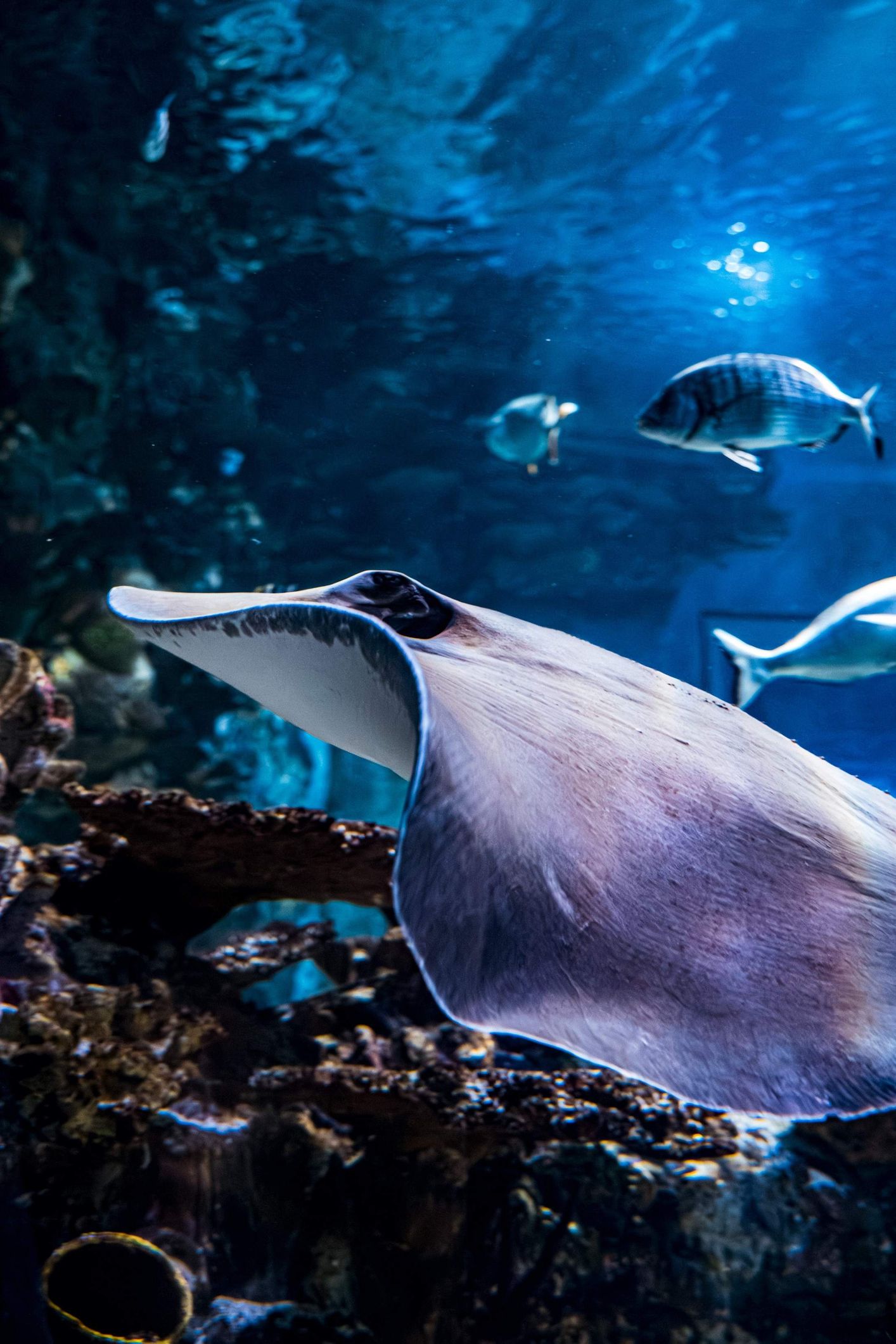
See them
in person too
Buy tickets
Frequently asked questions
When is the shark feeding?
On Mondays at 14:30 the sharks are fed from above, and on Thursdays at 14:30 by divers, in the shark aquarium. You can find the times of the other feedings on the Feedings and keeper talks page.
Can we come in bad weather or rain?
Yes. Tropicarium is a fully covered indoor attraction inside the Campona building, so you can enjoy it comfortably whatever the weather, in rain or cold.
How long does a visit take?
At a relaxed pace, 1.5–2 hours on average. If you want to catch a feeding or spend more time at the ray-petting pool, allow a longer visit.
Can I take photos?
For personal use, yes, but flash is prohibited because it disturbs the animals.
You will find answers to further questions on the FAQ page.