Wildlife of the Americas
From alligators to poison dart frogs — the most spectacular residents of the continent.
Visitor favourites
Click any of them and its description opens in the list below.
Residents of the Americas
62 species. Click a name for details.
Golden acaraAndinoacara rivulatusNot Evaluated
The golden acara is a robustly built cichlid, easily recognised by its metallic, shimmering scales and orange-edged fins. Older males often develop a small fatty hump on the forehead. It regularly roots through the substrate in search of food, eating small invertebrates as well as plant matter.
Golden doradoSalminus brasiliensisNot Evaluated
The golden dorado has exceptionally keen eyesight, which helps it track fast-moving prey in clear-water rivers. Its musculature is specialised for continuous swimming and sudden sprints. It often hunts alone, but can occasionally be seen in loose groups. Its powerful jaws let it take on fairly large prey. Only older fish are yellow; young ones have a greyish, silvery pattern.
Balsas splitfinIlyodon whiteiEndangered
In memory of Gilbert Percy Whitley
The Balsas splitfin is a small, live-bearing freshwater fish found in the rivers of western Mexico, primarily in the Balsas drainage system. It belongs to the highland splitfins (goodeids) and lives in clear, oxygen-rich water in its natural habitat. Its body is elongated and slightly flattened from the sides, and its colour is mostly greyish-silver. Its English name, “Balsas splitfin”, points to two features: “Balsas” refers to the Balsas river basin where the species is native, while “splitfin” refers to the males’ modified anal fin. This fin plays a role in reproduction and differs in shape from that of most other fish, which is one of the hallmarks of the group.
The “whitei” in the species’ scientific name comes from a personal name: the authors who named it were paying tribute to the Australian ichthyologist Gilbert Percy Whitley. He was a well-known fish taxonomist of the 20th century and took part in describing and classifying many fish species.
Green and black poison dart frogDendrobates auratusLeast Concern
Jewel of the forest
The green and black poison dart frog is one of the best-known poison dart frog species, instantly standing out from its surroundings with its vivid green, turquoise or bronze markings. Irregular patterns run across its black base colour, and they can differ from one individual to the next. Its striking colouring serves both as camouflage in a mossy setting and as a warning to predators. Despite its Hungarian name (“golden tree-climbing frog”), it comes in several colour variants.
A frog that is active by day, moving mainly across the forest floor or on lower plants. It hunts tiny insects and is especially fond of ants and termites. The species is an excellent climber, and its sticky-padded toes let it move easily over wet leaves and tree trunks.
The eggs laid by the female are often guarded by the male until they hatch. The parents may carry the tadpoles to smaller bodies of water, where their development continues. It is often kept in terrariums and zoos.
Mexican tetra (blind cave form)Astyanax jordaniLeast Concern
Cut off from the outside world
The blind cave tetra is a special form that evolved from a Mexican tetra species and is found in several isolated cave systems in Mexico. One of its most striking features is complete blindness: the eyes have disappeared entirely, since they serve no purpose in total darkness. At the same time, the fish’s other senses have become extraordinarily sharpened. Its lateral line system, which detects tiny vibrations in the water, is especially well developed, so the fish senses its surroundings by “touch”. Its sense of smell is also far more sensitive than that of surface-dwelling tetras, which helps it find food in complete darkness. Interestingly, the surface and cave forms are still able to interbreed. It is a scientifically important species: through this fish, researchers study how organisms lose traits that have become “unnecessary” (such as eyes), and how other senses grow stronger as they adapt to their environment.
Purple-edged goodeidZoogoneticus purhepechusVulnerable
One species, one aquarium
The purple-edged goodeid is native only to Mexico, in the clear, oxygen-rich waters of highland streams and lakes. Its habitat lies mainly in the river systems of the highlands of western and central Mexico, and researchers know of several separate populations of the species.
Like other highland splitfins (goodeids), it is a live-bearing fish. Males are smaller, slimmer, more brightly coloured and usually more intensely patterned, while females are larger and sturdier, especially when pregnant. This striking sexual dimorphism makes it easy to tell the sexes apart.
Its diet consists mainly of small invertebrates such as worms, aquatic insect larvae and small crustaceans, so the species leads a predominantly predatory lifestyle. It is not very peaceful: kept with other fish in an aquarium it can be prone to nipping fins, so most aquarists recommend keeping it in a single-species tank. In aquarium conditions it can live for 4–5 years, and it is relatively easy to breed if the water temperature, cleanliness and oxygen content are right. In its natural habitats, however, its numbers keep falling because of habitat loss, water pollution and introduced invasive species, so the species is becoming ever rarer in the wild, and it is not a common sight in zoos either.
False water cobraHydrodynastes gigasLeast Concern
The cobra that isn’t a cobra
The false water cobra is currently the only venomous snake species in the Tropicarium collection. It is a distinctly water-loving snake: it often occurs in swampy, floodplain areas and is an excellent swimmer. It also often gets its food in or near the water, preying on fish, amphibians and other small animals. False water cobras hunt both in the water and on dry land.
Although the species’ Hungarian name includes the word “cobra”, this animal is not actually a true cobra: it belongs to a family of rear-fanged colubrid snakes. It got its name because, when in danger, it flattens its neck and takes on a cobra-like appearance, trying to scare off predators that attack it. The animal’s venom is mainly a useful weapon for catching prey. Its venom fangs sit at the back of the upper jaw, and its bite is generally not dangerous to humans. It can cause local swelling and pain, but serious symptoms are rare. For this reason, under the legislation currently in force in Hungary it is not classed as a dangerous animal, no special permit is needed to keep it, and unlike with most venomous snakes, antivenom does not have to be available at the keeping site. It is sometimes kept as a companion animal, and several colour morphs have been bred in captivity. It is rare in European zoos, and as of March 2026 it was on display in Hungary only at Tropicarium.
Brazilian rainbow boaEpicrates cenchria cenchriaNot Evaluated
Scales with a rainbow shimmer
The Brazilian rainbow boa is one of South America’s most spectacular boa species. It lives mainly in tropical rainforests. It often travels on the ground, but can sometimes be seen on low branches too. Its movements are slow and cautious, and it waits patiently for its prey, which consists mainly of small mammals, birds and reptiles.
One interesting feature of the species is the “rainbow” shimmer that gave it its name: the skin’s tiny, glossy scales sparkle in sunlight or when lit by artificial light. It is worth knowing that there are several different rainbow boa species, whose colour, pattern and habitat can differ considerably; the Brazilian rainbow boa is medium-sized with a brown base colour and orangey and reddish markings, while other species can be brighter or darker in tone.
The Brazilian rainbow boa is essentially a nocturnal species, but can sometimes be active by day too. In terrarium conditions, its striking colouring provides excellent camouflage in the wild.
Brazilian salmon pink birdeaterLasiodora parahybanaNot Evaluated
The giant among spiders
The Brazilian salmon pink birdeater is the fourth-largest spider species in the world. Females are much larger and sturdier than males, and they also live longer. Despite its Hungarian name (“Brazilian giant bird spider”), it does not eat birds; its prey is mostly insects and other small animals. Its body is covered in dense, brownish hair, and its salmon-pink tint gives the species its English name.
When in danger it uses a characteristic defence: with its hind legs it flicks irritating hairs off its abdomen, which irritate the skin and mucous membranes of predators. If that is not enough, it adopts a threatening posture, raising its front legs and trying to scare off its opponent with its fangs. Although its appearance can be frightening, the species is generally not aggressive towards humans.
It lives on the ground, often building a simple burrow or using natural hiding places to shelter. It becomes active at night, slowly exploring its surroundings in search of prey. Its eyesight is relatively poor, so it finds its way mainly through ground vibrations and its sensitive hairs. It is a fast-moving tarantula that prefers to flee rather than attack when in danger. Its bite is relatively mild, roughly comparable to a wasp sting.
Females lay a large number of eggs in a silk cocoon, which they guard carefully. The tiny spiders that hatch start out in large numbers, but only a few reach adulthood. Young ones grow quickly, which is why the species is also popular among terrarium keepers.
Midas cichlidAmphilophus citrinellusNot Evaluated
Why is the Midas cichlid called “lemon”?
The Midas cichlid (Hungarian name: “lemon cichlid”) gets its name from its bright yellow or orange colouring, although wild specimens also include greyish and darker individuals. Captive breeding has produced many vivid colour variants. In the aquarium hobby it is a particularly popular, easily bred ornamental fish. Some of the bred varieties have a large, spectacular head crest. Males are often larger than females, and in old age the characteristic fatty hump on their forehead grows larger. This bump may play an important role in choosing a mate and establishing rank.
The Midas cichlid is an intelligent fish with highly territorial behaviour. It can be especially aggressive in the breeding season, fiercely defending its nest and young against its own kind and other fish. The parents carefully guard the eggs and then watch over the hatched fry for a long time. The advanced parental care typical of cichlids is easy to observe in this species too.
An omnivorous fish that in its natural environment eats smaller fish, invertebrates and plant matter. In an aquarium it is a hearty eater and fast grower, and needs a varied diet and a large tank. Like the oscar, it often rearranges the substrate and decorations in the aquarium.
The Midas cichlid is one of the best-known Central American cichlids. Its bright colours and spectacular behaviour make it a favourite with many aquarists. Under the right conditions it is a long-lived fish.
Striped leopard goodeidChapalichthys encaustusEndangered
The striped leopard goodeid is a small, live-bearing freshwater fish native to western Mexico, primarily the Lake Chapala drainage system. It belongs to the family of highland splitfins (Goodeidae). In its natural habitat it lives in shallower waters overgrown with vegetation. Its body is short and flattened from the sides, with a yellowish-silver base colour decorated with a darker, spotted and striped pattern.
Its Hungarian name (“striped leopard goodeid”) refers to the pattern on its body: the dark spots and bands recall a leopard’s coat, while the word “striped” stresses the lengthwise markings. Sexual dimorphism is easy to see in this species. Males are generally smaller and slimmer, with brighter colouring and a more contrasting pattern. Their anal fin is modified into what is called an andropodium, which plays a role in reproduction. Females, by contrast, are larger and fuller-bodied, especially when pregnant, and their colouring is more subdued. Their anal fin is not modified and stays rounded. The two sexes are therefore relatively easy to tell apart, and the differences are clearly visible not only in size but also in body shape and colouring.
The striped leopard goodeid is live-bearing, meaning the young develop inside the mother’s body and are born as fully developed fry. It is an omnivore: it eats algae, plant matter and small invertebrates. Its populations in the wild may be declining, which makes it an important fish from a conservation point of view as well.
A refuge for species
Highland splitfins (Goodeidae) are found only in the highland landscapes of Mexico, most of all around Michoacán. They are relatively small species, averaging 5–10 cm in size. Sexual dimorphism is clearly visible in most species: males are generally more colourful and more variegated, while females are less brightly coloured. These fish give birth to live young, just like some species that are well known as aquarium fish (e.g. swordtail guppies and platies). Sadly, the survival of the highland splitfins is threatened by a great many factors: the disappearance, destruction and drying-out of habitats, poor water management and water pollution all put them at risk. The KLG Goodeid Project is the first initiative in Hungary to protect and rescue the highland splitfins. Launched by a staff member of Kossuth Lajos Secondary School in Mosonmagyaróvár, the initiative has since been joined by many private individuals and Hungarian and foreign zoos, including Tropicarium in Budapest.
Striped Raphael catfishPlatydoras armatulusNot Evaluated
The striped Raphael catfish (Hungarian name: “striped grunting catfish”) is named for the light stripes running along its body and for its unusual sounds. When in danger or stressed, it can make grunting, creaking noises by moving its pectoral fins. Its body is protected by hard bony plates and sharp spines that make life difficult for predators. By day it usually hides under roots or stones, but at night it actively forages for food along the bottom. It is a peaceful, long-lived fish that can live for 15–20 years under the right conditions.
Barred sorubimPseudoplatystoma fasciatumNot Evaluated
This species is closely tied to sandy and muddy bottoms, where its pattern gives it excellent camouflage. Its barbels constantly pick up vibrations in the water and the movement of prey. It often waits completely motionless before attacking suddenly. In its natural habitat it is an important predator.
Painted wood turtleRhinoclemmys pulcherrima incisaLeast Concern
Aquatic or terrestrial?
The painted wood turtle is a Central American turtle species with a striking pattern. Its Hungarian name (“ornate land turtle”) comes from its distinctive, vividly patterned shell: the dark base colour is often decorated with reddish, orange or yellowish stripes and spots that form a slightly different pattern on every individual. This ornate look gives it a degree of camouflage among dry leaves, patches of shade and forest undergrowth.
The painted wood turtle is a species that is less tied to water. It spends most of its life on land. It likes bushy, shaded spots where the ground is damper and where it can find plenty of fallen fruit, insects or molluscs. When the weather is hot, it often retreats into shade, under leaf litter or into dense vegetation to avoid drying out.
Its diet is extremely varied. It eats various plant parts, such as fruit and fungi, but also insects, worms and snails, and sometimes even smaller vertebrates.
Females may lay eggs several times a year, usually 1–6 at a time. They bury the eggs in loose soil, where the developing embryos hatch in 2–3 months. In the first stage of their lives, newly hatched turtles are threatened by many predators: birds, mammals and larger reptiles. As a result, only a few young reach adulthood, but those that survive this period can live for 20–30 years.
The painted wood turtle is an essentially peaceful, calm animal. Because of this, and its attractive appearance, it is a popular companion animal. Although it is not currently considered an endangered species, habitat destruction, deforestation and the illegal pet trade may in places reduce the survival of its populations.
DiscusSymphysodon aequifasciatusNot Evaluated
The discus is one of the best-known South American ornamental fish, named for its flat, disc-shaped body. It is a calm, shoaling fish that reacts sensitively to changes in water quality. Its reproduction is especially interesting: in the first period of their lives, the hatched fry feed on the mucus layer produced on their parents’ skin. Most of its colour variants were developed through aquarium breeding. It is a much-loved aquarium fish, but relatively pricey and difficult to keep.
Dyeing poison dart frogDendrobates tinctorius “citronella”Least Concern
A natural source of dye
The “citronella” colour variant of the dyeing poison dart frog is known for its bright yellow and black pattern, which warns predators from afar of its toxic skin secretions. The species’ name comes from the fact that some South American indigenous peoples once used the frog’s secretion to alter the colour of parrot feathers.
A robustly built, ground-dwelling frog that is active by day. It can often be seen foraging among leaf litter or covering its territory in short hops. Males can be territorial and communicate with each other using soft, chirping calls.
When breeding, the female lays her eggs on a damp surface, which the male keeps regularly moist. The parents may carry the hatched tadpoles to smaller bodies of water. Thanks to its bright colour and active behaviour, it has become one of the best-known terrarium frog species in the world.
Pacu (fruit-eating piranha)Colossoma macropomumLeast Concern
Predator or herbivore?
The pacu, also known as the fruit-eating piranha, has a lifestyle and diet that differ considerably from those of the well-known predatory piranhas. Its body is tall and flattened, and its powerful jaws hold special teeth somewhat reminiscent of human teeth. These are excellently suited to cracking hard seeds and fruit.
The pacu mainly eats plant-based food. In the Amazon region, during the rainy season it often swims into the flooded forests, where it feeds on falling fruit and seeds. It plays an important role in dispersing the seeds of rainforest plants. Occasionally it also eats smaller invertebrates and fish. The pacu is generally a peaceful fish. Because of its powerful bite, however, anglers and fishermen have to handle it with care. In aquarium conditions, its large size and fast growth mean it can only be kept in a very spacious tank. It is often a problem for pet keepers when pacus kept as house pets outgrow their home aquariums.
Young specimens often live in shoals, which protects them from predators. Older individuals can be seen both alone and in groups. Their body colour is usually dark grey or black, with a lighter shade on the underside. Some young specimens have a reddish belly, a trait reminiscent of red-bellied piranhas.
The pacu is an economically important fish species in South America. Its meat is eaten in many places, and it is also farmed in fish farms.
River cooterPseudemys concinnaLeast Concern
The new favourite pet
The river cooter (Hungarian name: “hieroglyph slider”, also known as the “map turtle”) is one of the most beautiful and best-known North American freshwater turtles. Its Hungarian name comes from its distinctive shell pattern, which often resembles hieroglyphs made up of tiny lines and markings. Its shell is mostly olive-green or brownish, decorated with yellowish, orangey or pale green patterns. Lengthwise yellow stripes run along its head and neck, and its lower shell is a lighter shade, often speckled with darker spots. Young turtles are especially vividly coloured, but older ones gradually lose the brightness of their pattern over the years.
Its natural habitat consists mainly of slow-flowing rivers, lakes, swampy areas and shallow-water habitats. It is an excellent swimmer and spends most of its time in the water, but regularly climbs out to bask on fallen logs, rocks or waterside vegetation. In terms of diet, it is an omnivore. It eats various aquatic plants, algae, pondweeds and softer plant parts, but also insects, worms, snails, fish, small crustaceans and carrion. Young specimens eat more animal-based food. As is typical of other sliders and cooters, females are larger. The claws on the front legs of adult males are much longer than those of females. During the breeding season, females lay their eggs near the water’s edge in pits dug into sunny, loose soil. A clutch usually contains 10–25 eggs.
In recent decades the river cooter has become a popular companion animal. In Europe it is far rarer than the red-eared slider, but this species too is occasionally kept as an ornamental pet. Since selling red-eared and yellow-bellied sliders in pet shops was banned, the river cooter has become one of the species that took their place.
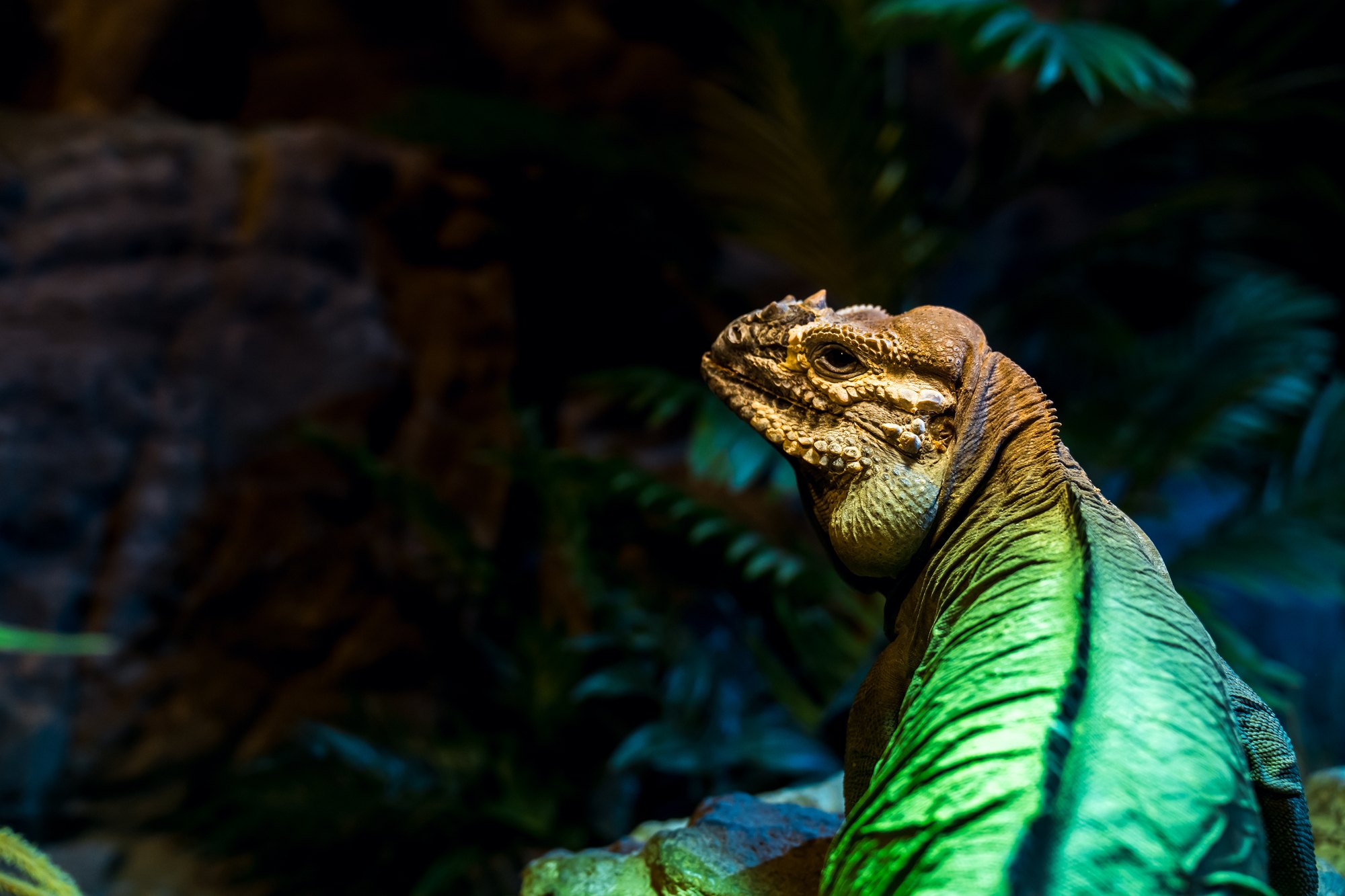
Hispaniolan rhinoceros iguanaCyclura cornutaEndangered
Island iguanas
Several different species of ground iguana are found on the islands of the Caribbean. The ancestors of these animals probably reached the islands from Central and South America. Almost every island has its own iguana species, which differ somewhat from one another in appearance and size outside their ranges. Of these, the Hispaniolan rhinoceros iguana is the largest.
The species’ Hungarian name (“rhinoceros iguana”) comes from the horn-like growths on top of its snout. These growths are especially well developed in males. Males are larger and sturdier than females. With their strong limbs and long claws they move well over rocky, dry terrain and are also skilled at digging burrows. Although rhinoceros iguanas are essentially herbivores, they cannot afford to be picky in their harsh habitat. They eat almost any plant-based food, and sometimes supplement their diet with animal protein. Young ones eat many insects, and adults sometimes eat carrion too. They like fruit, leaves, flowers and various shoots. They also play an important role in dispersing seeds.
The Hispaniolan rhinoceros iguana is active by day and spends most of its time basking, as that is how it regulates its body temperature. During the hottest hours it often retreats into rock crevices, under bushes or into underground burrows.
Females lay their eggs in sandy or loose-soiled places. It is an endangered animal, and its survival is threatened by the illegal collection and consumption of its eggs as well as by shrinking habitats. In addition, introduced predators such as dogs, cats and mongooses pose a serious threat, especially to young animals and eggs.
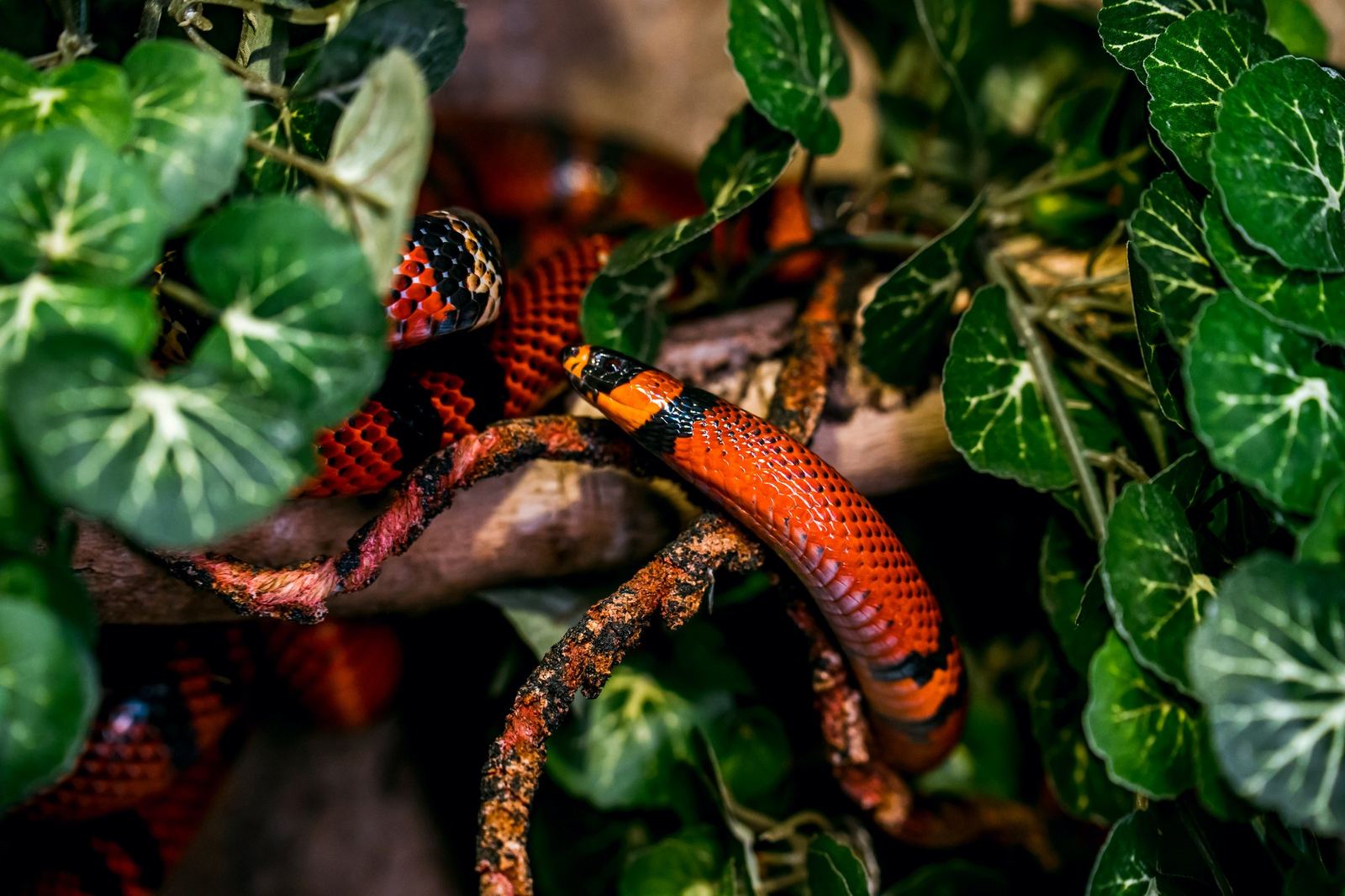
Honduran milk snakeLampropeltis triangulum hondurensisNot Evaluated
The art of deception
One of the most interesting traits of the Honduran milk snake is that, although it has no venom of its own, in appearance it mimics other, venomous snake species, mainly various coral snakes. Predators often avoid it, since the red-black-yellow colour combination signals danger. Mimicry is especially important in wooded and scrubby habitats, where predators quickly recognise the characteristic pattern of venomous species. With a little practice, however, we can easily tell apart the patterns of snakes with a venomous bite and harmless ones.
There is also a North American children’s rhyme that helps tell venomous and harmless snakes apart: “Red touches yellow, kills a fellow; red touches black, venom lack.” The rhyme itself probably spread in Hungarian-speaking areas around the turn of the 19th and 20th centuries, for educational purposes.
In captivity, the Honduran milk snake has been bred in several colour morphs. At Tropicarium you can see specimens with both red-black-yellow and red-black-white patterns. There are also melanistic and partially albino individuals: in the former, dark colours dominate the pattern, in the latter, light ones.
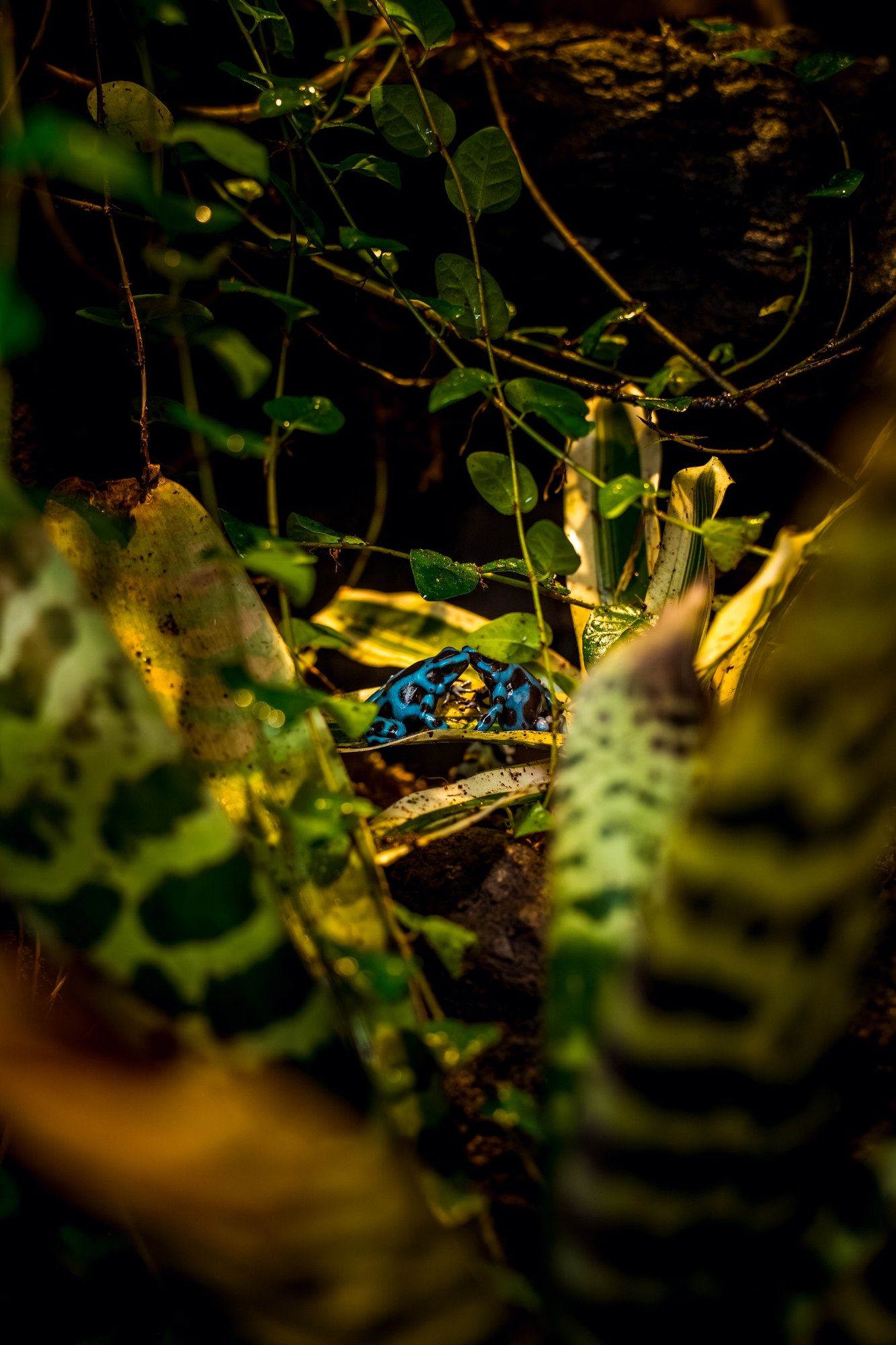
Blue poison dart frogDendrobates tinctorius azureusLeast Concern
One of the best-known frog species
The blue poison dart frog is a variant of the dyeing poison dart frog. Thanks to its extraordinary, bright blue colour, it is one of the best-known frogs in the world. Its body is covered in dark spots that form a unique pattern on every individual, much like human fingerprints. In the wild, its striking colour is an unmistakable warning to predators.
This species moves mainly across the forest floor, but is also an excellent climber on roots and lower plants. It is active by day and constantly searches for tiny insects. Because of its relatively small range, it can be sensitive to changes in its habitat.
The blue poison dart frog is also very popular in terrariums, as it is active by day and easy to observe. In a suitable environment it breeds regularly, and the parents also take part in caring for the tadpoles.
Bronze corydorasCorydoras aeneusNot Evaluated
The bronze corydoras is a bottom-dwelling, shoaling fish and one of the best-known armoured catfish. It uses its barbels to search the substrate for tiny bits of food. Through its intestine it can also take in atmospheric oxygen, so it occasionally swims up to the surface to gulp air. Thanks to its peaceful nature, it is one of the most widespread aquarium catfish species, the “jack of all trades” of the aquarium.
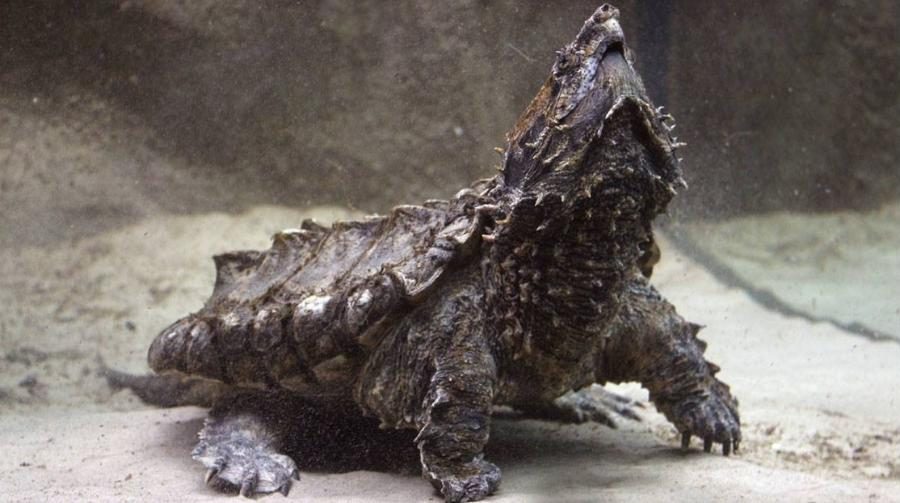
Alligator snapping turtleMacrochelys temminckiiVulnerable
A “beak” just like a vulture’s
The alligator snapping turtle is one of the largest freshwater turtle species in the world, living in areas connected to the Mississippi river system. Its Hungarian name (“vulture turtle”) comes from the horny sheath around its mouth, which resembles a vulture’s beak. Some gigantic specimens can have a shell more than 80 cm long and weigh over 100 kg. These giants can even catch waterbirds, larger rodents or young alligators. It is a sluggish, heavy-moving animal that spends almost its entire life underwater, often waiting motionless on the riverbed. Only females come ashore, to lay eggs. Its shell is strongly ridged and rough-surfaced, often overgrown with algae, which provides excellent camouflage in murky water. A special distinguishing feature of the species is the so-called supramarginal scute. This is an extra row of scutes on the side of the shell, above the marginal scutes. Of the turtles alive today, only alligator snapping turtles have this type of scute. That makes it one of the most important features by which the alligator snapping turtle can easily be told apart from other turtle species, such as the common snapping turtle (Chelydra serpentina).
One of the alligator snapping turtle’s most remarkable hunting tools is the red, worm-like appendage on its tongue. While lying motionless on the riverbed with its mouth open, it wiggles this tongue appendage to lure curious fish close. When the prey swims close enough, it snaps its extremely powerful jaws shut in a flash. Its bite is so strong that it can easily crush a turtle shell or thick bones. It can even bite off a human finger.
It feeds mainly on fish, but more rarely catches larger prey too, and also eats carrion. Although it is a fearsome predator, it mostly leads a secretive life and only rarely comes into contact with people. Individuals that have climbed onto land, however, are far more irritable, as they feel less safe there.
Females lay their eggs on sandy or loose-soiled banks. The hatched little turtles are independent from the start, but many predators threaten them when young. The species grows slowly and reaches sexual maturity late, so populations recover only with difficulty.
It used to be a popular companion animal, but its powerful bite makes it a particularly dangerous animal, capable of causing serious injuries to humans. For this reason, in Hungary it may only be kept in zoos. In its natural habitats, overhunting, water pollution and shrinking habitats may threaten the survival of its populations in the long term.
Colombian tetraHyphessobrycon columbianusNot Evaluated
The Colombian tetra is a fast-moving, shoaling characin. Its bluish, shimmering body and reddish fins make it especially spectacular when kept in a larger group. Because it is constantly on the move, it needs plenty of swimming space. In the wild it mainly eats tiny insects and planktonic organisms.
Common bristlenose catfish (Anci)Ancistrus sp.Not Evaluated
Ancis are among the best-known algae-eating catfish in the aquarium hobby. Males develop characteristic leathery outgrowths on their heads, known as “tentacles”. With their sucker-like mouths they scrape the algal film off stones and branches. They lead a secretive life, often resting by day under roots or in hiding places. In aquarium conditions several colour variants have been bred. At Tropicarium you can see normally coloured and golden ancis.
Cuban boaChilabothrus anguliferLeast Concern
ESB/European Studbook Programme
The giant snakes of Cuba
The Cuban boa is one of Cuba’s largest snake species. It lives mainly in tropical and subtropical forests and scrubland, where it moves along the ground, though its young often climb trees to avoid predators. It generally moves slowly and cautiously and waits patiently for its prey: it hunts smaller mammals, birds and lizards.
Cuban boas are usually brown or greyish brown with various markings, which blend in well with forest leaf litter and scrubby undergrowth, so the snake goes unnoticed by predators and prey alike. Interestingly, several boa species occur in Cuba, most of them smaller, tree-dwelling species. The Cuban boa is considered large among Cuban snakes: its body length can reach as much as 3 metres. These larger, more sluggish specimens climb trees only relatively rarely.
The Cuban boa does not lay eggs; they develop inside the mother’s body. The gestation period is about 5–6 months, and a litter contains 10–30 young. Young snakes are slightly paler than adults.
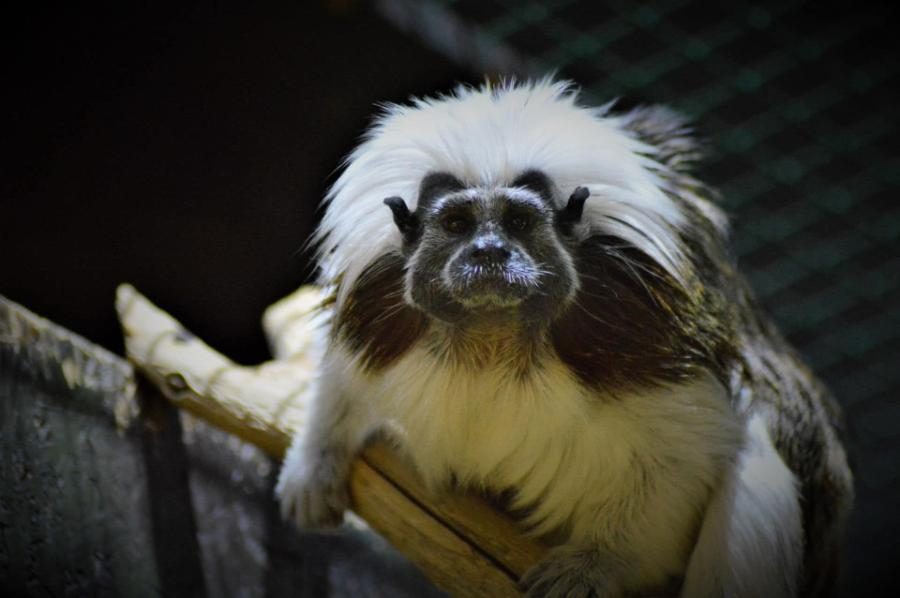
Cotton-top tamarinSaguinus oedipusCritically Endangered
Why is the cotton-top tamarin called the “Liszt tamarin” in Hungarian?
The cotton-top tamarin, known in Hungarian as the Liszt tamarin (also woolly-headed tamarin or Liszt monkey), is a tiny South American monkey species that is easy to recognise by its distinctive, long, white head fur. This characteristic “hairstyle” reminded those who named it of the hairstyle the composer Franz Liszt wore in his later years, which is where the animal’s Hungarian and German names come from. Its body is slim and its tail long, but not suited to gripping. Its face is dark, made even more striking by the white tuft of hair.
The cotton-top tamarin lives only in the forests of northern Colombia and is one of the primates with the smallest ranges. Its habitats are mainly tropical rainforests, riverside gallery forests and secondary woodland. In recent decades, much of its natural habitat has disappeared because of logging, road building and agricultural expansion. As a result, the species’ population has fallen drastically, and today it is a particularly strictly protected species among conservationists. In the past, the illegal animal trade also posed a serious threat to its survival, as many individuals were captured for use as pets or for research.
The cotton-top tamarin is an extremely social animal. It generally lives in family groups of 4–15 individuals, whose members are closely bonded. Only the parent pair can breed in the group; the other members are most often the pair’s offspring. Newborns are cared for not only by the mother but also by the father and older siblings. Often the father carries the young on his back, handing them to the mother only for nursing. Twins are almost always born; single young and triplets are rare.
The species’ diet is varied: it mainly eats fruit, insects, spiders and nectar, but may also prey on small lizards, frogs or bird eggs. Apart from its big toes, its digits bear claws rather than nails. With its sharp claws it easily searches the crevices of branches and hiding places among leaves for food. The cotton-top tamarin is active by day and spends most of its time foraging. Today many conservation programmes work to save the species, not only in Colombia but worldwide. European zoos keep and breed the species in a coordinated way, within the European endangered species breeding programme.
Lyons’ goodeidXenotoca lyonsiCritically Endangered
A world first at Tropicarium
Lyons’ goodeid is found only in Mexico, in the clear, highland waters of the Coahuayana drainage system. Its wild populations are dwindling because of habitat change and water pollution, so protecting the species is especially important.
Males are smaller and more brightly coloured than females: their bodies are generally in brighter shades of red, orange or gold, and coloured stripes are visible under the tail and on the anal fin, which makes them especially eye-catching. Females, by contrast, are larger and fuller-bodied, with more subdued silvery or greyish colouring, so they are easy to tell apart from males.
The species’ scientific name, “lyonsi”, refers to the American fish biologist Paul Lyons, who played an important role in the discovery of the species and in research on Mexican highland splitfins.
The species was only officially described in 2016. Lyons’ goodeid is extremely rare in zoo collections: in April 2025 only three zoos in the world kept it, and in Hungary it could be seen only at Tropicarium, where this species was shown to the general public for the first time in the world.
Sailfin mollyPoecilia veliferaNot Evaluated
One of the most striking features of the sailfin molly is the males’ huge, sail-like dorsal fin, which is especially spectacular during courtship. It is a peaceful, social fish that often lives in larger groups. In its natural habitat it plays an important role in eating algae, thereby helping maintain the balance of shallow waters. The species is live-bearing, meaning females give birth to fully developed fry. It is a popular aquarium fish, and countless colour variants have been bred.
Marbled hatchetfishCarnegiella strigataNot Evaluated
The marbled hatchetfish is known for its distinctive body shape, which from the side resembles the shape of a hatchet. Its breast muscles are extremely well developed, so when in danger it can leap out of the water and then glide short distances through the air. It lives near the water’s surface, where it mainly eats insects that fall onto the water. It moves in shoals, and because of its peaceful behaviour it is often kept in community aquariums. When keeping it in an aquarium, however, you need to make sure it cannot jump out of its habitat.
OscarAstronotus ocellatusNot Evaluated
A marbled-pattern aquarium predator
The oscar is a large South American fish of the cichlid family. Thanks to its powerful build, large head and mouth relative to its body, and striking pattern, it is one of the best-known and most popular predatory aquarium fish. Its base colour is usually dark brown or black, decorated with reddish, orange or marble-like patches. Many colour variants have been bred in aquarium conditions.
Its Latin species name, ocellatus, refers to the eyespot near the tail fin. This pattern can fool predators, as from a distance it can resemble the eye of a larger animal. The oscar is considered an intelligent and curious fish. It often recognises its keeper and may even take food from the hand. At the same time, it can show strongly territorial behaviour, especially in the breeding season. This can make it hard to keep with other species. Because of its large size and powerful jaws, it can only be kept in a shared aquarium with similarly robust fish. Its diet is varied: in its natural habitat it eats smaller fish, insects, aquatic invertebrates and, more rarely, plant-based food. In an aquarium it is known as a hearty eater, so it can easily become obese if given too much food. Because it digs and landscapes its surroundings so vigorously, it often rearranges the aquarium’s decorations and turns over the substrate.
The oscar is one of the most popular large cichlid species in the aquarium hobby. Keeping it, however, requires a large tank and good water quality. Under the right conditions it can be a long-lived and spectacular ornamental fish that breeds relatively easily in aquarium conditions.
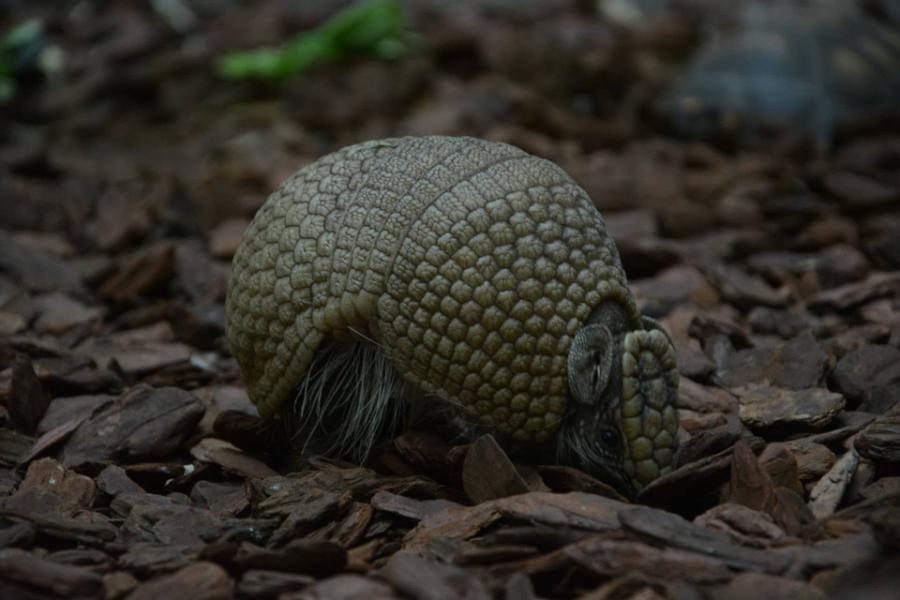
Southern three-banded armadillo (matako)Tolypeutes matacusNear Threatened
The living bowling ball
The southern three-banded armadillo is one of the few armadillo species able to roll up into a completely spherical ball. Its armour consists of three movable bands, which is where the animal’s Hungarian name (“three-banded armadillo”) comes from. When in danger, it pulls its head and limbs fully in, and the armour plates close tightly together, forming a hard, almost unbreakable “ball”. This defence strategy differs from that of most armadillos, which prefer to dig themselves into the ground or run away. Because when rolled up it looks a little like a bowling ball, the animal’s German name (“Kugelgürteltier”) comes from this.
The species is primarily insectivorous, although it may supplement its diet with other animals and plants. It mainly eats ants, termites and other tiny invertebrates. With its long, sticky tongue it easily pulls prey out of tunnels. Its sense of smell is excellent, but its eyesight is poor, so it finds its way mainly by scent. With its strong claws it can break open termite mounds and rotting logs. Unlike most armadillo species, it does not dig deep, complex burrow systems. It prefers to use burrows abandoned by other animals, or hides in dense vegetation. Although it can dig, its lifestyle is less “underground” than that of other armadillos. During the hot daytime hours it mostly hides, and only sets off to look for food in the cooler evening hours.
They are essentially solitary animals. Three-banded armadillos do not form groups and only seek each other's company during the mating season. Only the female and her young stay together for any length of time. Three-banded armadillos mark their territory with scent, but generally do not defend it aggressively against others of their species. After mating, the mother usually gives birth to a single young. The baby's armour is still soft at birth and only hardens gradually. The young grow quickly and are independent at just a few months old.
The species' natural enemies include larger predatory mammals and birds of prey, but thanks to their special defence technique, adults are hard to catch. In the wild, however, shrinking habitats and illegal capture pose a growing threat to the survival of three-banded armadillos.
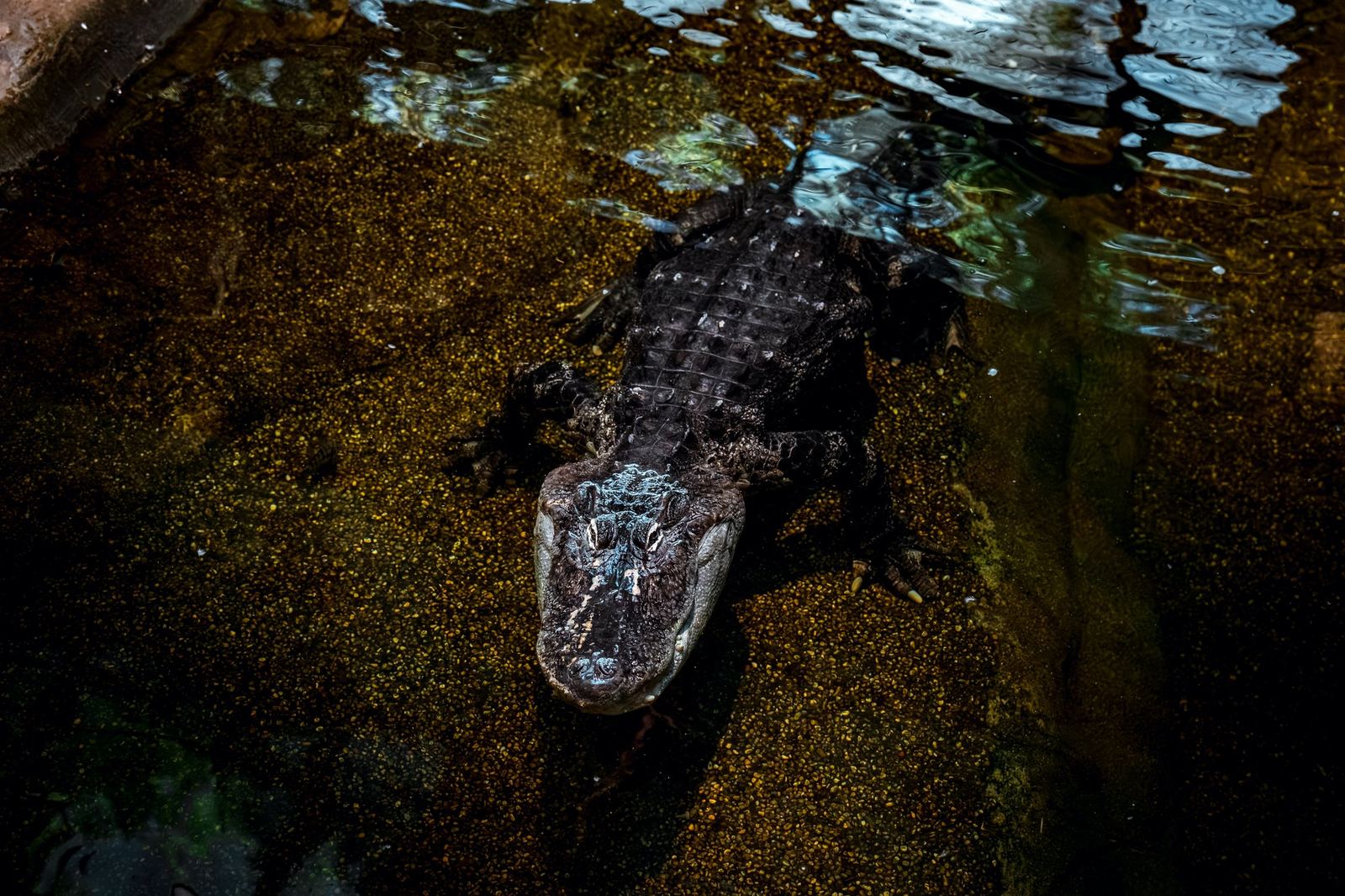
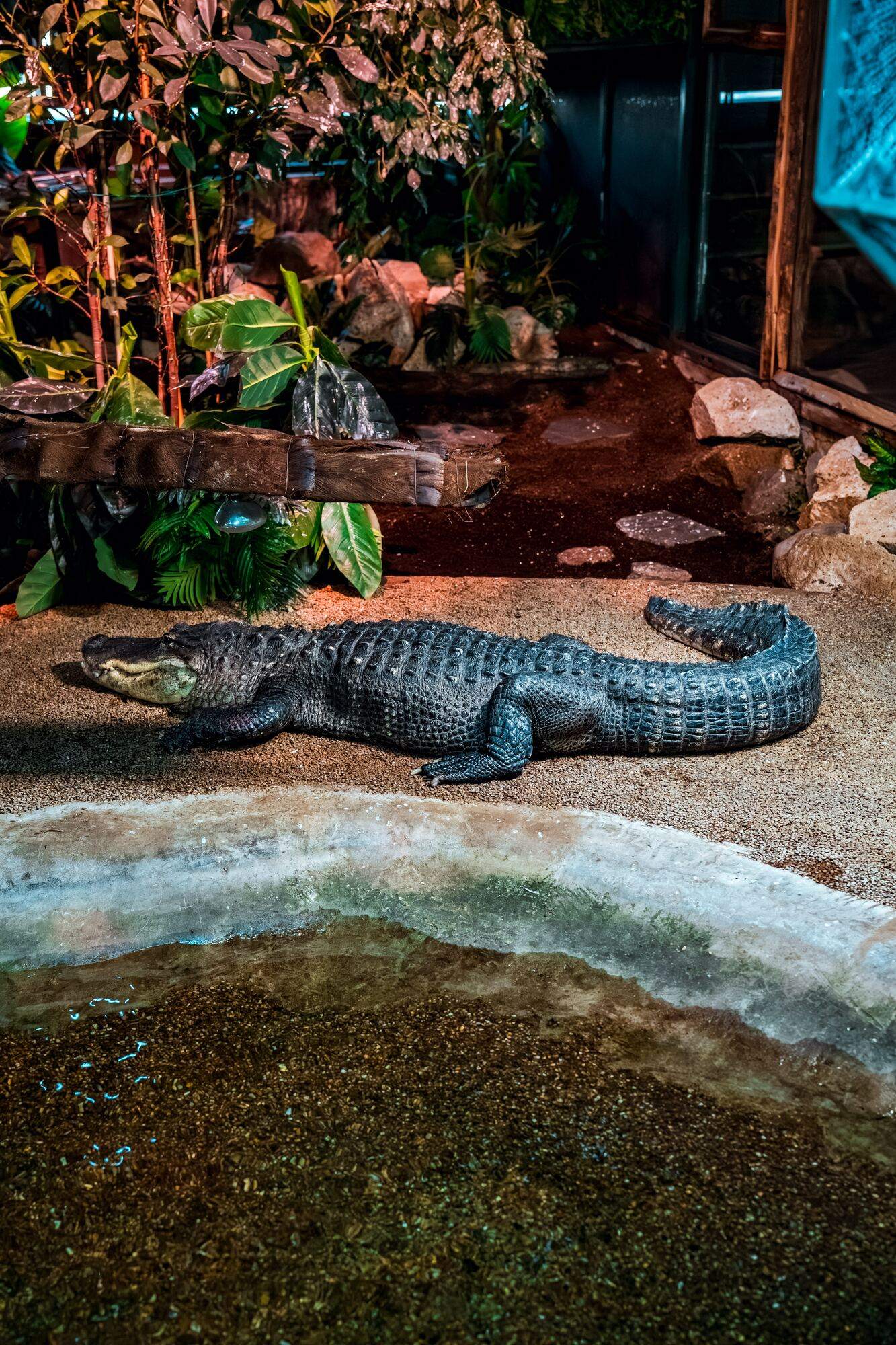
American alligatorAlligator mississippiensisLeast Concern
Crocodile or alligator?
Although the two groups of animals look very much alike, alligators are not true crocodiles. The alligator family is, however, closely related to the crocodile family, and there are several visible differences between them. An alligator's head is wider and U-shaped, while a crocodile's is narrower and V-shaped. With the mouth closed, an alligator's lower teeth are hidden, whereas a crocodile's are visible, especially the large fourth tooth.
Only two species of alligator are alive today: the Chinese alligator and the American alligator, also known as the pike-snouted alligator, of which the American is the larger. Males are bigger and sturdier than females and can reach a body length of 4.5 metres, occasionally even more. Most of the total length is made up by the tail. Alligators are well adapted to life in water: their eyes, nostrils and ears sit on the top of the head, so most of the body can stay submerged. They use their powerful tails for swimming and, less often, for defence.
They are predators and will eat almost anything they can catch. Young animals feed mainly on insects, small fish and frogs, while adults can take larger prey such as waterfowl, turtles or mammals. They grab their prey with their powerful jaws, but cannot chew with their teeth.
Young animals are more brightly coloured than adults. Among captive animals, albino and black-and-white patterned individuals are also known, which do not occur in the wild. During courtship and territory marking, male alligators produce a deep, bubbling bellow that can be heard from hundreds of metres away. Females lay their eggs in a nest built of plant material and guard it throughout incubation. After hatching, the young are protected by their mother during their first period of life. Adult alligators can be dangerous to humans, but they rarely attack people unless provoked.
Nelson's sliderTrachemys venusta nelsoniLeast Concern
A Central American slider species
Nelson's slider is a particularly beautiful, strikingly patterned member of the Central American sliders. It is named after the American naturalist Edward Nelson. Its appearance is spectacular: the shell is dark green or brownish, decorated with bright yellowish and orange markings. Thin yellow stripes run along the head and neck, and the lighter underside is often dotted with orange or reddish spots. Young animals are especially vividly coloured, while older ones gradually lose the brightness of their pattern over the years. Its natural habitat consists of lakes, slow-flowing rivers, swampy areas and shallow waters. Nelson's slider is an excellent swimmer and spends most of its time in the water, but regularly climbs out to bask on logs, rocks or vegetation along the shore. Basking plays an important role in regulating its body temperature and keeping it healthy. In warmer periods it often sunbathes for many hours. If danger threatens, it escapes into the water.
Its diet is varied. It eats aquatic plants, algae, insects, worms, snails, tiny crustaceans, small fish and carrion. Young animals are more carnivorous, as they need more protein to grow. In older turtles, plant-based food gradually plays a bigger and bigger role. During the breeding season, females lay their eggs in pits dug into sunny, loose soil near the water's edge. A clutch usually contains 10–20 eggs. The baby turtles hatch after roughly 70–90 days.
In recent decades, Nelson's slider has also become increasingly popular as a terrarium pet. Thanks to its colourful looks and relatively calm behaviour, it has been exported to many countries. Although it is far rarer in Europe than the red-eared or yellow-bellied slider, this subspecies is occasionally kept as a hobby animal too. Specimens released into the wild can cause problems, however, because as a non-native species they may displace the European pond turtle from its habitat. In Hungary, Nelson's slider is not yet considered an invasive species, so it can also be bought in pet shops.
Jack DempseyRocio octofasciataLeast Concern
The Jack Dempsey gets its name from the iridescent blue-green spots on its dark body. It is a powerfully built, dominant cichlid that defends its territory fiercely. In its natural habitat it eats small fish, insects and crustaceans. Its English name comes from the American boxer Jack Dempsey, because of its aggressive behaviour. In addition to the normal colour form, Tropicarium also has the paler, blue-coloured Blue Dempsey.
Suckermouth catfish (Pleco)Hypostomus plecostomusNot Evaluated
Why is it called a pleco?
Hypostomus plecostomus is one of the best-known algae-eating catfish, which aquarists simply call a “pleco”, a shortened form of the animal's scientific name. Its body is covered in hard, armour-like plates, and its modified mouth has evolved into a sucker-like organ. With it, the fish clings to stones, roots or, in captivity, the aquarium glass, and scrapes off algae and other organic deposits.
As a youngster the pleco is a small, attractively patterned algae eater, but under the right conditions it grows quickly. As an adult it becomes a large, powerfully built fish, so it can only be kept long-term in a spacious aquarium. Aquarists often struggle to rehome specimens that have outgrown their tank, and the plecos living in Tropicarium came to us this way. It is a strong swimmer and a surprisingly good digger, so it often shifts aquarium decorations or uproots plants from the substrate.
The species is mainly active at night. During the day it likes to hide under stones, roots or in crevices. In its natural habitat it often lives near drifting branches and roots, since the fibres of rotting wood play an important role in its digestion. Its hard armour gives good protection against predators. Its food is mainly plant-based. Besides algae, plant remains and decaying organic matter, it may also eat small invertebrates, and even carrion. In an aquarium a varied diet is important for it, which we can provide with vegetables and algae-based fish food. For animals kept in an aquarium, it is also worth offering a sufficient number of hiding places.
Giant mountain splitfinAlloophorus robustusVulnerable
A rare predator among the highland splitfins
The giant mountain splitfin is one of the largest highland splitfins. It lives in the high-altitude waters of Central America, where the water is cooler and richer in oxygen than in lowland habitats. It is well adapted to these conditions: its robust body and relatively slow metabolism help it survive in the changeable mountain environment. Females are larger and sturdier than males, which are slimmer and less conspicuously coloured. Although most highland splitfins are essentially herbivorous, the giant mountain splitfin is a predator, feeding on water insects, worms and small fish. It moves slowly, usually waiting for prey hidden among aquatic plants and hovering motionless, then strikes at a suitable moment like a tiny pike. It also happily devours smaller members of its own species.
It is a live-bearing species, and after birth the young seek shelter among the plants to escape the voracious adults. Interestingly, despite its size and predatory nature, it is surprisingly tolerant of more crowded aquarium conditions, and the species is long-lived: in favourable conditions it can live for more than 10 years. During the breeding season, males display particularly spectacular behaviour: their colouring becomes more intense and they actively defend their territory against other males.
Giant hatchetfishThoracocharax stellatusNot Evaluated
The giant hatchetfish's distinctive, deep-chested body shape is adapted to life near the water surface. It is a close relative of the hatchetfishes. With its huge chest muscles it can leap out of the water when in danger, and can even glide for a short distance. It usually swims just below the surface, where it catches insects that fall onto the water. It is a shoaling fish that best shows its natural behaviour when kept in a larger group.
Orinoco sailfin catfishPterygoplichthys multiradiatusNot Evaluated
The Orinoco sailfin catfish is easily recognised by its armour-like body and its huge, sail-like dorsal fin. With its sucker-like mouth it can attach itself to stones or driftwood while feeding on algal films and organic debris. Animals kept in aquariums also cling to the glass. Its strong armour plates give it good protection against predators. It copes well in oxygen-poor waters, as to a certain extent it can also take oxygen from the air. In an aquarium it plays a significant role in keeping the substrate and surfaces clean.
Lake Pátzcuaro axolotlAmbystoma dumeriliiCritically Endangered
The one that stays a child for life
This salamander species is native only to Lake Pátzcuaro in Mexico. In the wild it is already threatened with extinction, with its population estimated at just a few hundred individuals. It is a close relative of the well-known Mexican axolotl (Ambystoma mexicanum), often kept as a pet, and leads a similarly remarkable lifestyle. The Lake Pátzcuaro axolotl keeps the features typical of salamander larvae throughout its life. This means that adults have long, densely branching external gills and a fin fringe, just like young animals, thanks to the species' characteristic so-called neotenic way of life.
Interestingly, in the wild, special environmental conditions are needed for it to become an adult (metamorphosis): water temperature, oxygen levels and hormonal signals all influence whether the larva transforms into a land-dwelling salamander. However, the vast majority of Lake Pátzcuaro axolotls keep their larval form throughout their lives, so transformation is rare. It often happens only through artificial intervention, under laboratory conditions.
Interestingly, axolotl species have an extraordinary ability to regenerate: they can regrow lost limbs, a heart and even brain tissue. Because of their neotenic way of life and regenerative ability, the Mexican axolotl, far more commonly kept in aquariums, is also an especially important species for scientific research.
The Lake Pátzcuaro axolotls living in Tropicarium arrived at our zoo as part of a conservation breeding programme called Citizen Conservation. We were the first in Hungary to present this fascinating species.
Ram cichlidMikrogeophagus ramireziNot Evaluated
The ram cichlid, also known by its nickname “ramirezi”, is a small, brightly coloured cichlid that is especially popular in the aquarium hobby. Males are generally more colourful and have larger fins than females, and they are also larger in size. It is a peaceful species, but during breeding it fiercely protects its eggs and young. In its natural environment it feeds on tiny invertebrates and organic debris.
Red-head Tapajos cichlidGeophagus sp. “Tapajos Red Head”Not Evaluated
The red-head Tapajos cichlid is one of the so-called “eartheater cichlids”. While feeding, it takes sand into its mouth and sifts out tiny invertebrates and organic debris. The reddish-orange colouring of its head is especially striking on dominant males. It is a fairly peaceful species that feels safe in smaller groups.
Redstriped eartheaterGeophagus surinamensisNot Evaluated
The redstriped eartheater is a calm, elongated fish. True to its name, it constantly sifts through the substrate in search of food. Reddish and turquoise markings can be seen on its sides, which can look especially vivid in the light. When breeding, it shows mouthbrooding behaviour.
Largemouth bassMicropterus salmoidesLeast Concern
An American newcomer in Hungarian waters
The largemouth bass is a medium-sized predatory fish that was introduced to Hungary mainly for angling. Its original home is North America, where it lives in clear, cool lakes and rivers. Its body is usually olive-green with dark spots along the sides, and its fins often have a slightly reddish tinge. A voracious predator, its diet consists mainly of smaller fish, water insects and molluscs. Young fish often swim in large shoals, while older ones lead a more solitary life. The largemouth bass is especially popular among anglers, as its lively movement and strong bite make it a favourite catch.
Salvin's cichlidCichlasoma salviniLeast Concern
The fish species known as Salvin's cichlid is famous for its vivid yellow, red and black pattern, which is especially striking on adults. In its natural habitat it eats small fish, insects and invertebrates. The species is strongly territorial and becomes aggressive especially during the breeding season. Its parental care is well developed: the pair jointly guard and shepherd the fry.
Yellow-bellied sliderTrachemys scripta scriptaLeast Concern
The stand-in for the red-eared slider
The yellow-bellied slider belongs to the same species as the red-eared slider; it is simply a different subspecies. After its red-eared relative, it is one of the best-known sliders. Its Hungarian name refers to the bright yellow stripes on the sides of its head, which stand out clearly against its darker base colour. Its shell is olive-green or brownish with yellowish markings, which are especially striking in youth and fade in older animals. The yellow-bellied slider's natural habitat is the south-eastern part of North America, where it lives in lakes, slow-flowing rivers, swamps and other shallow waters. An excellent swimmer, it spends most of its time in the water, but regularly climbs out to bask on fallen tree trunks, rocks or shoreline areas. Basking is an important activity for it, as it helps regulate its body temperature.
Its diet is extremely varied. It eats aquatic plants, algae, insects, worms, snails, small fish and the remains of dead animals. Young animals lead a more predatory life, while plant-based food plays a larger role in the diet of older ones. Like the red-eared slider, females can lay eggs several times a year. The eggs are usually placed in pits dug into sunny, loose soil near the water's edge. Incubation time and lifespan are the same as described for the red-eared slider.
The yellow-bellied slider was a popular terrarium pet for a long time, so many specimens were brought to Europe too. It was once very popular in Hungary as well. When pet shops were banned from selling red-eared sliders, the yellow-bellied slider stood in for its red-eared relative for a while. However, yellow-bellied sliders released into the wild have settled in several places and, like the red-eared ones, are considered an invasive species that may endanger native wildlife. Today the yellow-bellied slider also occurs in Hungary's natural waters. Trade in this subspecies is now prohibited as well.
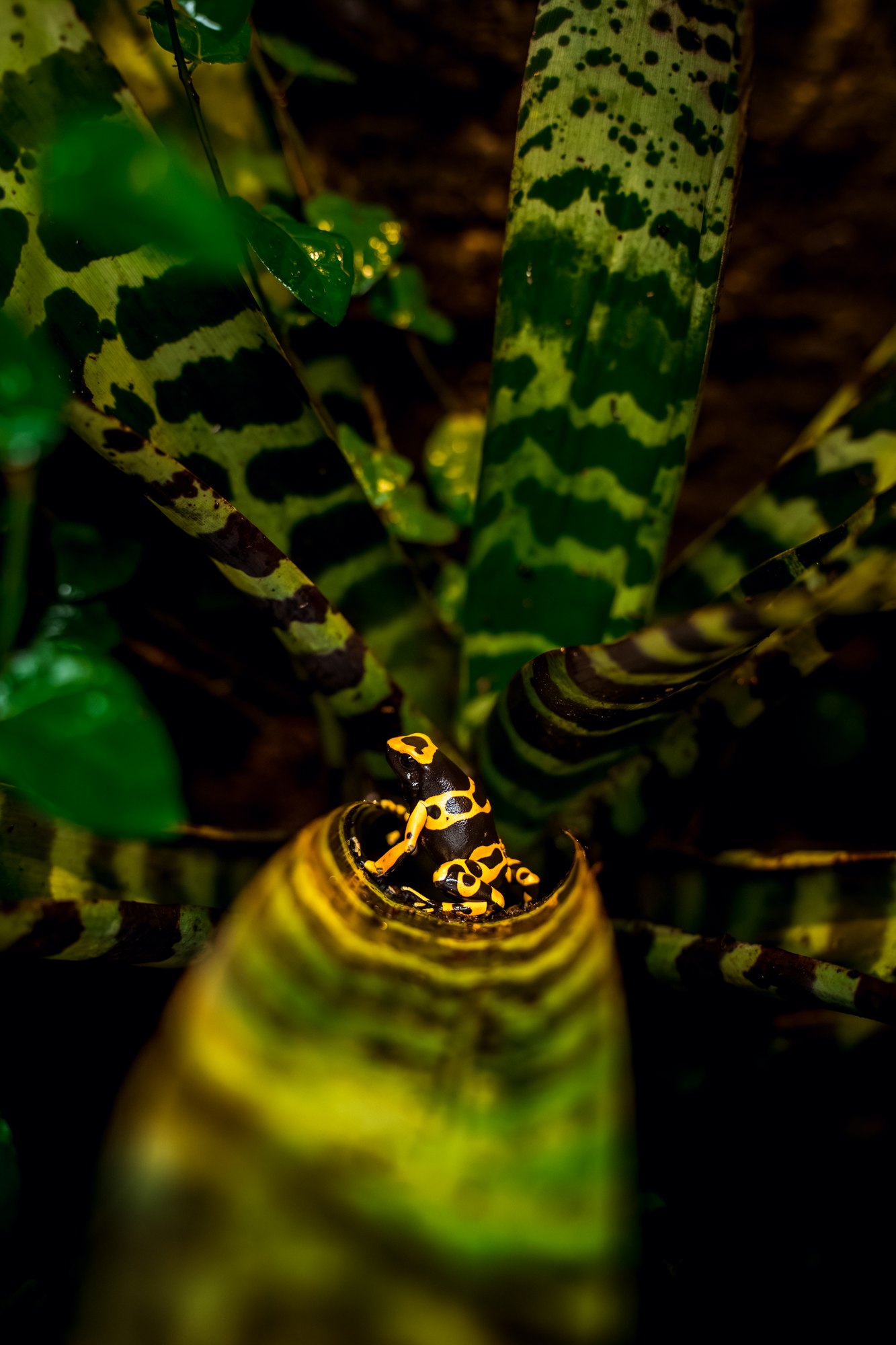
Yellow-banded poison dart frogDendrobates leucomelasLeast Concern
A poison dart frog with a striking pattern
The yellow-banded poison dart frog has bright yellow or orange stripes and patches across its black base colour, making it conspicuous from afar. Its colouring serves as a warning signal, indicating that its skin may contain toxic substances.
During the day it patrols its surroundings almost constantly in search of food. Its voice is surprisingly loud compared to other poison dart frogs: males announce their presence and defend their territory with chirping, clicking calls.
It likes damp, humid surroundings and often hides among stones, roots or mossy tree trunks. It is a popular species in the terrarium hobby.
Red-footed tortoiseChelonoidis carbonariusVulnerable
A black base colour with red spots
The Hungarian name of the red-footed tortoise (“charcoal tortoise”) comes from its dark, almost black shell. Another distinctive feature of its colouring is that bright red or orange scales decorate its legs and head. This striking colouring helps the animals communicate with one another. The centre of some of the shell's scutes is often a lighter shade.
The red-footed tortoise prefers damp, warm habitats, so it likes to stay in the undergrowth of rainforests, where plenty of food is available. During the hot daytime hours it often rests in shady spots or under dense vegetation to avoid drying out. Thanks to its good sense of smell, it easily finds food such as fallen fruit.
The red-footed tortoise is basically herbivorous, but besides plant food it occasionally also eats animal protein: insects or carrion. It plays an important role in seed dispersal. Although generally regarded as a sluggish, slow-moving animal, it can cover surprisingly long distances in search of food. Female red-footed tortoises lay their eggs in loose soil or leaf litter, and the warmth of the sun helps the eggs develop. The hatchlings are independent from the start and do not need their parents' care. Because of their tiny size, many predators lie in wait for them. Young animals are usually more brightly coloured than older ones.
GuppyPoecilia reticulataLeast Concern
The most popular ornamental fish
A shoal of guppies shares an enclosure with our alligator snapping turtle. The guppy is one of the best-known and most popular aquarium fish in the world. It gets its name from the extremely varied and vivid colouring of the males. Through breeding, countless colour and fin varieties have emerged: there are red, blue, yellow, mosaic, leopard-patterned and even rainbow-patterned fish. Females are generally larger but far more modestly coloured than males; only their tail fin is patterned. In the wild this difference can be an advantage for them, as they are less conspicuous to predators. The males' spectacular colours, on the other hand, play an important role in choosing a mate.
The guppy is a live-bearing fish, meaning the female does not lay eggs but gives birth to fully developed fry. After birth the little fish swim and feed on their own straight away. Thanks to its rapid reproduction, the species adapts easily to new environments, which is why it has been introduced in several tropical countries to control mosquito larvae.
Its diet is extremely varied. It eats tiny invertebrates, algae and plankton, but in an aquarium it will eat almost any fish food of a suitable size. The guppy is extremely hardy and easy to keep, which is why it is the first fish for many beginner aquarists. Small and active, it brings an aquarium to life with its constant movement. Today it is one of the most popular aquarium fish.
Guinea pigCavia porcellus
Domesticated species (not on the Red List)
Not actually a pig at all
Few household pets have such a distinctive repertoire of sounds as the guinea pig. The Hungarian name (“sea pig”) was given not because of any relation to pigs, but because of its slightly grunt-like sounds and stocky build. The “sea” part refers to the fact that the species came to Europe from across the sea, from South America, in the 16th century. Guinea pigs communicate with a variety of sounds: excited squeaking often signals that feeding time is near, while soft purring or rumbling plays a role in social relationships. Vocalising is an important part of keeping in touch with other guinea pigs and with humans, which is why guinea pigs quickly learn to recognise their keeper's voice.
The wild ancestors of the domesticated guinea pig lived in small groups in the Andes, which still shapes their social behaviour today. The guinea pig is a decidedly social animal, so it is recommended to keep at least a pair, or, if you do not want offspring, several females together. Loneliness can cause stress, loss of appetite and behavioural problems in the long run. A clear hierarchy develops within the group, but conflicts are mostly mild and short-lived. Being close to one another gives them a sense of security, and they often rest huddled together.
Its diet is entirely plant-based. A constant intake of fibre is especially important for it, which is best provided with good-quality hay. A guinea pig's teeth grow continuously throughout its life, so chewing is essential not only for feeding but also for wearing the teeth down properly. Interestingly, the guinea pig, like humans, cannot produce vitamin C, so it has to get it from its food. A lack of vitamin C can lead to serious illness, lethargy and dental problems.
The guinea pig is by nature a peaceful, curious animal. In the wild it was a prey animal, so it can easily be frightened by sudden noises or movements. Instead of fleeing, it often freezes motionless or quickly runs for cover. With enough patience, however, it is easily tamed, and many individuals gladly seek out human company. After a relatively long gestation period, females give birth to well-developed young. Baby guinea pigs are born with their eyes open and soft fur, and can move around on their own within a few hours. Although they initially feed on their mother's milk, they very soon start showing interest in solid food too. Today the guinea pig is one of the most popular hobby animals worldwide. Countless colour varieties have been bred, and animals with unusual coats are also known (hairless guinea pigs, crested, rosette and long-haired ones).
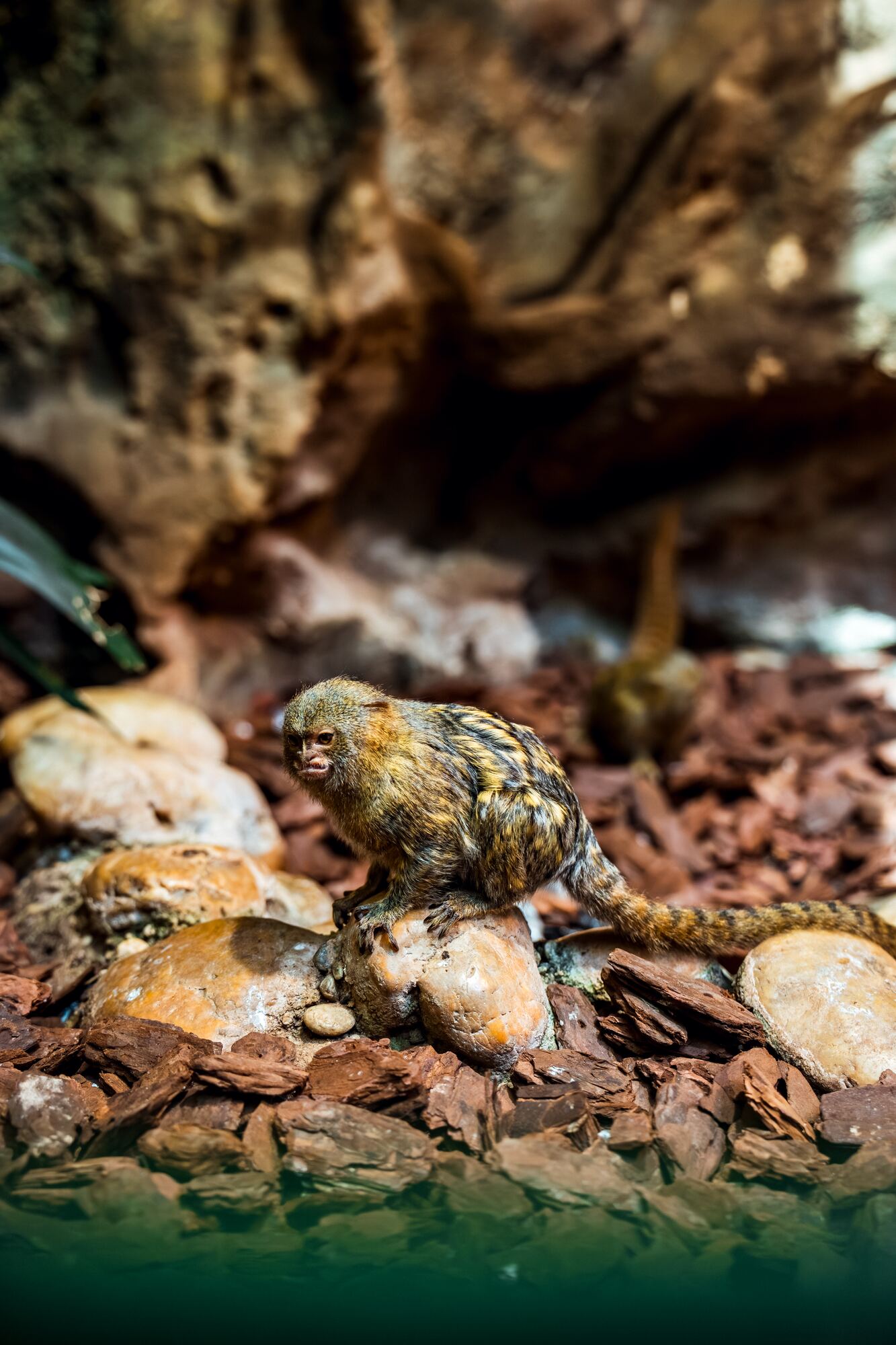
Pygmy marmosetCebuella pygmaeaVulnerable
The world's smallest monkey
Native to the Amazon basin, the pygmy marmoset is the smallest true monkey in the world, and among all primates only the mouse lemurs are smaller. Its body is just 12–16 centimetres long, with a tail of the same length. An extremely agile animal, it moves between tree branches with lightning-fast leaps, spending most of its life there. Its long tail helps it balance as it moves along thin branches and vines.
The pygmy marmoset belongs to the marmosets and tamarins. A special feature of this group is that their digits, apart from the big toe, have sharp claws rather than flat nails. This helps the animals grip tree bark more easily and efficiently reach one of their main foods, tree sap. With their sharp teeth they gnaw tiny holes in the bark and then lick up the sap that flows out. They regularly visit a favourite “sap source” and can use it over a long period.
Their diet is not limited to tree sap, however: they also eat other plant-based food, insects, spiders and small vertebrates. Pygmy marmosets have a fast metabolism, so they search for food almost all day. They are especially fond of soft fruit and insects. Pygmy marmosets are social creatures that usually live in small family groups. Group members communicate with one another through calls, postures and scent marks. Their high, whistling or chirping calls help them stay in touch in dense vegetation. They often mark their territory with scent, thus setting themselves apart from other groups.
Their care of the young is especially remarkable: not only the mother but also the father and other members of the group actively take part in raising the little ones. The babies often ride on the back of their father or older siblings while the mother rests or feeds. This cooperative care significantly increases the young's chances of survival. Twin births are common in this species, as in almost all marmosets and tamarins. Single babies and triplets are rare.
The pygmy marmoset's natural enemies include birds of prey, snakes and smaller predatory mammals. In case of danger they flee in a flash into the shelter of the dense canopy. Their camouflage colouring helps them blend into the forest environment.
Although the pygmy marmoset is not currently among the most severely threatened species, the destruction of its habitat and the illegal animal trade can have a negative impact on its populations. Many people try to keep it as a pet, even though its special needs make it unsuitable for this. Under the laws currently in force, only a zoo may keep it in Hungary.
Dwarf otocinclusOtocinclus affinisNot Evaluated
The dwarf otocinclus is a tiny, peaceful algae-eating fish that lives in shoals. With its sucker-like mouth it constantly grazes algal films off stones and plants. It is sensitive to poor water quality, so it feels best in a stable environment. It plays a particularly useful role in reducing algae growth in aquariums.
Glass bloodfin tetraPrionobrama filigeraNot Evaluated
The species' body is largely transparent, so its spine and some of its internal organs are clearly visible. Males have a brighter red tint to the tail fin than females, especially during the breeding season. It lives in larger shoals, where the movements of the individuals are almost perfectly synchronised. In its natural habitat the dark water helps it hide. It feeds on tiny insects, plankton and organic matter falling into the water.
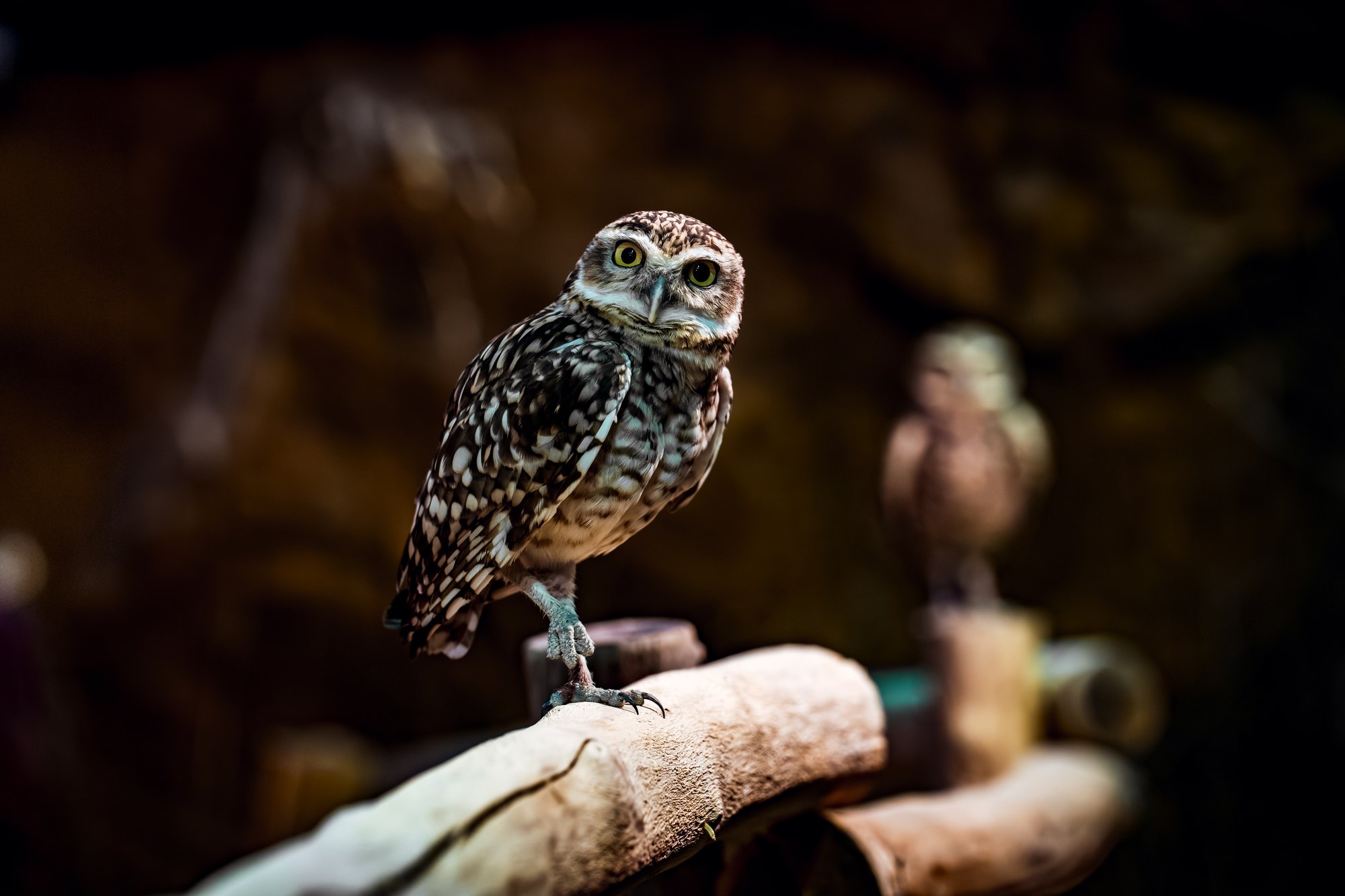
Burrowing owlAthene cuniculariaLeast Concern
The eccentric burrow dweller
An owl species native to the American continent, found in North, Central and South America alike. It is related to the little owl (Athene noctua) found in Hungary. The burrowing owl avoids closed forests and mountain regions; it is mainly a bird of grassland: prairies and pampas, as well as scrub, and dry, semi-desert areas. Unlike most owl species, it rests and nests in underground burrows. It sometimes digs these burrows itself, and at other times takes over those abandoned by other animals. Its long, elongated legs help it dig and walk on the ground. Its appearance differs from that of most owls: its long legs, pale eyebrow stripe and bright yellow eyes make it easy to recognise. When in danger, it may perform characteristic bobbing movements while watching an approaching stranger. Young birds often line up at the burrow entrance to wait for their parents to arrive.
Burrowing owls are mainly active at twilight, but in some habitats they can be seen during the day too. It is not a fussy eater: although a large part of its diet is made up of insects, it also eats smaller vertebrates. It often chases its prey on foot. Its flight is fast and low, and it hunts in open terrain, often with sudden changes of direction.
Most males have only one mate, but some breed with two females at the same time. Pairs often nest in small colonies. It often lines its nesting burrow with the dung of larger mammals, such as cattle. This unusual behaviour helps create the burrow's microclimate and also attracts insects that serve as food. The burrowing owl tolerates human presence relatively well and is often seen near inhabited areas.
Although the species as a whole is not yet considered threatened, its numbers are declining in some areas. The disappearance of natural grasslands, the conversion of farmland and the decline in burrow-digging mammals all have an adverse effect on burrowing owl numbers.
Sailfin giant pleco (gibbiceps)Pterygoplichthys gibbicepsNot Evaluated
A spectacular-looking algae-eating catfish
The sailfin giant pleco takes its name from its huge, tall dorsal fin, which, when spread, resembles a ship's sail. Its body is decorated with pale spots and a net-like pattern on a dark base, which makes the animal especially spectacular. It is a popular and well-known algae-eating catfish in the aquarium hobby.
Like other algae-eating catfish, the species' body is covered in hard bony plates that protect it from predators. With its sucker-like mouth it anchors itself to stones and roots. Thanks to its strong mouthparts, it can hold on easily even in faster-flowing waters.
Like the pleco, young specimens are popular and readily bought aquarium fish. For older, adult animals, however, it is difficult to create suitable conditions in an aquarium, as they only thrive in very large spaces.
The sailfin catfish is mainly active at night. During the day it likes to hide under roots or stones. Its food is mainly plant-based: it eats algae, plant remains and rotting wood, but also small invertebrates and carrion. The fibres of wood may play an important role in its digestion, so put some driftwood in its aquarium for it to gnaw on.
The species is found worldwide in the aquarium hobby. In several tropical countries it is considered an invasive species. Specimens once kept in aquariums and then released adapt well to their new environment, where they compete with native fish species for habitat and food.
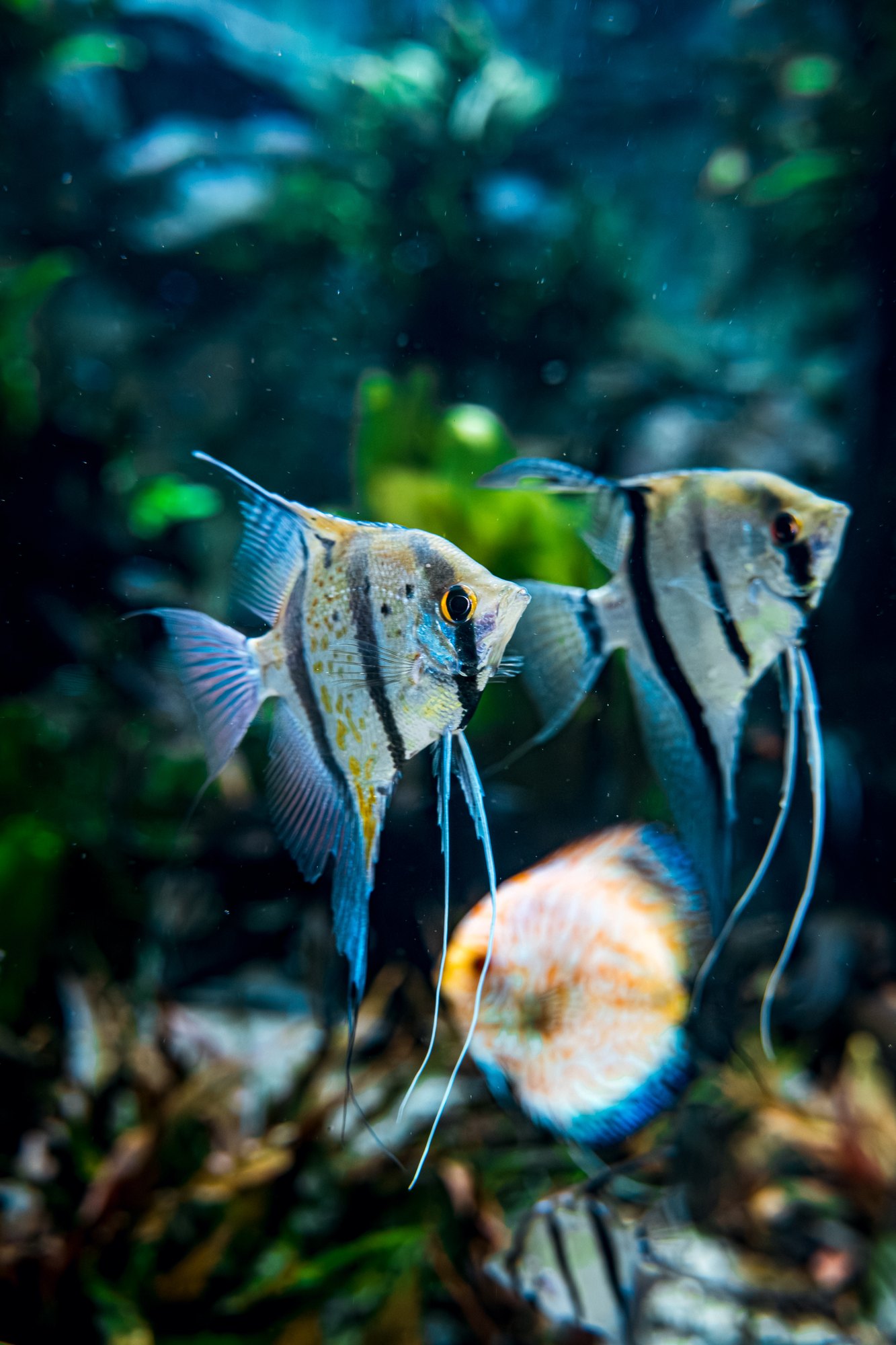
AngelfishPterophyllum scalareNot Evaluated
With its tall, laterally flattened body and long fins, the angelfish is one of the best-known fish of Amazonian habitats. In the wild form, its vertical black stripes help it hide among aquatic plants and roots. It can be territorial, especially during the spawning season. It breeds in pairs, usually laying its eggs on leaves or other smooth surfaces. Many colour varieties have been bred. At Tropicarium you can see the so-called Peruvian altum angelfish, which also occurs in the wild.
Cardinal tetraParacheirodon axelrodiNot Evaluated
The cardinal tetra is a tiny, shoaling characin, easily recognised by its vivid blue and red colouring. It is one of the best-known ornamental aquarium fish. It lives in shoals, and the metallic, shimmering bodies of the fish swimming together create a spectacular effect. In its natural habitat it feeds mainly on tiny invertebrates and plankton. Thanks to its peaceful behaviour and striking looks, it is one of the most popular aquarium fish.
Redtail catfishPhractocephalus hemioliopterusNot Evaluated
The redtail catfish is a fast-growing, large Amazonian predator. It is territorial and lives close to the bottom. Thanks to its extremely powerful jaws and large mouth, it is an opportunistic feeder, eating practically anything it can overpower. Its well-developed senses help it find its way in murky water.
Red-eared sliderTrachemys scripta elegansLeast Concern
Invasive armoured animals
The red-eared slider is one of the best-known turtles in the world, and also one of the most commonly kept pet turtles. Its Hungarian name refers to the bright red stripe on each side of its head, which is especially vivid in young animals. Its shell is olive-green or brownish with yellowish markings, which often darken with age. It is originally native to North America. The red-eared slider likes slow-flowing rivers, lakes, swamps and canals. It spends most of its time in the water, but is often seen basking on logs, rocks or banks. A good swimmer, it quickly escapes into the water when in danger. As for diet, it is an omnivore. It eats aquatic plants, algae, insects, worms, molluscs, small fish and carrion. Young animals mostly eat animal food, while plants play a larger role in the diet of older turtles.
Females can lay eggs several times a year. They lay their eggs in pits dug into sunny, loose soil near the water's edge. The hatchlings are threatened by many predators, but surviving animals can be long-lived, reaching 30–40 years or even more.
Thanks to the ornamental animal trade, the red-eared slider has now spread almost all over the world. Many specimens ended up in natural waters through irresponsible owners who released pets they had grown tired of or that had grown too large. The species is extremely adaptable, so it has successfully established itself in many countries and become invasive. It can also be seen in the wild in Hungary. Its presence causes a serious conservation problem, because it competes for food with Hungary's only native turtle species, the European pond turtle, and can push it out of its natural habitat. For this reason, under European Union regulations, keeping, breeding and trading it is now prohibited, and new animals can no longer be legally acquired for keeping at home. If someone still has a red-eared slider at home, they may keep the animal. Releasing it into the wild, however, is strictly prohibited, as this could further increase the numbers of invasive populations.
Red-bellied piranhaSerrasalmus nattereriLeast Concern
Nowhere near as bad as its reputation
The red-bellied piranha is one of the best-known piranha species. Despite its large size, this species also belongs to the characins, like the neon tetras well known in the aquarium hobby. Several species of piranha are known. Meat-eating species are characterised by powerful jaws and sharp teeth, with which they can quickly tear their prey to pieces.
The reputation of piranhas is often surrounded by exaggerated stories and films, but in reality these fish are more opportunistic predators and scavengers that rarely attack larger animals, and mainly only when they are very hungry. Given the chance, the red-bellied piranha eats carrion, and its favourite food is dead fish. Interestingly, when kept in an aquarium the red-bellied piranha is a timid, easily frightened fish. No wonder, since in the wild this animal also faces plenty of dangers: despite its predatory lifestyle, it is an important prey animal for many other predators. Red-bellied piranhas have excellent senses: they react extremely sensitively to vibrations in the water and the smell of blood. In their natural habitat they play an important role in clearing away dead animals, thus helping to keep aquatic habitats clean.
Moving in shoals is characteristic of the species: dozens or even hundreds of individuals move together, which helps protect against predators and makes more efficient hunting possible. The bright red colour of the red-bellied piranha's belly is stronger in adults than in young fish. It often also serves as a signal of dominance or of having reached sexual maturity. During the breeding season, pairs create a spawning site in shallower areas, which they guard aggressively against other fish and members of their own species.
Convict cichlidAmatitlania nigrofasciataNot Evaluated
The zebra of the cichlids
The convict cichlid is named for the dark vertical stripes running across its body, which resemble a zebra's pattern. Its base colour is grey or bluish-grey, decorated with 8–9 black crossbars. The belly of females is often orange-tinged, especially in the breeding season. The species is one of the best-known and hardiest Central American cichlids. It adapts well to different water conditions, which is why it has long been a popular species in the aquarium hobby. It breeds readily in aquarium conditions. Despite its small size it is extremely bold and aggressively defends its territory against its own species and other fish, especially at spawning time.
Convict cichlids live in pairs, and a strong bond can develop between male and female. They often choose each other as breeding partners several times in a row instead of changing mates. The female usually lays the eggs on a sheltered surface of stones or in cavities. The parents jointly guard and care for the eggs, and then supervise the hatched fry for a long time. If they sense danger, they quickly herd the fry to a safe place. It can only be kept with other species in a large aquarium, but it is best for the fish if only convict cichlids are kept in one tank.
It is an omnivorous fish that in its natural environment eats tiny invertebrates, insect larvae, algae and plant parts. In an aquarium they accept almost any kind of fish food, but they stay healthy and brightly coloured only with a varied diet. The convict cichlid often digs through the substrate. It likes hiding places built from stones.
Azara's agoutiDasyprocta azaraeLeast Concern
The gardener of the forest
Azara's agouti, known in Hungary as the green agouti, is a medium-sized South American rodent, easily recognised by its slim body, long legs and smooth, glossy coat. It is a member of the agouti family (Dasyproctidae), related to the guinea pig family. Its fur is mostly brownish, reddish or olive in tone, which in the right light can also give a greenish effect. Its hind legs are longer than the front ones, so it moves quickly and springily, often travelling in little hops through the forest undergrowth. Its tail is very short and barely visible.
Azara's agouti lives in the wooded areas of central and northern South America. It most often occurs in dense tropical and subtropical forests, but can also settle in riverside groves, scrubland and partly disturbed habitats. Although the species is not currently considered threatened, habitat destruction and hunting may reduce its numbers in some areas. Its meat is eaten in many places, so it is often hunted, and it is also an important prey animal for many predators.
Azara's agouti lives alone or in small family groups and is mainly active during the day. It is an extremely alert animal: its excellent hearing and sense of smell help it avoid predators. It looks for food mainly on the ground, where it collects fallen fruit, hard-shelled seeds and nuts. With its strong incisors it easily cracks even thick-shelled fruits. It often buries surplus food to come back for later. It does not find some of the hidden seeds again, however, so they can germinate. For this reason Azara's agouti is considered one of the most important seed-dispersing animals of the forest, playing an important role in the survival of several large-fruited tree species.
A female Azara's agouti usually gives birth to one or two well-developed young which, unlike the offspring of most rodents, are born furred and with their eyes open, and are able to move and follow their mother shortly after birth. The young develop quickly and soon learn the behaviours needed to find food.
See them
in person too
Buy tickets
Frequently asked questions
When is the shark feeding?
On Mondays at 14:30 the sharks are fed from above, and on Thursdays at 14:30 by divers, in the shark aquarium. You can find the times of the other feedings on the Feedings and keeper talks page.
Can we come in bad weather or rain?
Yes. Tropicarium is a fully covered indoor attraction inside the Campona building, so you can enjoy it comfortably whatever the weather, in rain or cold.
How long does a visit take?
At a relaxed pace, 1.5–2 hours on average. If you want to catch a feeding or spend more time at the ray-petting pool, allow a longer visit.
Can I take photos?
For personal use, yes, but flash is prohibited because it disturbs the animals.
You will find answers to further questions on the FAQ page.