Europe’s wildlife
The fish of Hungarian waters and the animals of the continent, including species that are also at home in the Danube and Tisza river systems.
Visitor favourites
Click any of them and its description opens in the list below.
Residents of Europe
14 species. Click a name for details.
Grass carpCtenopharyngodon idellaLeast Concern
The fish that even eats reeds
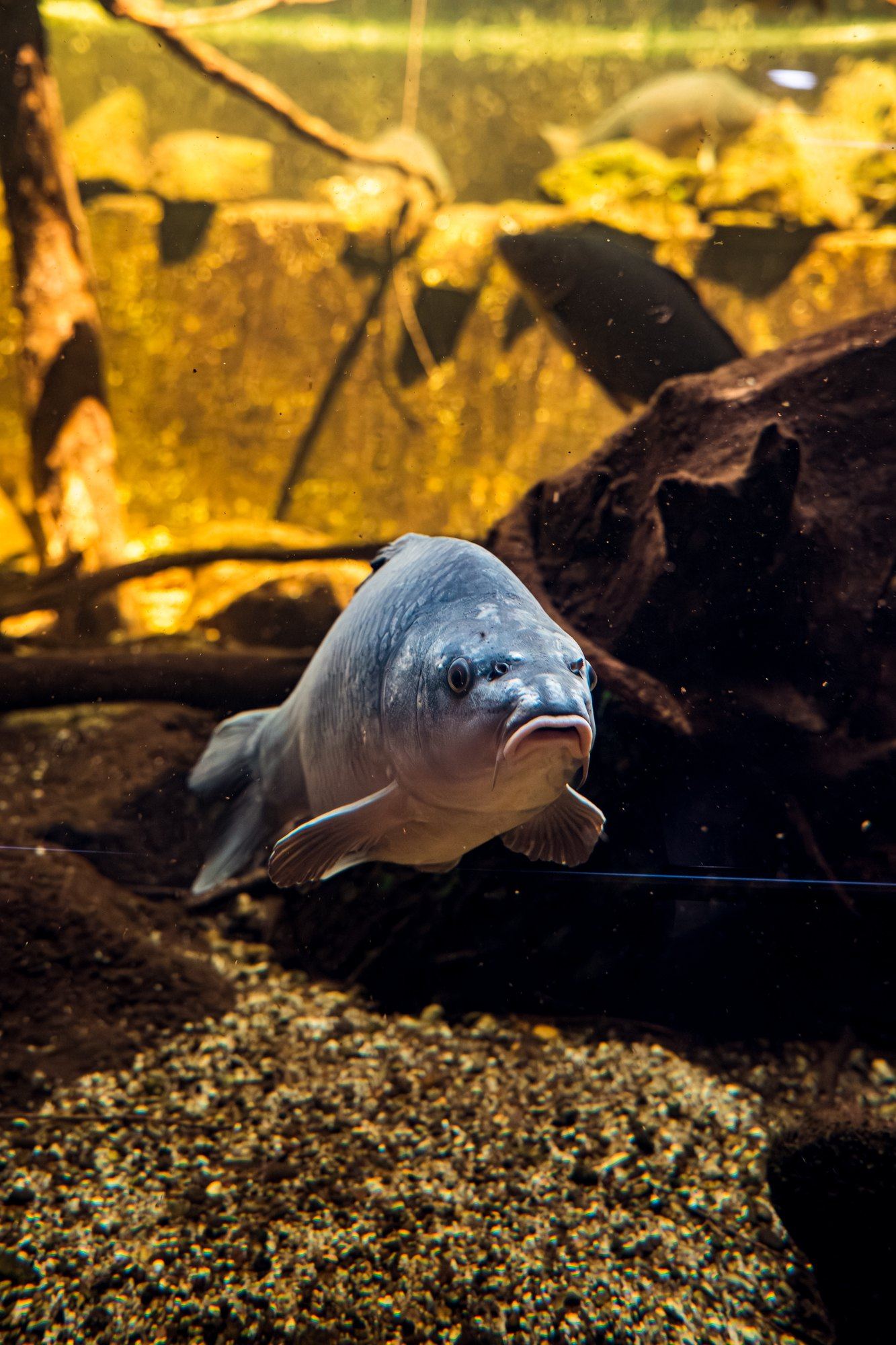
The grass carp is a large, herbivorous fish. It is not native to Hungary but an introduced species. Its homeland is East Asia, mainly the area stretching from southern Siberia to the central river systems of China, and its Hungarian name comes from the Amur River. Its eyes are set slightly forward on the sides of its head, which is unusual among fish and lets it observe its surroundings better while feeding. It is a herbivore, eating mainly aquatic plants, pondweed, reeds and algae. Interestingly, grass carp can “devour” entire patches of reeds, so introducing them helps control aquatic vegetation. It is regarded as a popular angling fish, since large specimens can reach 15–20 kilograms. The grass carp’s ability to adapt to its environment is remarkable, as it can cope with both slow and fast water.
RoachRutilus rutilusLeast Concern
Rudd or roach?
The roach is a medium-sized, common freshwater fish found in almost every type of water in Hungary. Its appearance is very similar to the rudd’s, so the two species are often confused. The most important difference is that the roach’s body is less golden in tone and more silvery, its fins are a paler red than the rudd’s fins, and its mouth ends at the tip rather than pointing upward as the rudd’s does. Its eye is usually reddish, which also makes accurate identification easier. Its diet is similarly varied, including both plant and animal food. It is a common catch among anglers and a well-known fish even for beginners. In 2022 the Hungarian Ichthyological Society named it Fish of the Year.
TenchTinca tincaLeast Concern
A lesser-known carp relative
The tench is a medium-sized, stocky freshwater fish that lives mainly in slow-flowing waters, lakes and floodplains. It belongs to the carp family, but its economic importance is much smaller than the carp’s. Compared with its larger relative, it is a less well-known fish. Its body is covered in tiny, slimy scales that make it smooth to the touch. Its colour is usually dark greenish or brownish, with silvery shimmering sides. It especially likes areas covered with dense aquatic vegetation, where it can hide among the plants. It feeds mainly on aquatic plants, algae and small invertebrates. It is mostly active at night and often hides among vegetation by day. It breeds in spring, when it moves into shallow, densely vegetated areas to spawn. The tench grows slowly but is long-lived and can reach 15–20 years. In recent years the tench has become a popular fish for ornamental ponds. Several colour varieties have been bred in captivity, such as the golden tench, which is also on display at Tropicarium.
Common breamAbramis bramaLeast Concern
The common bream and the Swedish rock band
The common bream is a larger, strongly laterally flattened freshwater fish that lives mainly in slow-flowing rivers and still waters. It belongs to the carp family. It is a very widespread fish in Hungary. Its build clearly distinguishes it from the rudd: it is high-backed and “plate”-shaped, whereas the rudd is slimmer and less tall-bodied. Its colour is generally silvery-grey, and it may take on a bronze tint in old age. Interestingly, the Swedish rock band Abramis Brama is named after its scientific name. The common bream feeds mainly near the river bed, eating small invertebrates, worms and organic detritus. It is a popular catch among anglers, especially the larger specimens.
Prussian carpCarassius gibelioLeast Concern
The goldfish’s silver ancestor
The Prussian carp is a medium-sized, stocky freshwater fish that, thanks to its good adaptability, can live in almost any kind of water. Like the other fish species in the aquarium, it belongs to the carp family. It is not native to Hungarian fauna: it is an introduced species originally from East Asia that has adapted extremely well and has multiplied in huge numbers in many of our waters. Interestingly, it is a close relative of the goldfish, being its wild ancestor. The wild Prussian carp differs considerably from the domesticated form: its body is deep and laterally flattened, and its colour is silvery-grey, which is how it got its Hungarian name (“silver crucian”). In terms of diet it is omnivorous, mainly filtering its food from the mud and eating tiny organisms and organic matter.
ChubSqualius cephalusLeast Concern
Why is the chub called the “headed” chub?
The chub is a medium-sized, elongated freshwater fish found mainly in rivers and streams, but also in still waters. It belongs to the carp family. In Hungary it is a particularly common species, found in almost all our natural waters. Its Hungarian name (“fejes”, meaning “headed”) comes from its distinctive, disproportionately large, thick head: the word refers to this robust skull, which is especially conspicuous in size compared with the rest of the body. This big head hides a strong jaw, which helps the fish in its omnivorous feeding. Although the chub also eats plant food, whenever it can it happily supplements its diet with other animals, such as smaller fish. It is a popular catch among anglers, though its culinary value is moderate because of its many small bones. It grows at a medium rate, but under favourable conditions it can grow fairly large and live for more than a decade.
SterletAcipenser ruthenusVulnerable
Hungary’s smallest sturgeon
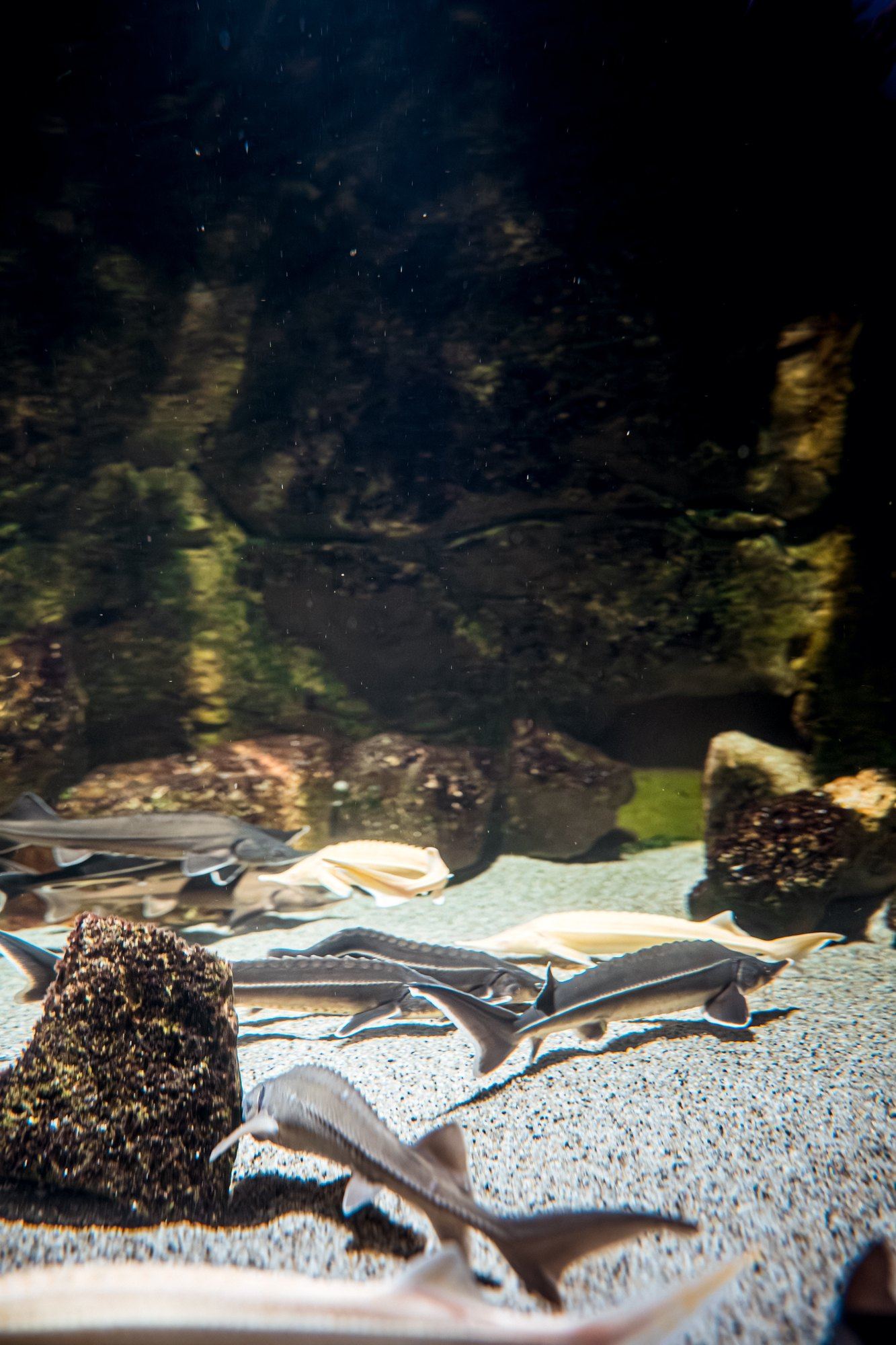
The sterlet is a medium-to-large fish found mainly in flowing waters and belongs to the sturgeon family. It is a relatively rare species in Hungary, found mainly in the larger stretches of the Danube and the Tisza. Its body is elongated and laterally flattened, its back is dark olive-green, its sides shimmer silver, and its belly is pale. Its mouth is located underneath, and it uses its barbels to sense food on the bottom, which consists mainly of invertebrates, molluscs and smaller crustaceans. What makes the sterlet special is that, like other sturgeons, it often chooses the gravelly, sandy stretches of the original riverbed for spawning, where the young hide among sand and silt. The sterlet is the smallest sturgeon in Hungary, although some individuals can grow to 50–70 cm in length and 2–3 kg in weight, though in our waters larger specimens are rarer.
The sterlet is extremely sensitive to water quality: it needs clean, oxygen-rich flowing water, and its presence is often an indicator of a river’s ecological condition. An albino colour variety has also been bred in captivity, and it too is on display at Tropicarium.
Wels catfishSilurus glanisLeast Concern
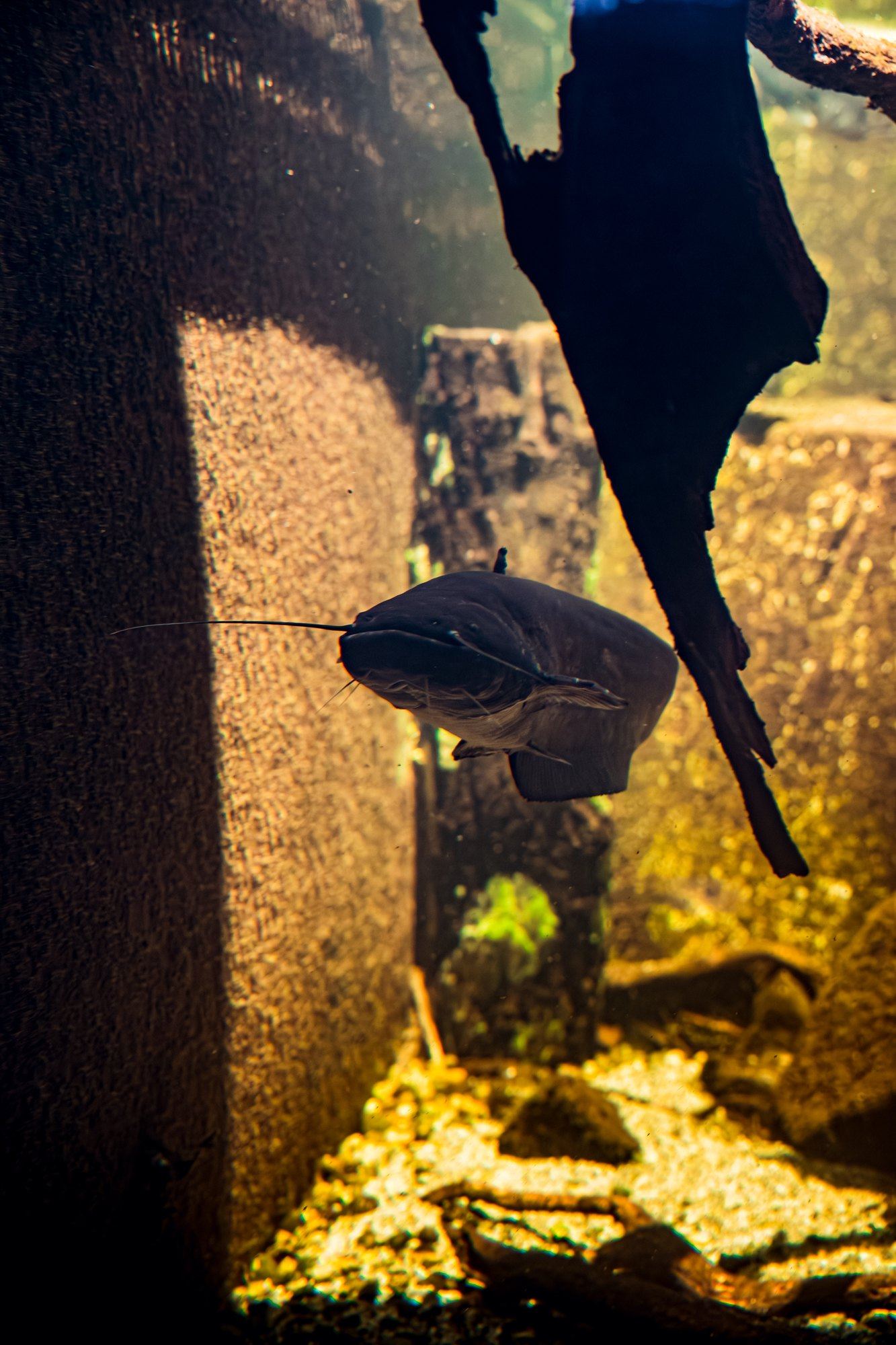
The wels catfish is a large predatory fish that lives mainly along the banks of slow-flowing waters, lakes and oxbow lakes. It is one of the largest freshwater fish in the world: some individuals can grow 2–3 metres long and weigh over 100 kilograms, although in Hungarian waters we usually meet smaller ones of 1–2 metres. Its elongated body, broad head and distinctive barbels make it an easily recognisable fish. With these barbels it senses movements in the water, which is especially important for finding its way in the dark and in murky water. It is mainly active at night and rarely moves during the day, feeding mostly on fish, crayfish, frogs and smaller aquatic creatures. The wels catfish can hunt at depths of several metres and often lies in ambush, waiting for approaching prey. It is a significant fish for anglers and an exciting target, because once hooked it tries to break free with powerful, sudden jerks, which is a serious challenge even for experienced anglers.
BarbelBarbus barbusLeast Concern
Sensory barbels
The barbel is a medium to large, elongated freshwater fish that feels at home mainly in faster-flowing, oxygen-rich waters. It belongs to the carp family, like the chub, the tench and the Prussian carp. In Hungary it is common mainly in our larger rivers, such as the Danube and the Tisza. Its body is streamlined and flattened underneath, which is well suited to stronger currents; its colour is generally brownish-grey, with a paler belly. A distinctive feature is the four fleshy feelers around its mouth, known as barbels, which serve as an important sense organ. With their help the barbel easily finds food on the river bed, often even in murky water. The barbels are extremely sensitive, so the fish almost “feels” the stones and mud with them while searching for insect larvae, worms and small crustaceans. This trait is closely linked to its bottom-dwelling lifestyle. The barbel is a particularly prized catch among anglers. Landing one is a serious challenge. Its diet consists mainly of animal food, e.g. aquatic insects, but it occasionally also eats plant matter.
Largemouth bassMicropterus salmoidesLeast Concern
An American newcomer in Hungarian waters
The largemouth bass is a medium-sized predatory fish that was introduced to Hungary mainly for angling. Its original home is North America, where it lives in clear, cool lakes and rivers. Its body is usually olive-green with dark spots along the sides, and its fins often have a slightly reddish tinge. A voracious predator, its diet consists mainly of smaller fish, water insects and molluscs. Young fish often swim in large shoals, while older ones lead a more solitary life. The largemouth bass is especially popular among anglers, as its lively movement and strong bite make it a favourite catch.
Common carpCyprinus carpioVulnerable
Our most economically important fish
The common carp is a medium to large fish found in every type of Hungarian water, native to Europe and Asia. It has been introduced to many other parts of the world. Its body is covered in golden or bronze scales, its fins are often reddish, and its head is broad and slightly blunt. Its diet is varied: it eats both plant and animal food, such as aquatic plants, insect larvae, worms and smaller invertebrates. Interestingly, it can search for food on the bottom with a “digging motion”, often stirring up the mud. The carp is the most popular catch among anglers and can be caught relatively easily and often. From an economic point of view it is Hungary’s most important fish. Large specimens are especially impressive. The Hungarian Ichthyological Society chose it as Fish of the Year in 2021, highlighting its importance in nature and in recreational angling alike. Interestingly, carp are basically social fish and often move in shoals.
Besides the wild form of the carp, many cultivated varieties have also been bred. The best known are the mirror carp, which has large, irregularly placed scales; the leather carp, whose body is almost entirely scaleless; and the colourful ornamental carp, e.g. koi, which are often kept in garden ponds. These cultivated forms are less common in natural waters, but can be found in some lakes through introductions.
Racovitza’s ruddScardinius racovitzaiExtinct in the Wild
Saved from extinction
Racovitza’s rudd looks very similar to its close relative the rudd, but while the latter is widespread and often found in rivers and lakes, Racovitza’s rudd is extremely rare and has now disappeared completely from its natural habitat. It once lived exclusively in Transylvania, in the Püspökfürdő thermal lake near Oradea, where the water’s temperature and chemical composition provided a special ecological environment for it.
In the early 2010s conservationists warned that the lake’s water level had dropped significantly and that it even froze over at times in winter, which had not been typical before. This created a particularly serious situation, as the lake was the last natural habitat of several endemic species (native species found nowhere else in the world): Racovitza’s rudd, the ribbed Melanopsis snail and the thermal water lily. The main cause of the problems was the repeated hotel construction in the area and the excessive extraction of thermal water, which far exceeded the rate at which the water supply replenishes naturally. As the water level fell and the habitat changed, the lake’s ecosystem was thrown out of balance, and the thinning of vegetation and food sources directly endangered the Racovitza’s rudd population. The lake dried out completely in 2017, but fortunately has since refilled.
According to experts, the habitat’s original state can no longer be restored even so, since the native species that lived there have disappeared. The ribbed Melanopsis snail is extinct for good, and Racovitza’s rudd survives only under artificial conditions. Today the species is found only in zoos, aquariums, museums with living animals and research institutes. It is kept in fewer than ten places worldwide, and in March 2026 Tropicarium was the only Hungarian zoo where it could be seen. The survival of Racovitza’s rudd is thanks to human care.
Russian sturgeonAcipenser gueldenstaedtiiCritically Endangered
Protected in Hungary, with a conservation value of HUF 10,000
A sturgeon with a rounded snout
The Russian sturgeon is a medium-sized fish of the sturgeon family found in flowing waters. In Hungary it is a rare and protected species, found mainly in the Danube, the Tisza and larger stretches of their tributaries, but only scattered individuals are encountered in Hungary. The species has a conservation value of HUF 10,000. Its body is elongated and laterally flattened, with a dark olive-green back, silvery shimmering sides and a pale belly. Its mouth is on the underside, and with the help of three pairs of sensory barbels it filters food from the bottom, which consists mainly of molluscs, crustaceans and tiny invertebrates. Interestingly, young Russian sturgeon are often mistaken for the starlet or the Siberian sturgeon, but with a little practice they can be told apart fairly easily. From the starlet, the Russian sturgeon can be distinguished by its more slender body proportions and smaller, flatter head; its barbels are longer and thinner, whereas the starlet has a rounder, stockier head shape. Unlike the Siberian sturgeon, the Russian sturgeon has an evenly curved back line, while the Siberian sturgeon’s back line is often slightly raised; in addition, the Russian sturgeon’s barbels start from the edge of the mouth and are longer, whereas in young Siberian sturgeon the barbels are shorter and the head slightly blunter. The Russian sturgeon’s snout is shorter and more rounded than that of the other two sturgeon species.
For spawning, the species often chooses the gravelly and sandy stretches of the original river bed, where the young hide among the sand and mud. The Russian sturgeon can grow up to 1–1.2 metres long and 10–15 kilograms, although in Hungarian waters smaller specimens of 60–80 cm are more common. The species is sensitive to water quality and oxygen levels, so its presence is a good indicator of the ecological condition of rivers.
RuddScardinius erythrophthalmusLeast Concern
A shoaling fish with a striking appearance
The rudd is a medium-sized, laterally flattened freshwater fish that lives mainly in still and slow-flowing waters. It belongs to the carp family. In Hungary it is a very common species. It gets its name from its striking, brightly coloured fins: the pelvic, anal and tail fins are bright red or orange, which gives it a particularly beautiful, “colourful” look. Its body has a golden-greenish shimmer, and its eye is often reddish. It likes to stay in waters thickly overgrown with plants. In terms of diet it is an omnivorous fish: it eats aquatic plants, algae and smaller invertebrates. Because of its smaller size, it is a less sought-after catch for anglers.
See them
in person too
Buy tickets
Frequently asked questions
When is the shark feeding?
On Mondays at 14:30 the sharks are fed from above, and on Thursdays at 14:30 by divers, in the shark aquarium. You can find the times of the other feedings on the Feedings and keeper talks page.
Can we come in bad weather or rain?
Yes. Tropicarium is a fully covered indoor attraction inside the Campona building, so you can enjoy it comfortably whatever the weather, in rain or cold.
How long does a visit take?
At a relaxed pace, 1.5–2 hours on average. If you want to catch a feeding or spend more time at the ray-petting pool, allow a longer visit.
Can I take photos?
For personal use, yes, but flash is prohibited because it disturbs the animals.
You will find answers to further questions on the FAQ page.