Wildlife of Australia
The remarkable reptiles, fish and insects of the continent and New Guinea.
Visitor favourites
Click any of them and its description opens in the list below.
Residents of Australia
18 species. Click on a name for details.
Australian green tree frogLitoria caeruleaLeast Concern
The frog that can change its colour
Far larger than our native tree frog, the Australian green tree frog has the remarkable ability to change its colouring within a certain range. Although its base colour is green, depending on its surroundings and mood it can also take on a brownish or bluish tint. This is why the species has another, less well-known Hungarian name, the blue tree frog. Its skin is thick and slimy, with a waxy feel, which helps against drying out, so the species adapts surprisingly well even to seasonally drier habitats.
This frog often occurs along inhabited areas: it is not rare to find it resting during the day in gardens, near water taps or even on the walls of houses. It mostly hides by day but hunts actively at night, catching its prey with its sticky tongue. The Australian green tree frog is an excellent climber, made possible by its fingers with large adhesive discs. With these it moves easily on leaves, branches and even vertical glass surfaces. It is a calm, slow-moving frog that, when in danger, would rather freeze motionless than try to flee.
It breeds in the rainy season, when males lure females to the water with loud, deep croaking. Rapidly developing tadpoles hatch from the eggs and transform into young frogs within a few weeks. Although it is not currently a threatened species, the loss of its natural habitat and the spread of diseases (such as fungal infections) can affect its populations in places. Thanks to its striking appearance, large size and calm behaviour, it is a frog species often kept in terrariums and zoos.
Boeseman's rainbowfishMelanotaenia boesemani
Boeseman's rainbowfish is known for its distinctive two-tone body pattern: the front half of the body is bluish and the rear orange-tinted, which intensifies in sexually mature males. The species is a decidedly active swimmer that stays mainly in the middle water layer.
Breeding typically takes place in the morning hours, with females producing a small number of eggs laid continuously. The eggs stick to plants and hatch in about 1–2 weeks. Young fish slowly acquire their final colouring, which only becomes fully intense at sexual maturity.
Cyan rainbowfishMelanotaenia lacustris
The cyan rainbowfish is known for its vivid blue-turquoise colouring, which shimmers metallically in strong light. The species is sensitive to water quality and therefore depends on clean, oxygen-rich habitats.
The males’ colouring is strongly influenced by the angle of the light and by social rank, so the intensity of the colours can vary from fish to fish. Males in breeding colours develop a yellowish tint on the top of the head. The species is an egg-scatterer and shows no parental care; the eggs are scattered among the vegetation. Young fish are at first more translucent, and the characteristic blue colour develops gradually.
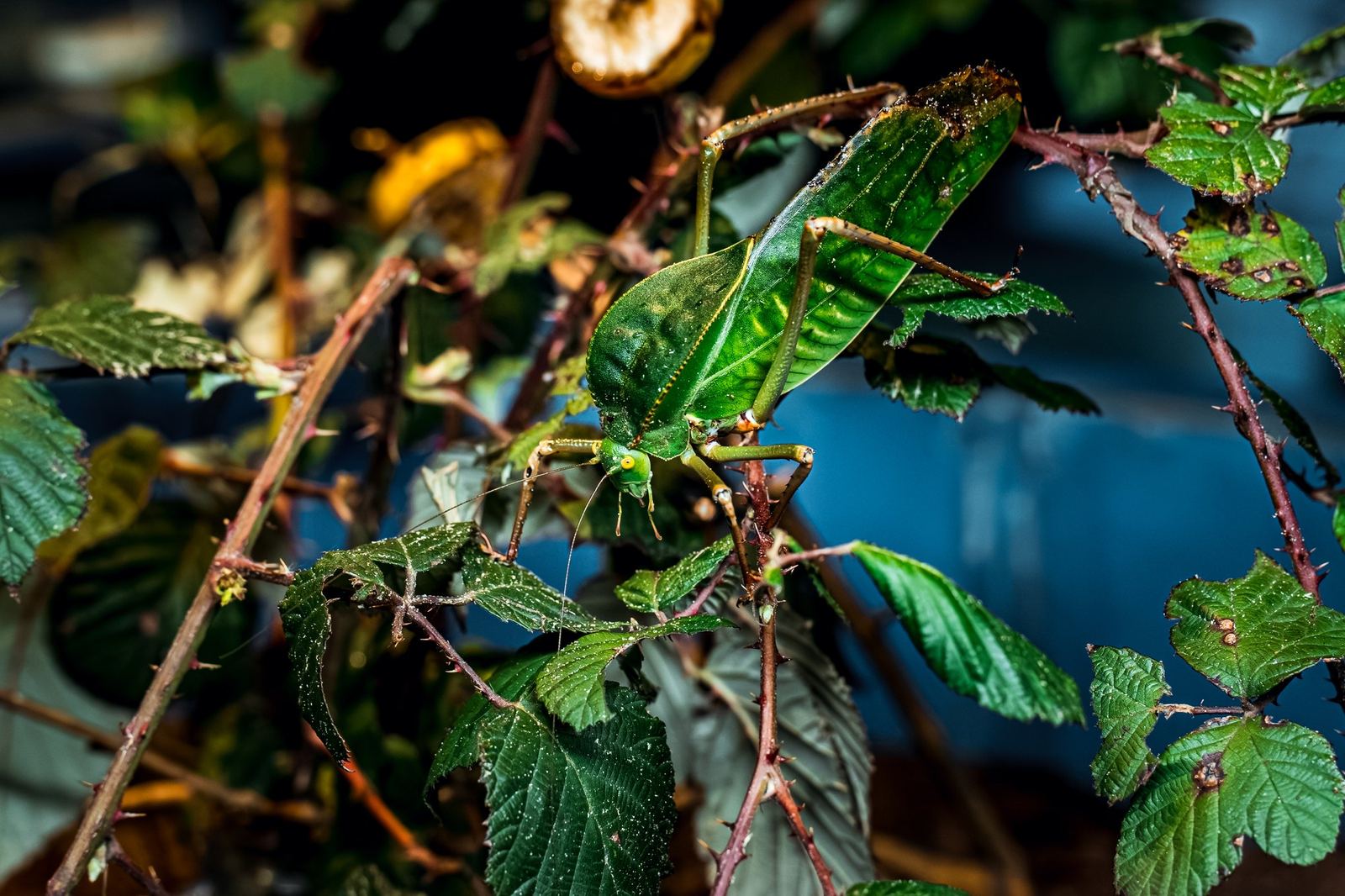
Hooded giant katydidSiliquofera grandisNot Evaluated
A giant among insects
The hooded giant katydid is one of the largest katydids in the world, and one of the biggest insects overall, striking from the very first glance. Females are larger than males and can grow as long as a man’s palm. It gets its Hungarian name from its distinctive helmet-like pronotum, which looks as if it were wearing a “hood”. This structure is not only spectacular but also helps with camouflage, as it lets the insect blend into its surroundings more easily. The animal’s base colour is green with a brownish pattern, which gives it excellent cover on tree bark or in dense vegetation. Although its huge size makes it hard to stay unnoticed, its stillness and disguise help it avoid predators fairly successfully. When in danger, it can leap suddenly with its strong legs and can also perform short gliding flights with its wings.
The species is nocturnal: it sets out to feed after dark and hides during the day. As a herbivore it eats leaves and other plant parts, and it plays a significant role in the forest ecosystem. Its wings are suited not only to flying but also to producing sound: males communicate with a characteristic chirping during the mating season. It prefers younger leaves and tender shoots, which are easier to digest.
During reproduction, females lay their eggs in the soil or among plant material. The hatching young go through gradual metamorphosis and reach their adult form after several moults.
Because of its unusual appearance, the hooded giant katydid is a favourite among zoos and hobby keepers. Keeping it is not easy, however: it needs plenty of space, high humidity and a varied plant diet, so its care is recommended mainly for more experienced keepers.
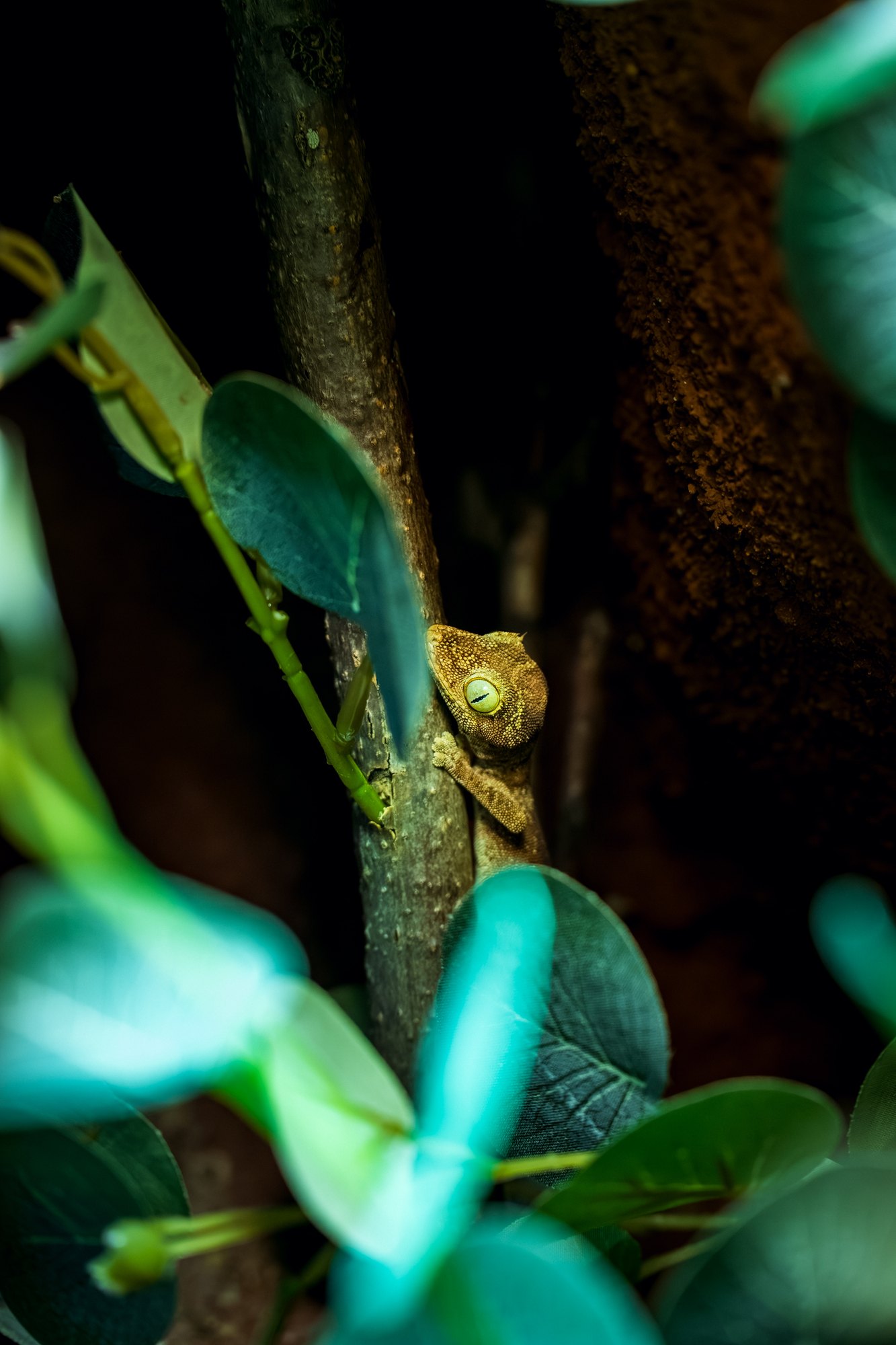
Northern spiny-tailed geckoStrophurus ciliarisLeast Concern
A special defence
The northern spiny-tailed gecko is a mainly nocturnal gecko that is rarely seen during the day. Despite its Hungarian name, it does not occur only in northern Australia but can be found across most of the continent. It inhabits dry and semi-arid areas and scrubland. During the day it lies low among the branches of trees or bushes, where its camouflage colouring provides excellent cover.
In case of danger it uses a special defence: it can shoot a sticky, skin-irritating fluid at its attacker from the base of its tail. This secretion can scare off smaller predators and buys the gecko time to escape. Its spine-like tail projections give it a distinctive look and may also play a role in defence.
It is nocturnal: after dark it sets out to hunt, mainly small insects and spiders. It often moves under tree bark, on branches or near termite mounds, where it easily finds both food and hiding places. Its large eyes give it excellent night vision, while its toes with adhesive pads let it move easily even on thin branches.
Its clutch contains only two eggs, but the female may lay several times within a year. It comes in many colour variants, which also occur in the wild: some individuals have a reddish pattern, others a yellowish or greyish one. It is rarely seen in European zoos, but its unusual looks are making it more and more popular in the terrarium hobby.
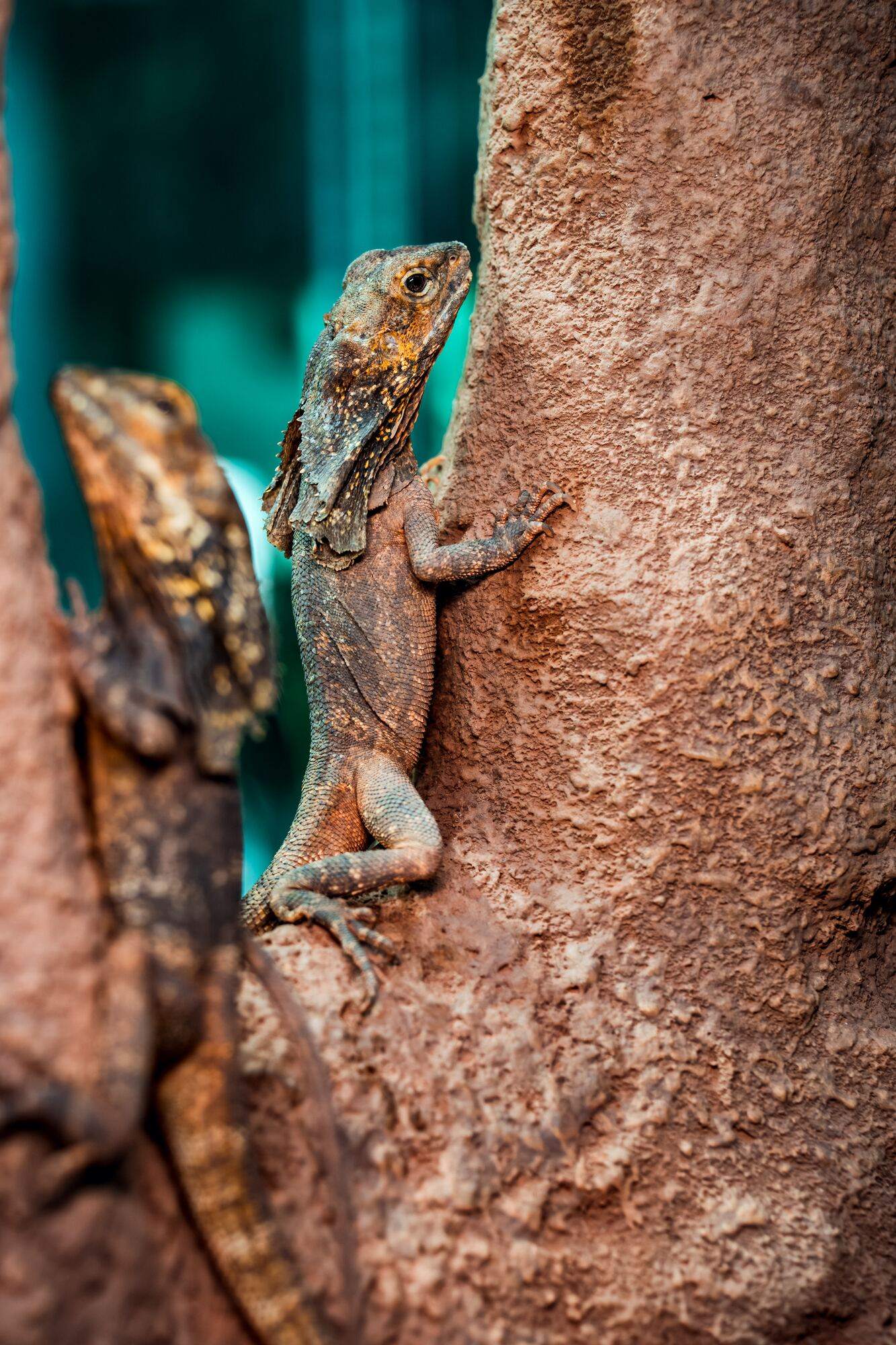
Frilled lizardChlamydosaurus kingiiLeast Concern
The master bluffer
Few reptiles have a defence mechanism as spectacular and well known as the frilled lizard’s. The species gets its name from the large, fan-like flap of skin around its neck, which it suddenly spreads when in danger. With its sudden appearance and vivid colouring, this frill warns and startles the enemy, while the animal, mouth gaping and hissing, tries to look bigger and more threatening than it really is. The frill is held open by long cartilage rods located around the jaw and neck.
If this bluff fails, the frilled lizard can rise onto its hind legs and sprint away at lightning speed. While running it uses its long tail for balance, which often makes its movement resemble a tiny dinosaur. It then seeks shelter among the branches of the nearest tree or bush. Frilled lizards open their frills not only when in danger but also during courtship and when defending their territory. Interestingly, individuals living in zoos and terrariums only rarely spread their frills fully, as they experience less stress.
The frilled lizard is one of Australia’s best-known reptiles, often featured in Aboriginal culture and in modern Australian nature films. It is not only found at ground level: it is often seen resting on termite mounds or hiding among branches. Its brownish-grey pattern provides excellent camouflage on tree bark and in dry undergrowth. At rest it lies motionless, pressed against tree trunks, which makes it extremely hard to spot.
It is essentially a solitary species that may show territorial behaviour towards others of its kind, especially among males. Dominant males warn their rivals with dramatic body postures and by spreading their frills. A single male can even live peacefully with several females in the same territory. During the hot daytime hours it often retreats into the shade, and its activity can also vary with the seasons and the amount of rainfall.
In terms of diet, the frilled lizard is mainly an insect-eater, feeding chiefly on ants, termites, beetles and spiders, though it occasionally catches smaller vertebrates too. It seizes its prey with a quick movement of the head. When breeding, the female lays her eggs in a burrow dug into the ground, often in a sunny spot where the soil temperature ensures the embryos’ development. Young lizards begin an independent life straight after hatching and at first lead a secretive existence. Their pattern is brighter and more contrasting than that of adults, which may help to confuse predators. Today the frilled lizard has become a popular pet.
Seven-spot archerfishToxotes chatareusNot Evaluated
The seven-spot archerfish is one of the largest members of its genus. It is named after the large dark spots on its sides. Thanks to its powerful build, it hunts not only with jets of water but often leaps right out of the water to catch prey. In the wild it is often seen among the roots of mangrove trees, lurking near the surface for insects and smaller animals.
Banded archerfishToxotes jaculatrixNot Evaluated
Despite its Hungarian name (“Javan”), it is not native only to Java. The banded archerfish is one of nature’s best-known “sharpshooters”. Thanks to the special structure of its mouth cavity, it can shoot a precise jet of water, knocking insects sitting above the surface into the water. A larger fish can hit its target with surprising accuracy even from several metres away. It often lives in small groups, and younger fish frequently hunt together in shallow coastal zones.
Thorny devil stick insectEurycantha calcarataNot Evaluated
A thorny bark-dweller
The thorny devil stick insect is one of the most unusual-looking stick insects, resembling at first glance a spiny twig or a piece of bark. Its body is covered in a rough, brownish-black chitinous armour decorated with sharp spines and outgrowths. This distinctive surface mimics tree bark perfectly, making the animal almost invisible in its natural environment.
Females are much sturdier and larger, while males are slimmer with longer legs. The males’ hind legs often bear strong spines, which they can also use for defence. When in danger the animal does not jump or fly but freezes motionless, relying on its excellent camouflage. If cornered, it can defend itself with its powerful legs. It is nocturnal: by day it hides motionless in the vegetation, while at night it feeds actively. It eats leaves and shoots and plays an important role in breaking down plant biomass. When reproducing, females simply drop their eggs onto the ground. The hatchlings look like miniature copies of the adults, though their colouring still differs from theirs. Interestingly, in some cases the species can reproduce without males, by parthenogenesis.
The males’ behaviour is especially striking, as they often clash with one another over mating, and then they genuinely use the spines on their hind legs as weapons. Females, by contrast, are much calmer and spend most of their time feeding, since sustaining their larger bodies takes more energy. It is interesting to watch that when disturbed, they do not flee at once but often first “play the part” of a twig, staying motionless for a long time.
The thorny devil stick insect is often seen in zoos and home terrariums, but keeping it takes a little care. It needs high humidity, adequate ventilation and a constant supply of fresh plant food. Although it is a fascinating animal, its spines mean handling it calls for some caution, so it is better suited to more experienced keepers.
Pig-nosed turtleCarettochelys insculptaVulnerable
The last of its kind
The pig-nosed turtle, also known by its less common Hungarian name “piglet-faced turtle”, is a truly remarkable reptile that lives in the fresh waters of Australia and New Guinea. It looks odd even at first glance, as it differs in many ways from other turtles. Although its appearance combines features of sea turtles and softshell turtles, it is closely related to neither. It is the only living species of the genus Carettochelys, and its close relatives are now extinct. One of its most striking features is that it has no hard shell like most turtles, but a softer, leathery-looking one.
Its nose looks like a small snout that really does resemble a pig’s. That is why it is called the “pig-nosed turtle”, and its other English name is the “Fly River turtle”, which refers not to flying but to the Fly River. Its front limbs have only two claws each, unlike most turtles, which have five on each foot. With its limbs almost completely modified into flippers, it practically “flies” through the water.
It spends almost its whole life in the water and only very rarely comes onto land, mainly females when laying eggs. It can stay underwater for long periods because it can absorb oxygen to some extent through its cloaca as well. This special way of breathing helps it stay hidden from predators for a long time. Its small snout helps too, since it does not need to stick its whole head out of the water to take a breath.
It is omnivorous and eats plants, fruit, insects and smaller animals. Fruit that falls along the rivers, for example, makes up an important part of its diet. The individuals living in Tropicarium eat mussel meat, fruit, lettuce, vegetables and aquatic plants.
Threadfin rainbowfishIriatherina werneriLeast Concern
The threadfin rainbowfish is known for its exceptionally long, ribbon-like fins, which are spectacular in males. During courtship, males try to impress females with spread fins and quivering movements. It is a peaceful, shoaling species that, like Paska’s rainbowfish, swims mainly near the water surface. It feeds on tiny insects, planktonic organisms and algae.
Paska’s rainbowfishPseudomugil paskaiNot Evaluated
Paska’s rainbowfish is a tiny, lively fish made special by its brilliantly shimmering blue eyes. Males often compete with one another, spreading their fins to show off their colours. It lives in small shoals and stays mainly near the water surface. Its diet consists of tiny insects, planktonic organisms and algae.
Desert tree frogLitoria rubellaLeast Concern
An amphibian of dry lands
The desert tree frog is a tiny, highly adaptable Australian tree frog. What makes it special is that it can live not only in rainforests but also in distinctly dry, hot habitats. It is often found in seasonally filling puddles and catchments, and even in inhabited areas, for example near garden taps, drains or garden ponds. Interestingly, the species has no official Hungarian name; “sivatagi levelibéka” (desert tree frog) is a literal translation of the English name.
Its colour is variable: depending on habitat and temperature it can be light green, brownish, greyish or even reddish. This camouflage helps it stay barely noticeable when hiding among dry vegetation or along the ground. Its skin retains moisture well, which is key to surviving in water-poor habitats. Its fingers have adhesive discs, which let it climb easily onto bushes, branches or even the walls of buildings.
It breeds in the rainy season, when males call to females with high-pitched, repeated calls at freshly filled puddles. Tadpoles develop quickly, because these habitats are often available only briefly before they dry out.
Although common in the wild, it is very rarely displayed in zoos. In April 2026 it could be found in only three zoos worldwide, and in Europe only at Tropicarium in Budapest.
Dwarf rainbowfishMelanotaenia praecox
The dwarf rainbowfish is one of the smallest members of its genus, but its colouring is extremely intense, with a neon-blue glow, especially in males. It is a fast, active shoaling fish that favours dense vegetation.
When breeding, it lays a relatively small number of eggs but spawns repeatedly over a longer period. Because of their tiny size, the larvae initially feed on planktonic organisms. The species shows sexual dimorphism: the males’ colours are much brighter and more contrasting than the females’.
Forktail rainbowfishPseudomugil furcatus
The forktail rainbowfish is named after its distinctive, deeply notched tail fin, as well as its vivid blue eyes. Males show yellowish-orange colouring on the chest, which becomes brighter during courtship.
The species is an egg-layer, and the eggs stick to tiny plant fibres, where they develop in 10–15 days. The young are very small, so at first they feed on plankton. The forktail rainbowfish lives in shoals, but forms only loosely structured groups.
Western rainbowfish
(Melanotaenia australis)
The western rainbowfish’s varied colouring differs between geographic populations; in males a combination of bluish and orange bands can be seen. The species adapts well and can survive in different types of water.
When breeding, they scatter the eggs among plants, and the eggs go on developing freely. The species shows no parental care. It can breed all year round if conditions are favourable. Young fish grow quickly and can reach sexual maturity within a few months.
Red rainbowfishGlossolepis incisusNot Evaluated
The red rainbowfish is one of the most eye-catching members of the rainbowfish family, and its vivid red colouring develops at sexual maturity. The species lives in shoals, but is not a shoaling fish in the strict sense; it forms looser groups.
As an egg-scattering species, females lay tiny eggs over several days, and the males fertilise them externally. The larvae hatch quickly and at first feed on planktonic organisms.
Zebra finchTaeniopygia guttataLeast Concern
The world-conquering ornamental bird
It is the bird species seen in the greatest numbers at Tropicarium. The zebra finch is one of the best-known and best-loved ornamental finches and, after the various parrots and the canary, the most widespread ornamental bird in the world. Thanks to its good adaptability, it also thrives in its natural habitat, the drier regions of Australia. It is a social bird that in the wild moves in smaller or larger flocks and keeps in touch with its companions by calling. It is a lively, active bird that searches for food actively all day. It feeds mainly on seeds, but during the breeding season it also gathers insects so that its chicks get enough protein.
Its Hungarian, English and German names refer to the black-and-white stripes on its throat, which resemble a zebra’s. Males have especially ornate plumage: their orange cheek patches and patterned flanks easily set them apart from females. This description applies only to birds of the wild-type colour variety, the one also seen in nature. Countless colour varieties of the zebra finch have been bred today. This species breeds extremely fast and, under favourable conditions, can raise several broods a year. Zebra finches build their nests from blades of grass and soft plant material, often sheltered by bushes or tree hollows. They are popular pets and, given plenty of space, can be kept together with other bird species.
Green tree pythonMorelia viridisLeast Concern
Life in the canopy
The green tree python’s other Hungarian name is the emerald python. It is a giant snake with a special way of life: it lives in trees and shrubs and moves through the canopy. It usually waits patiently for its prey, coiled up in one spot. It can be active both day and night, although it mostly begins to move after dark. It hunts small mammals, nestlings and lizards, which, like other constrictors, it kills by squeezing. Because the green tree python lives mainly in trees and shrubs, it rarely comes down to the ground, usually only when looking for food, such as smaller mammals, or an occasional water source. Descents to the ground typically happen once or twice a week, depending on how much food is available in the canopy. The python drinks mostly from natural sources, such as rain-filled catchments, or by licking water droplets off leaves, but captive animals need fresh, clean water every day. Drinking and coming down to the ground are essential for survival, thermoregulation and hydration, since moisture is less evenly available in the canopy.
In appearance, the green tree python, found in Asia and Australia, closely resembles the emerald tree boa of the Americas (Corallus caninus), especially in the shape of its head and its laterally flattened body, yet the two snake species are only very distantly related. This similarity is the result of convergent evolution: because of a similar lifestyle and environment, the two look-alike snakes developed independently in two parts of the world.
In green tree pythons the young’s colouring is completely different from the adults’: hatchlings are usually yellow, orange or reddish, and only after a few months do they lose their vivid colours and take on the characteristic bright green shade of adulthood.
See them
in person too
Buy tickets
Frequently asked questions
When is the shark feeding?
On Mondays at 14:30 the sharks are fed from above, and on Thursdays at 14:30 by divers, in the shark aquarium. You can find the times of the other feedings on the Feedings and keeper talks page.
Can we come in bad weather or rain?
Yes. Tropicarium is a fully covered indoor attraction inside the Campona building, so you can enjoy it comfortably whatever the weather, in rain or cold.
How long does a visit take?
At a relaxed pace, 1.5–2 hours on average. If you want to catch a feeding or spend more time at the ray-petting pool, allow a longer visit.
Can I take photos?
For personal use, yes, but flash is prohibited because it disturbs the animals.
You will find answers to further questions on the FAQ page.