Wildlife of Africa
Snakes, geckos and small mammals from the continent's dry and wet habitats.
Visitor favourites
Click any of them and its description opens in the list below.
Residents of Africa
32 species. Click a name for details.
West African lungfishProtopterus annectensNot Evaluated
The African lungfish belongs to the lungfishes, one of the most ancient groups of fish still living today in evolutionary terms. Its special feature is that besides its gills, a modified swim bladder works like a lung, so it can also take oxygen from the air. This lets it survive in waters where other fish would suffocate.
In the dry season it burrows into the ground and wraps itself in a cocoon of mucus, reducing its metabolism to a minimum, so it can survive for months without water. It moves slowly, in a snake-like way, and lives mostly on the bottom. It is an active predator mainly at night, feeding on smaller fish and invertebrates. Because of its appearance and way of life it is often called a “living fossil”.
African red-eyed tetraArnoldichthys spilopterusLeast Concern
A fast-moving schooling fish that swims mainly in open water. Its diet consists of insect larvae, planktonic organisms and plant matter. Males are usually more brightly coloured, especially in the breeding season. In its natural habitats it plays an important role in regulating populations of small aquatic invertebrates.
Masked flower chaferPachnoda marginataNot Evaluated
A colourful terrarium resident
The masked flower chafer is a well-known tropical species of the flower chafer subfamily. The pattern on the back of each masked flower chafer is unique to the individual: no two specimens have the same markings. It plays a major role in the decomposition processes of forest ecosystems. The adults are often seen on flowers and fermenting fruit, where they not only feed but may also play an indirect part in pollination.
The species has a rapid development cycle, which allows populations to recover quickly under favourable environmental conditions.
Its larvae develop in the humus-rich layers of the soil, where they break down organic matter intensively and so contribute to nutrient cycling. During their short lifespan the adults specialise mainly in energy-rich, sugar-rich food sources, which give them a fast metabolism.
One of the flower chafer species most commonly kept in terrariums.
Electric yellow cichlidLabidochromis caeruleusLeast Concern
Thanks to its bright yellow colour it is one of the best-known African cichlids in the aquarium hobby. In the wild it collects its food from crevices between rocks. It is relatively peaceful compared with most Lake Malawi cichlids. It constantly searches the surface of stones for tiny invertebrates. The female is a mouthbrooder, so the fry are protected in the early stages of development.
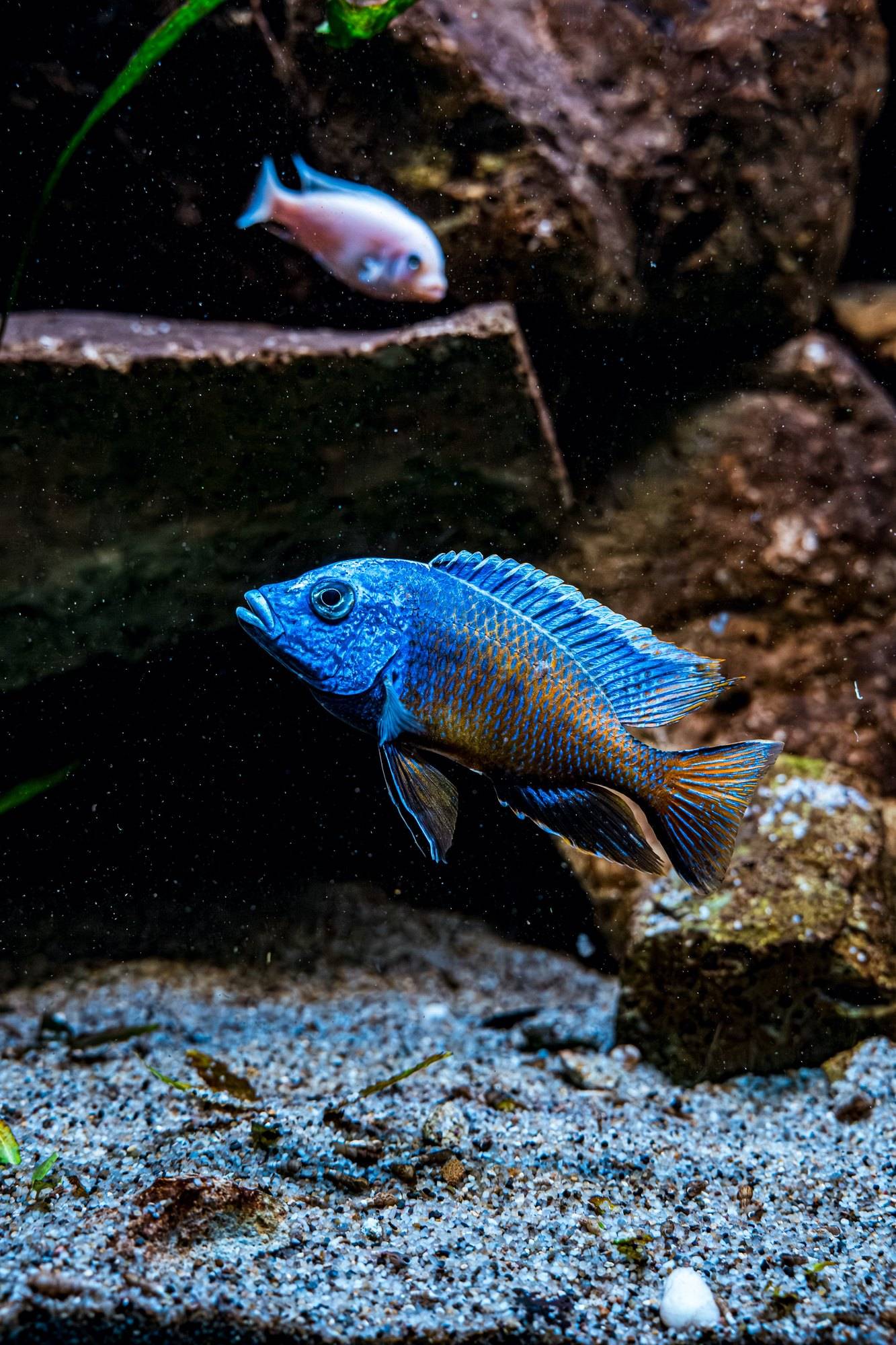
Emperor cichlidAulonocara stuartgrantiLeast Concern
The males' extremely vivid blue, yellow and orange colouring plays a role in mate choice. With its sensitive lateral line system it can detect even tiny animals hiding in the sand. The species is generally calmer in behaviour than many other African cichlids. Males guard small territories on the substrate, where they court the females. During breeding the female carries and protects the developing fry in her mouth.
Dolphin cichlidCyrtocara mooriiLeast Concern
It gets its name from its rounded forehead and bluish colouring, which resemble a dolphin. With age, males can develop a characteristic fatty hump on the forehead. It is a calmer cichlid that often moves in small groups. While feeding it searches the bottom for tiny invertebrates. It is a mouthbrooding species: the female carries the fertilised eggs in her mouth until they hatch.
White-spotted cichlidTropheus duboisiNot Evaluated
The striking white-spotted pattern of the young fades gradually as the animal gets older. It is a highly specialised algae grazer that scrapes the coating off the surface of rocks. It lives in schools, where the hierarchy within the group plays an important part in the fishes' lives. Because it feeds continuously, it is almost constantly active.
Henkel's leaf-tailed geckoUroplatus henkeliEndangered
Tree bark come to life
Henkel's leaf-tailed gecko is one of the most remarkable reptiles of the Madagascan rainforests and takes its name from its strikingly broad, leaf-like tail. This “camouflage tail” and the rough, bark-like pattern covering its body together make the animal almost invisible as it rests on tree trunks.
By day it clings to trees completely motionless, flattening its body against the bark so that it blends perfectly into its surroundings. In danger it does not flee at once but instead reinforces its hiding silhouette, pressing itself flat, and only as a last resort does it leap away from the attacker at lightning speed. Interestingly, Henkel's leaf-tailed gecko can change its colour within a certain range, adapting even more effectively to its surroundings and the light conditions.
Henkel's leaf-tailed gecko has tiny adhesive pads on its toes, which let it move easily on vertical tree trunks and even on the undersides of branches. Its eyes are extremely large and its pupils widen enormously after dark, so it can detect the slightest movement in the night forest. It is a nocturnal species: with its large, light-sensitive eyes it hunts for small insects, spiders and other arthropods. Its survival is made harder by its very slow reproduction and its specialised habitat requirements. Habitat loss and deforestation also threaten the survival of its populations. Although it is rarely seen in its natural habitat, it is becoming an increasingly popular species in terrarium keeping.
Hongi cichlidLabidochromis sp. “Hongi”Not Evaluated
The species' vivid orange-and-blue colouring is especially striking in dominant males. It lives in the rocky parts of Lake Malawi and establishes small territories. It feeds mainly on tiny invertebrates and algal growth. It is an agile, active fish that constantly patrols its surroundings in search of food. Like most Malawi cichlids, it is a mouthbrooding species.
Blockhead cichlidSteatocranus casuariusLeast Concern
Its Hungarian name (“cassowary-headed cichlid”) comes from the characteristic fatty hump on the heads of males, which resembles the casque of the bird known as the helmeted cassowary. With its strong pectoral fins it can brace itself steadily among the stones even in a strong current. It often establishes a territory in caves or in hollows under stones. During breeding both parents actively guard the eggs and the fry. Its body shape means it is well adapted to surviving in fast-flowing African rivers.
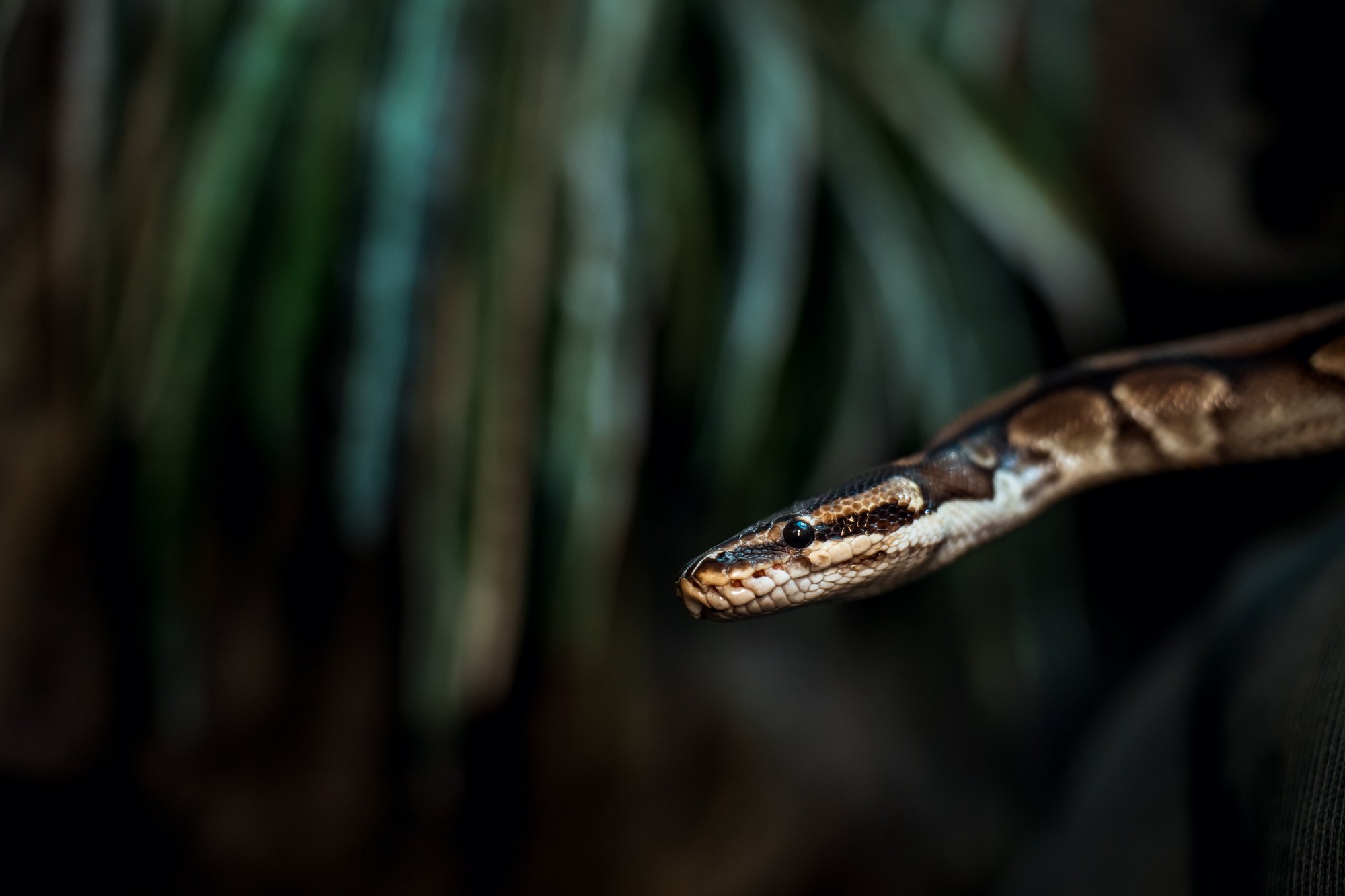
Ball pythonPython regiusLeast Concern
A popular pet
The ball python is the smallest python species in Africa and one of the smallest giant snakes in the world. When in danger it coils into a ball, trying to scare off predators and, above all, to protect its head. This is also where its English name, “ball python”, comes from.
In male ball pythons, tiny spiny spurs can be seen on either side of the cloaca. These are remnants of hind legs inherited from the snakes' lizard-like ancestors (snakes evolved from lizards). The spurs matter mainly during mating: males use these spurs to gently brace against the female's side and keep a stable position. These spurs can be seen in most python species.
The ball python is an especially popular pet because its size makes it easy to keep, and most individuals are calm and tame well. At Tropicarium we show specimens of the so-called normal colour morph, which also occurs in the wild. No two of these animals have the same pattern; every animal's markings are unique. Under terrarium conditions many special colour and pattern morphs of the ball python have been bred. By some estimates there may be 300–400 morphs. For a snake of a more valuable colour morph, astronomical sums are often asked.
Like other giant snakes, the ball python has no venom. It does have teeth, however, and may bite if it feels threatened. Its bite usually causes only minor injuries. Even so, it is important to look after your pet carefully if you decide to keep a ball python at home. The ideal temperature in a ball python's terrarium is 26–32°C by day and 22–24°C at night, and a warmer basking spot of 30–32°C must always be provided. Humidity of around 50–60% is optimal. It is important to create hiding places in the terrarium where the snake can feel safe. In addition, these animals need a large water bowl in which they can bathe comfortably.
Congo tetraPhenacogrammus interruptusLeast Concern
A large African characin species. Males have long, veil-like fins and iridescent, rainbow-like colouring. It is a schooling fish that in its natural habitat moves mainly in the middle water layers. It feeds chiefly on tiny insects, planktonic organisms and plant debris. It thrives in dim waters thickly overgrown with vegetation. A calm-natured characin.
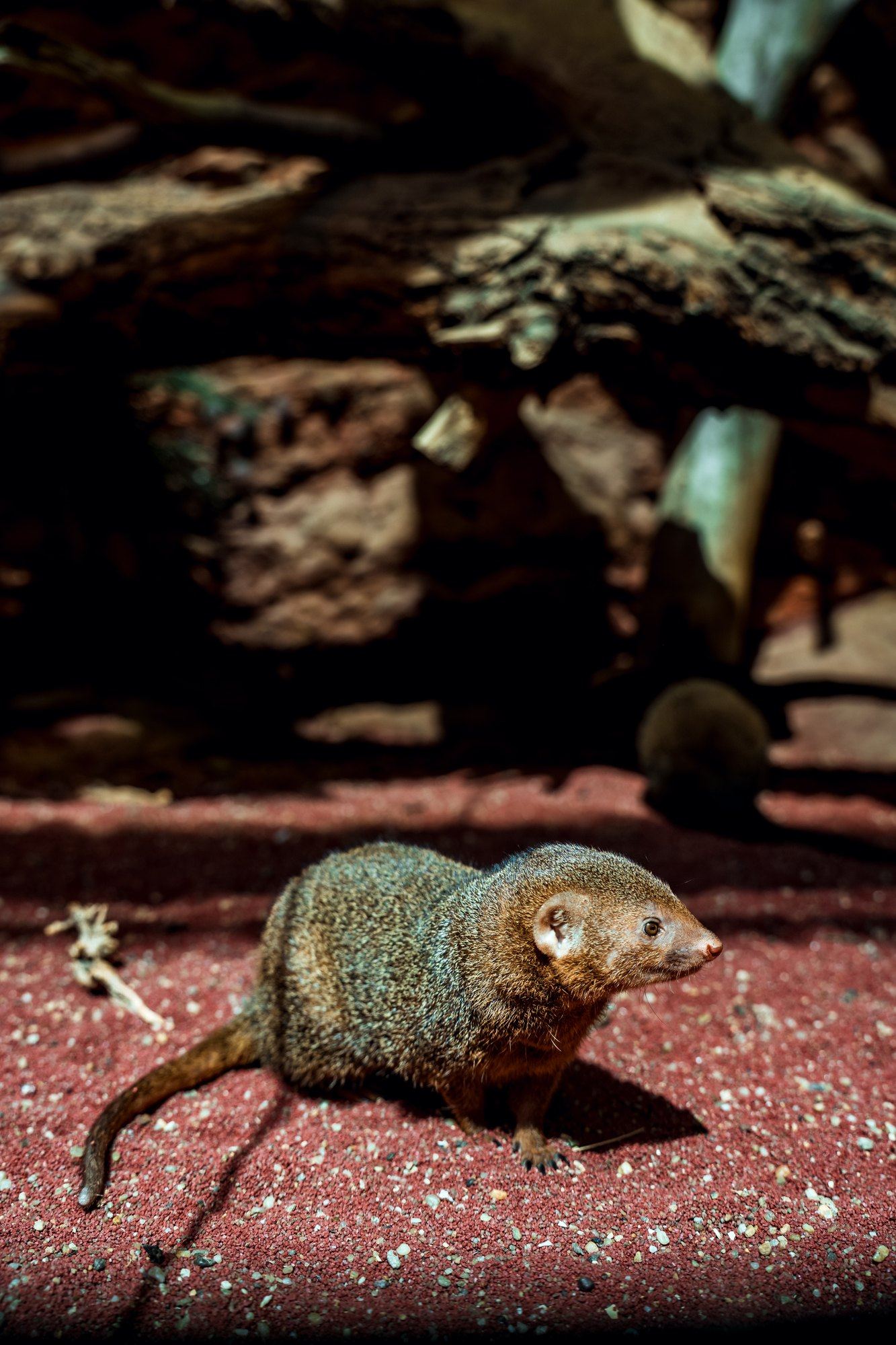
Common dwarf mongooseHelogale parvulaLeast Concern
The smallest mongoose
The common dwarf mongoose is the smallest mongoose species in the world and one of the carnivores with the most complex social behaviour. It lives in family groups, usually of 5–15 individuals, characterised by a strict hierarchy. Members of the group hunt together, raise the pups together and take turns standing guard. Only the dominant female of the troop breeds, and she is usually the mother of all the other animals (except the lead male).
The dwarf mongoose's fur is brownish-grey, which provides excellent camouflage in dry, grassy habitats. Its body is slender, its legs short and its tail relatively long. It moves fast and nimbly, often zigzagging as it searches for food among stones, bushes and leaf litter. With its strong claws it easily turns over the soil or pulls apart rotting logs to find insects.
Dwarf mongooses eat insects, spiders and small reptiles, and occasionally fruit as well. When foraging they can tackle larger prey, such as a snake, together. They sometimes add eggs to their diet. While hunting they stay in constant contact with each other through soft chirping or growling sounds. As with the meerkat, “sentinel” behaviour can be seen in this species: while the rest of the group feeds, one individual stands on a higher spot watching the surroundings and warns its companions with an alarm call if danger appears. They use different alarm calls for different predators.
Their communication consists of varied sounds, scent signals and body postures. Group members often groom each other's fur, which strengthens social bonds. At night they retreat together into burrows or termite mounds, where they sleep huddled close together. This not only gives them security but also helps them retain body heat. The common dwarf mongoose adapts well to changing environments. It often uses abandoned burrows or even termite mounds. Although it is currently not threatened, the loss of its habitats may have a negative effect on some populations. In some places it tolerates the spread of farmland well and even appears near human settlements, where the insect-rich environment suits it.
Leopard tortoiseStigmochelys pardalisLeast Concern
The leopard of the tortoises
The leopard tortoise, also called the panther tortoise, is Africa's second-largest land tortoise; only the African spurred tortoise is bigger. Its strong, domed shell protects it effectively against predators. Although it looks sluggish at first glance, it actually needs a lot of exercise and is a tireless wanderer that can cover large areas in search of food. Although basically herbivorous, it occasionally also eats insects, snails and plant matter contaminated with droppings. On hot days it often retreats into the shade or rests in burrows to avoid overheating.
The leopard tortoise is named after the spotted pattern on its shell, which resembles a leopard's. The pattern changes gradually with age. Young animals have a more contrasting, livelier marking, while on older tortoises the pattern gradually becomes paler and more even. Tortoises begin to lose their juvenile pattern at 3–5 years of age. The characteristic leopard pattern typical of the species is seen on older specimens. Every animal's pattern is unique, which also makes the animals easier to identify. If you wish to keep a leopard tortoise as a pet, it must have a breeder's certificate proving the animal's origin. Until the tortoise reaches a shell length of 10 cm, this breeder's certificate carries photos of the plastron and the carapace, whose patterns make it possible to tell individuals apart.
Madagascar giant day geckoPhelsuma grandisLeast Concern
The oddball of the geckos
True to its name, the Madagascar day gecko, unlike most gecko species, is active not at night but by day. Its bright green base colour, red spots and pattern give it excellent camouflage in the canopy. It is a fast, agile animal that actively patrols its territory during the day. The adhesive pads on its feet let it cling easily to almost completely vertical surfaces, even glass.
It is often seen close to people, for example on house walls or in gardens, where it hunts insects and also likes to eat sweet fruit and nectar. With its long tongue it can lick nectar from flowers, so it may play a part in pollinating some plants. Its large, light-sensitive eyes give it excellent daytime vision, and in bright light its pupils narrow to thin slits.
The species is territorial: males in particular aggressively defend their own area against other geckos. When in danger it flees lightning-fast into the vegetation and, like many other gecko species, can shed its tail, which later regrows. Its skin is quite fragile, so if a predator or a person tries to grab it, the top layer of skin can easily come off.
In one clutch the female usually lays only two eggs, which she glues to a hidden, sheltered spot. She may breed several times within a season. The young grow quickly and within a few months can reach most of their adult size. The species is a popular terrarium animal, although keeping it requires some experience.
Barred bichirPolypterus delheziNot Evaluated
The barred bichir's body structure is considered one of the most ancient among bony fish alive today, which is why it is often called a “living fossil”. Several separate dorsal fins help it move steadily in habitats thickly overgrown with vegetation. Its armour-like, thick scales give it effective protection against predators.
Its respiratory system lets it take air from the water surface, so it stays active even in oxygen-poor environments. It is a slow predator that waits motionlessly for prey to come close. It becomes truly active at night, when it feeds on smaller fish and aquatic invertebrates.
KribensisPelvicachromis pulcherLeast Concern
During the spawning season its belly can turn a vivid purplish red, which is where its Hungarian name (“cherry-bellied cichlid”) comes from. It is a rather peaceful cichlid that breeds in small caves or under roots. The pair look after the eggs together and shepherd the fry. Its diet consists of tiny invertebrates, algae and organic debris. Thanks to its colourful looks and interesting family behaviour, it has long been a popular ornamental aquarium fish.
Orange-banded tropheusTropheus mooriiNot Evaluated
This species is an extremely active algae grazer that constantly cleans the surface of stones in search of food. It is strongly social and lives in larger groups. Its colouring varies considerably: in different regions of the lake live orange-banded tropheus of different colour forms. Because it defends its territory, it often nips at its own kind.
Norman's lampeyePoropanchax normaniNot Evaluated
The species is named for its distinctive, bluish shimmering eye, which is especially striking when lit from the side. It is a peaceful schooling fish that stays near the water surface. A small, extremely lively species, it constantly watches its surroundings in search of tiny food. In its natural habitats it favours places with dense aquatic vegetation. Its name preserves that of the British ichthyologist (fish biologist) John Roxborough Norman. The species was described by Ernst Ahl in 1928 and named after Norman, because it was he who sent the specimens under study to Ahl for identification.
Tomato frogDyscophus guinetiLeast Concern
Tomatoes in the rainforest leaf litter
The tomato frog is an easily recognised species thanks to its vivid reddish-orange colour. This colour is also a warning: its skin produces a mildly irritating secretion that deters predators. Its colouring and shape really do give this frog a tomato-like look.
By day this frog mostly buries itself in the ground or hides under leaf litter, but at night it hunts actively. It catches its prey, mainly insects and worms, with its sticky tongue. Its body is stocky and rounded, which helps it burrow quickly into loose soil or leaf litter. When in danger it often puffs up its body, so that it looks bigger and harder to swallow to predators. The sticky secretion of its skin is not only irritating but can be so adhesive that it may briefly glue shut the mouths of smaller predators.
It breeds in the rainy season, when males call females to shallow water with loud “croaking”. Females are usually much larger and more brightly coloured than males; the sexual dimorphism of the species is striking. Quickly developing tadpoles hatch from the eggs and turn into young frogs within a few weeks.
Although the tomato frog is not currently considered threatened, habitat loss and the illegal animal trade may locally have a negative effect on its populations. Thanks to its eye-catching looks it is a species often shown in zoos and terrariums. Interestingly, there are several different tomato frog species, which differ from one another in their range and somewhat in their colouring.
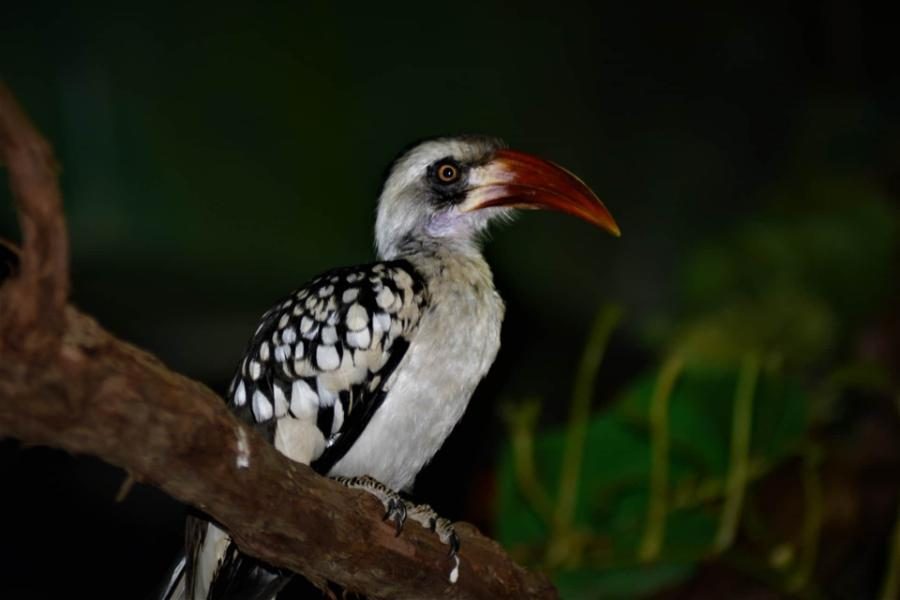
Red-billed hornbillTockus erythrorhynchusLeast Concern
The real Zazu
The red-billed hornbill is an African member of the hornbill family. With its long tail, black-and-white plumage and strikingly curved, bright red bill, it is one of the most characteristic birds of the African savannas. Zazu, a character in the cartoon The Lion King, was modelled on this bird. Its bill is light in structure yet powerful, and it uses it for foraging, digging and defence. Its distinctive territorial song carries far.
The species is widespread across much of Africa and is especially common in drier, open areas. It mostly forages near the ground, where it looks for insects, spiders, smaller reptiles and fallen fruit. It is often seen near larger mammals too, because their movement flushes out prey. Its breeding is especially interesting: during the nesting season the female withdraws into a tree hollow, and the male walls up the entrance almost completely with mud, droppings and food remains. He leaves only a narrow slit, through which he can feed the female and later the chicks. This special form of behaviour protects the eggs and chicks from predators.
Yellow-tailed cichlidLepidiolamprologus elongatusNot Evaluated
The yellow-tailed cichlid is an active, fast-moving predator that hunts in the narrow crevices and shaded areas of rocky habitats. Its body is elongated, which helps it accelerate and change direction suddenly among the stones. It often lives alone and firmly defends its own territory against other predators. It mostly takes its prey by ambush.
Helmeted geckoTarentola chazaliaeVulnerable
A zoo rarity
The helmeted gecko is named for its distinctive, slightly “helmet-like” head shape and the heavily armoured look of its head pattern. In appearance this species is specialised for perfect concealment: the pattern of its body blends superbly into coastal rocks, stones and crevices. When in danger it most often freezes motionless and presses itself against the surrounding features. If that is not enough, it hides lightning-fast in a rock crack, where its flat body lets it almost “squeeze” itself into even the narrowest gaps. Like many other gecko species it can shed its tail (autotomy), which still moves afterwards and so can distract the predator.
The helmeted gecko is also an extremely skilled climber. Its eyes are large and light-sensitive, giving it excellent night vision for hunting in the dark. The species reproduces relatively slowly, as the female usually lays only 1–2 eggs at a time. The helmeted gecko becomes active at night: it then hunts tiny insects and catches its prey with extremely fast reflexes. The species basically lives a solitary life, but several individuals can be kept together under terrarium conditions. Thanks to its good adaptability it often turns up in inhabited areas too, where insects gathering around artificial lights offer it easy food.
The helmeted gecko is currently not threatened, but habitat loss, for example disturbance of coastal areas, may locally affect its populations. Because of its natural, secretive way of life it is rarely seen in the wild. Even though it is an increasingly popular pet, we can only rarely meet it in zoos: in April 2026, only three zoos in Europe, Tropicarium among them, showed this species.
Many-striped shell-dwellerNeolamprologus multifasciatusNot Evaluated
This is one of the smallest cichlid species of Lake Tanganyika. It shows extremely complex social behaviour. It lives in small colonies in which several individuals jointly use and defend a “settlement” made of snail shells. The shells provide not only shelter but also a place to breed. Pairs establish their own territory by constantly moving and arranging the sand.
Senegal bichirPolypterus senegalusLeast Concern
Bichirs are among the most ancient fish species on Earth. Separate dorsal finlets line their elongated bodies, giving them a distinctive way of moving. Thanks to a modification of their swim bladder they can also breathe atmospheric air, so they survive in oxygen-poor waters. They hunt actively at night for smaller fish and invertebrates and hide by day. With their strong pectoral fins they are also able to “crawl” along the bottom.
Rainbow land crabCardisoma armatumLeast Concern
Africa's colourful land crabs
The rainbow land crab is native to the coastal areas of West Africa and occasionally also occurs in river estuaries and on islands. The carapace of young animals is bluish-purple, which together with the red legs makes for an attractive appearance. After moulting the animal's colours are always more vivid, and the intensity of the colouring fades with age. It spends most of its time on land. If frightened, it often escapes into the water and tries to hide from its attacker there. It likes to hide under stones or fallen trees. It is an omnivore, eating food of both animal and plant origin. It also eats carrion, and adults may even eat young of their own species.
In the wild it often stays in burrows it digs itself, which protect it from predators and from drying out. With its strong claws it not only gets food but can also move soil effectively. The moulting period is especially vulnerable for it, as its shell is still soft then, so it leads a more secretive life. In coastal ecosystems it plays an important part in breaking down dead plant and animal remains.
The name rainbow land crab is sometimes also used for other colourful land crab species. It defends its territory aggressively, so under terrarium conditions it can only be kept alone or in a small group.
MeerkatSuricata suricattaLeast Concern
EEP – European Endangered Species Programme
Honour guard in the blazing sun
The meerkat, also known by the less familiar Hungarian name “four-toed mongoose”, is one of the best-known small carnivores of Africa's dry, open areas. With its strong claws it skilfully digs burrows, which serve not only as hiding places but also protect against extreme temperatures and predators, and it is here that females give birth to their young. Because many predators hunt it in its natural habitat, such as birds of prey, snakes, big cats and canids, meerkats are extremely cautious and live in well-organised communities. Breeding in the colony is strictly regulated: usually only the alpha pair breeds, while the pups of younger or lower-ranking females are often killed. Even so, the young are raised and protected jointly by the adults, so all members of the colony contribute to their survival. The group always appoints a sentinel, which stands on a high point (for example a termite mound) watching the surroundings and warns its companions with a loud alarm call if danger appears.
The group accepts members from another group with great difficulty. When two groups meet, they often fight bloody battles for dominance. This is why getting animals from different places used to one another is a difficult task in zoos.
In terms of relationship, meerkats belong to the civet family (Viverridae) and, according to genetic studies, are closer to hyenas than to true cats. This is particularly interesting, as in their behaviour and social organisation they also resemble hyenas: they live in close groups and follow a strict hierarchy.
The meerkat is not picky about food and adapts well to what its harsh habitat offers. It eats mainly insects, spiders, scorpions and other small animals, but also smaller vertebrates, eggs and plant parts. Particularly noteworthy is that it is partly resistant to scorpion venom, so it can eat prey that would be dangerous to many other animals. Several individuals together can even bring down venomous snakes.
Tanganyika six-striped cichlidNeolamprologus sexfasciatusNot Evaluated
The six-striped cichlid behaves like its close relative the five-striped cichlid, but is generally a more reclusive and cautious species. It uses crevices and hollows between rocks as shelter, from which it attacks, “shooting out” quickly. It holds a smaller territory but defends it extremely fiercely. Its diet consists mainly of tiny invertebrates and smaller fish.
Tanganyika five-striped cichlidNeolamprologus tretocephalusNot Evaluated
This species is strongly territorial and is attached to small hollows between rocks. It often holds a chosen area for a long time and actively defends it. It gets its prey with a quick, sudden attack, mainly eating smaller fish and invertebrates. Its pattern helps it hide in its rocky surroundings.
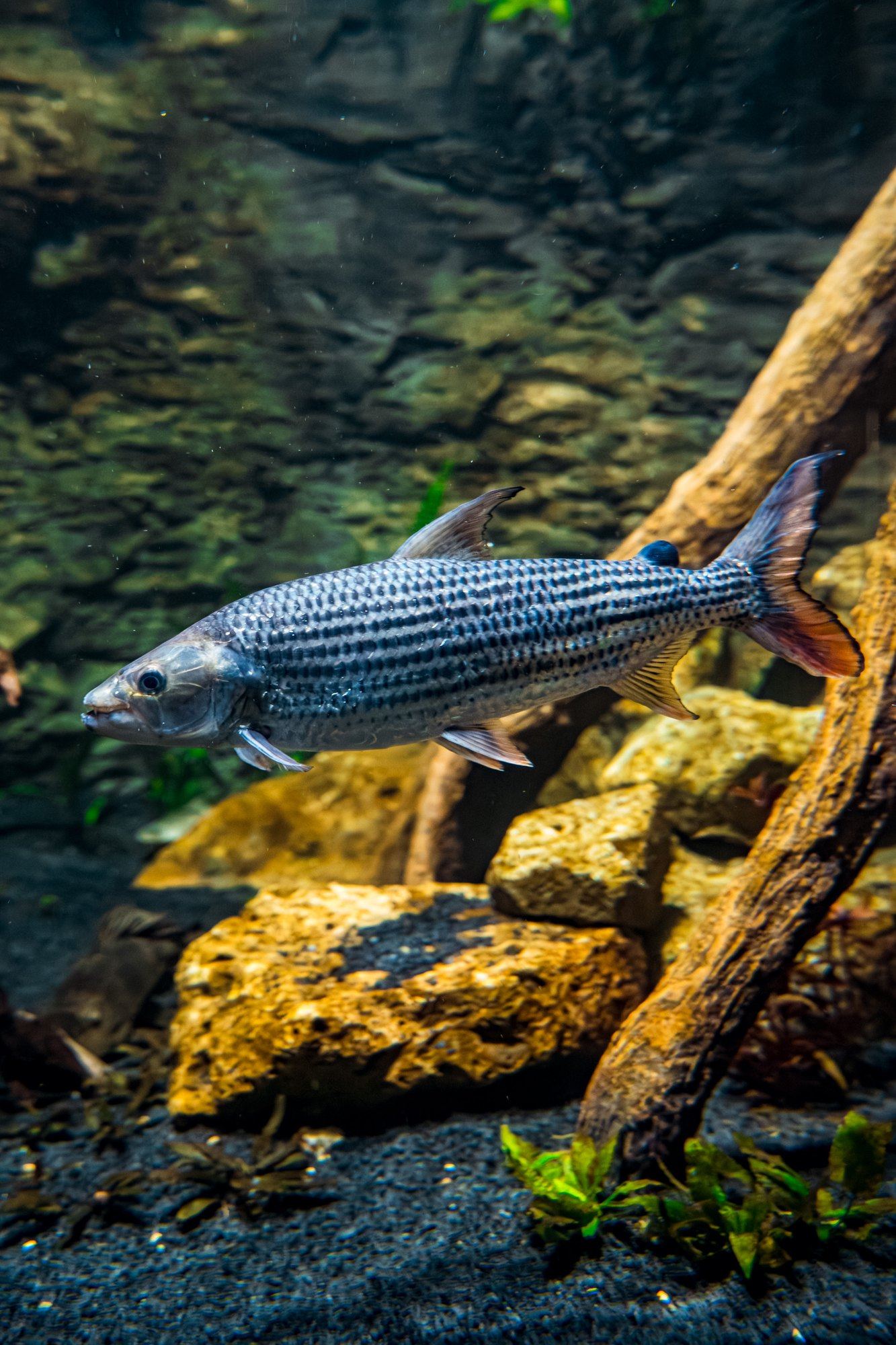
TigerfishHydrocynus vittatusNot Evaluated
The tigerfish's special feature is its extremely well-developed, razor-sharp dentition, suited not only to catching prey but also to cutting up larger prey. Its teeth interlock, so its bite is particularly effective and fast. The species has a strong lateral line organ that detects vibrations travelling through the water from a great distance.
The tigerfish is an extremely fast swimmer, capable of explosive acceleration over short distances, with which it surprises its prey. It often hunts in the middle and upper water layers of rivers, where it chases smaller fish. Its behaviour is strongly opportunistic, adapted to food availability: it always chooses the food that is easiest to get. In some habitats it is regarded as one of the most challenging predatory fish for anglers.
Lilac-breasted rollerCoracias caudatusLeast Concern
The roller of Africa
The lilac-breasted roller is one of Africa’s most colourful birds. It is a close relative of the European roller, which can also be found in Hungary. The long, forked outer tail feathers that give the bird its name lend it an elegant look.
The species’ courtship flight is remarkable. The male puts on an aerial show for the female, full of sudden dives, twists and somersaults. These acrobatic moves play a part not only in choosing a mate but also in defending territory. The bird’s call is a harsh, rasping cry that carries a long way across the open savanna.
The forked-tailed roller usually watches its surroundings for prey from prominent branches, posts or utility poles. From there it suddenly swoops down on insects, lizards or small rodents moving on the ground. It is a fast and precise hunter, and often catches prey flushed out by fires or large animals. It mostly nests in tree hollows, but sometimes takes over abandoned woodpecker holes or natural cavities. The species is currently considered common and is widespread across much of Africa, but habitat fragmentation and the growth of farmland may reduce its natural populations in the long term.
Habitats 23 and 24 (A1 and A2)
Red zebra cichlidMaylandia estheraeLeast Concern
The species can be extremely varied in colour, from shades of orange and red all the way to bluish tones. Males are strongly territorial, especially in the spawning season. In its natural habitat it grazes the algal film growing on rocks, and also eats small invertebrates. Females carry the eggs and the newly hatched fry in their mouths.
See them
in person too
Buy tickets
Frequently asked questions
When is the shark feeding?
On Mondays at 14:30 the sharks are fed from above, and on Thursdays at 14:30 by divers, in the shark aquarium. You can find the times of the other feedings on the Feedings and keeper talks page.
Can we come in bad weather or rain?
Yes. Tropicarium is a fully covered indoor attraction inside the Campona building, so you can enjoy it comfortably whatever the weather, in rain or cold.
How long does a visit take?
At a relaxed pace, 1.5–2 hours on average. If you want to catch a feeding or spend more time at the ray-petting pool, allow a longer visit.
Can I take photos?
For personal use, yes, but flash is prohibited because it disturbs the animals.
You will find answers to further questions on the FAQ page.